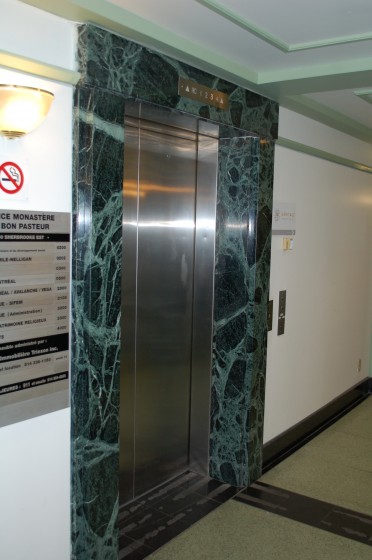
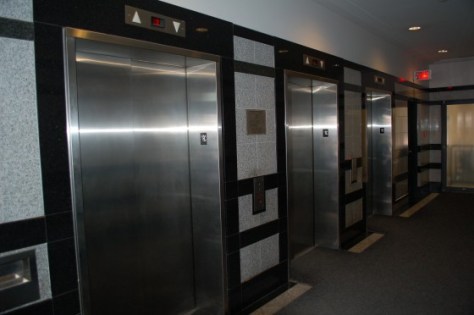
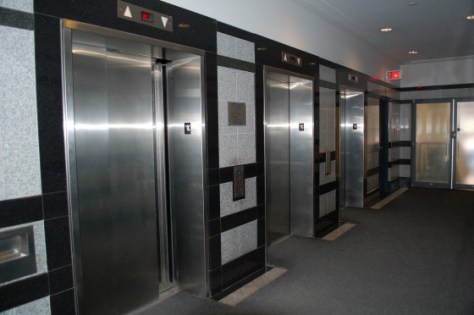
Back in 1988 there was much consternation as Westmount Square was renovated. As part of the renovations, the Travertine was removed from the plaza and replaced with granite. If I remember correctly the excuse used was that it wasn’t able to stand up to the extreme weather here in Montreal.
The Westmount Square Plaza
They started to build Westmount Square in 1965. So the travertine was about 23 years old when they replaced it. The granite 24 years old this year. It isn’t doing much better. I think they should redo it and replace the granite with travertine.
The Westmount Square Plaza
And while they are at it, get rid of the skylights, and bring the fountain back.
The fountain on the Westmount Square PlazaThe skylights on the Westmount Square Plaza
This is called death by neglect, and it is horrible.
Forces, by Claude Théberge at Square VigerForces, by Claude Théberge at Square Viger
Believe it or not, it was built in 1985.
Forces, by Claude Théberge at Square VigerForces, by Claude Théberge at Square VigerForces, by Claude Théberge at Square VigerForces, by Claude Théberge at Square VigerForces, by Claude Théberge at Square Viger
More information about it and him can be found here and here.
Forces, by Claude Théberge at Square VigerForces, by Claude Théberge at Square VigerForces, by Claude Théberge at Square VigerForces, by Claude Théberge at Square VigerForces, by Claude Théberge at Square VigerForces, by Claude Théberge at Square VigerForces, by Claude Théberge at Square VigerForces, by Claude Théberge at Square VigerThe view from Forces, by Claude Théberge at Square VigerThe view from Forces, by Claude Théberge at Square VigerThe view from Forces, by Claude Théberge at Square VigerThe view from Forces, by Claude Théberge at Square VigerThe view from Forces, by Claude Théberge at Square VigerThe view from Forces, by Claude Théberge at Square Viger
Sorry Miriam, Diary of a Neighbourhood has got to be one of the worst pieces of public/community art I have ever seen in a long time, if not my entire life. I’m addressing Miriam Ginestier, head of Studio 303 and one of the partners in Michael Toppings project called Diary of a Neighbourhood because I really like her and her organization what they do and how they try to do it. But in this case not one bit, so I want to make extremely clear and 100% sure that she understands that this isn’t personal. Now that I got that out of the way, let me backtrack slightly so that the rest of you (all 10 of you) understand as well.
Yesterday, I was walking down Jeanne Mance, when as I crossed Léo-Pariseau and went to take a picture of MAI, I noticed that there was some writing in their windows. I vaguely remembered having seen writing (standard issue plastic stenciled lettering) in some some the other windows in some of the apartments facing MAI. Now normally, I am a big fan of this type of community-building public art. Bringing art to the masses, one for art – art for all, that sort of thing, but this just fails on so many different levels, that it shows how removed from the actual art made the decision makers and signers of checks are, and it is unfortunate, if not really really sad that CALQ gave Mr. Topping $20K to pull this off (the Canada Council also gave a significant chunk of change, but their database stops at 2010, so I have no idea how much he got – and then upon looking a little further it appears as if he got some cash from someone named Margaret Rind, the city and possibly the Cirque du Soleil as well).
If you want the CliffsNotes version of why Diary of a Neighbourhood sucks the big one, aka is really horrible or is just bad art, I have five words for you: unoriginal and impossible to view. Then to make matters worse not only is it unoriginal and impossible to view, but had Mr. Topping had even a moment to pause and reflect, instead of just slapping some letters up on some windows and then wrapping everything in multisyllabic nonsense designed to confuse bureaucrats and take advantage of the fact that he is an English Canadian in Quebec, he actually could have pulled off something cool, interesting, effective and useful. Pity.
Now that we got that out of the way, let me explain why it’s unreadable, and that’s simple enough. For some strange reason Mr. Topping decided to use windows that were on the third and fourth floors along with some lower level windows that were obscured by foliage.
Diary of a Neighbourhood: a literary work by Michael ToppingsDiary of a Neighbourhood: a literary work by Michael Toppings
Plus, I strongly doubt that in the time that MAI has been around there have been more than two dozen people who have walked along Jeanne Mance and looked up at their windows. So while technically it may be possible to see what’s written on their windows, for all intents and purposes no one is going to.
Diary of a Neighbourhood: a literary work by Michael Toppings
By using the MAI windows, Mr. Topping also sends a mixed message, because they use the exact same type of signage to publicize the events that they organize, it muddles whatever message Mr. Topping is trying to send. Is a list of visual art exhibits and plays part of the artistic intervention? Or not? I don’t know. You tell me.
Diary of a Neighbourhood: a literary work by Michael Toppings
Then, again while I realize that technically a neighborhood can and does include the people who work there. Practically, it means the people who interact with each other in some kind of loosely (or tightly) defined geographic area. So the people working in a neighborhood would be for the most part the store clerks, cashiers, bus drivers, waiters, etc. Faceless bureaucrats working in a low-rise office building (even if it for the most part only has artistic organizations as tenants) really don’t do much to a neighborhood. They show up at about 10 o’clock in the morning, work in their cubicles, eat lunch in the food court or park nearby depending on the weather and how much their salary is, then leave and go home at about 6 o’clock, to their own neighborhoods. Yes, there might be some people who work at 3680 Jeanne-Mance who walk to work. But the vast majority of the couple of hundred or so people who work there drive, bike or take the 80/435 to get to work and as a consequence are minimally part of the neighborhood around Jeanne Mance and Léo-Pariseau. The lines written in the windows of MAI imply a completely different type of story than those on the windows of a house.
Nor do I understand why the church at the corner of Prince Arthur that was turned into condos was not included. Aren’t the people living there as much a part of the neighborhood as the people on the east side of the street?
Diary of a Neighbourhood: a literary work by Michael Toppings
The, don’t even get me started on the voyeuristic nature of this project. In order to read it you have to stare directly into people’s living rooms and bedrooms.
Apparently, there were some events happening as part of this intervention. Unfortunately, I wasn’t aware of them until way too late, so I was unable to participate, but it strikes me that these would be events that were fairly insular in nature and designed and organized around the people already participating instead of being more open inviting and inclusive. There was nothing on the street explaining to the outsider what was happening or why. Given the very strong negative values associated with being a voyeur and/or inquiring into things that are obviously not your business, I’d be hard pressed to believe that anyone besides the aforementioned people in the neighborhood and the people involved in the project took part in any of the events. And as there are over 40 people (not including “all those volunteers making up the mob scene”) mentioned by name on Mr. Toppings website in the credits, and I counted over 60 separate entrances to apartments I would hope that in his reports to the various funding agencies that he got at least 1,000 people to participate in his 21 separate events. While 1,000 sounds like a lot of folk, that’s actually less than 50 per event. With 60 apartments and 40 people involved, that’s a very low threshold to cross.
To me this is a perfect example of what I would call Grant Art. It involves what the grant officer would presume were not regular grant recipients. There were two well established arts organizations willing to help. It was multicultural. Sounds way more complicated than it is. Used large multisyllabic words. And is forgotten as soon as it is over.
Then, to get very specific (I was scanning Mr. Topping’s description of the project, while writing that last paragraph) if Diary of a Neighbourhood is truly “a self-penned literary work.” Then what exactly are the “quotations from a large pool of disparate sources – David Wojnarowicz, Hart Crane, WU LYF, Nietzche, Jeanette Winterson?” Is he implicating himself as a plagarist? And I’m not quite certain what he means when he writes “With the actual neighbourhood as stage, performers infiltrate by assuming the role of resident, rendering portrayals of the everyday and the banal alongside deconstructions and gender inversions of film and theatre classics such as Network and A Streetcar Named Desire.” He self-penned it (whatever that means) then has quotations included, and during the events he’s going to have one person yell out their window
And another one yell
Gimme a break! But as long as I am discussing the content, I might as well add that what bits I was able to read were not compelling in any way, shape or form. It appeared to me as more of “ain’t I cool, that I can everyone (or almost everyone) to do this.” Thank any real literary work. I realize that there is such a category as Experimental Fiction, but until I see otherwise Mr. Topping can’t hold a candle to what Robert Coover, Gail Scott or Georges Perec write. Add to that, the fact that easily a third to half of the entire project is physically unreadable and I just guess that in practice the actual content of this “literary work” was secondary, if not tertiary to whatever the main objectives really were.
Personally, if I had $50,000 (what I guess he raised from the various sources) and really wanted to do “a community-based initiative, implicating the residents of one street in one Montréal neighbourhood. Envisioned as a trans-disciplinary project… [encompassing] public art, print art, installation, street theatre and performance but remains, in essence, a literary work.” I would have thrown a street party to end all street parties, and then simply asked everyone who participated to write down their thoughts and impressions. I would have then published everything and given each participant a copy of the book. But then, maybe that’s why I don’t apply for grants.
Oh, and one last thing. I might be blind, but while I was looking at and taking pictures of the various texts on the windows, while I did see text in French, English, Spanish, Arabic, and Chinese, I did not see the Braille.
Diary of a Neighbourhood: a literary work by Michael Toppings
Diary of a Neighbourhood: a literary work by Michael Toppings
Diary of a Neighbourhood: a literary work by Michael Toppings
Diary of a Neighbourhood: a literary work by Michael Toppings
Diary of a Neighbourhood: a literary work by Michael Toppings
Diary of a Neighbourhood: a literary work by Michael Toppings
Diary of a Neighbourhood: a literary work by Michael Toppings
Diary of a Neighbourhood: a literary work by Michael Toppings
Diary of a Neighbourhood: a literary work by Michael Toppings
Diary of a Neighbourhood: a literary work by Michael Toppings
Diary of a Neighbourhood: a literary work by Michael Toppings
Diary of a Neighbourhood: a literary work by Michael Toppings
Diary of a Neighbourhood: a literary work by Michael Toppings
Diary of a Neighbourhood: a literary work by Michael Toppings
Diary of a Neighbourhood: a literary work by Michael Toppings
Diary of a Neighbourhood: a literary work by Michael Toppings
Diary of a Neighbourhood: a literary work by Michael Toppings
Diary of a Neighbourhood: a literary work by Michael Toppings
Diary of a Neighbourhood: a literary work by Michael Toppings
Diary of a Neighbourhood: a literary work by Michael Toppings
Diary of a Neighbourhood: a literary work by Michael Toppings
Diary of a Neighbourhood: a literary work by Michael Toppings
Diary of a Neighbourhood: a literary work by Michael Toppings
Diary of a Neighbourhood: a literary work by Michael Toppings
Diary of a Neighbourhood: a literary work by Michael Toppings
Diary of a Neighbourhood: a literary work by Michael Toppings
Diary of a Neighbourhood: a literary work by Michael Toppings
Diary of a Neighbourhood: a literary work by Michael Toppings
Diary of a Neighbourhood: a literary work by Michael Toppings
Diary of a Neighbourhood: a literary work by Michael Toppings
Diary of a Neighbourhood: a literary work by Michael Toppings
Diary of a Neighbourhood: a literary work by Michael Toppings
Diary of a Neighbourhood: a literary work by Michael Toppings
Diary of a Neighbourhood: a literary work by Michael Toppings
Diary of a Neighbourhood: a literary work by Michael Toppings
Diary of a Neighbourhood: a literary work by Michael Toppings
Diary of a Neighbourhood: a literary work by Michael Toppings
Diary of a Neighbourhood: a literary work by Michael Toppings
Diary of a Neighbourhood: a literary work by Michael Toppings
Diary of a Neighbourhood: a literary work by Michael Toppings
Diary of a Neighbourhood: a literary work by Michael Toppings
Diary of a Neighbourhood: a literary work by Michael Toppings
Diary of a Neighbourhood: a literary work by Michael Toppings
Diary of a Neighbourhood: a literary work by Michael Toppings
Diary of a Neighbourhood: a literary work by Michael Toppings
Diary of a Neighbourhood: a literary work by Michael Toppings
Diary of a Neighbourhood: a literary work by Michael Toppings
Diary of a Neighbourhood: a literary work by Michael Toppings
Diary of a Neighbourhood: a literary work by Michael Toppings
Diary of a Neighbourhood: a literary work by Michael Toppings
Diary of a Neighbourhood: a literary work by Michael Toppings
Diary of a Neighbourhood: a literary work by Michael Toppings
Diary of a Neighbourhood: a literary work by Michael Toppings
Diary of a Neighbourhood: a literary work by Michael Toppings
Diary of a Neighbourhood: a literary work by Michael Toppings
Diary of a Neighbourhood: a literary work by Michael Toppings
Diary of a Neighbourhood: a literary work by Michael Toppings
Diary of a Neighbourhood: a literary work by Michael Toppings
Diary of a Neighbourhood: a literary work by Michael Toppings
Diary of a Neighbourhood: a literary work by Michael Toppings
Diary of a Neighbourhood: a literary work by Michael Toppings
Diary of a Neighbourhood: a literary work by Michael Toppings
Diary of a Neighbourhood: a literary work by Michael Toppings
Diary of a Neighbourhood: a literary work by Michael Toppings
Diary of a Neighbourhood: a literary work by Michael Toppings
Diary of a Neighbourhood: a literary work by Michael Toppings
Diary of a Neighbourhood: a literary work by Michael Toppings
Diary of a Neighbourhood: a literary work by Michael Toppings
Diary of a Neighbourhood: a literary work by Michael Toppings
Diary of a Neighbourhood: a literary work by Michael Toppings
Diary of a Neighbourhood: a literary work by Michael Toppings
Diary of a Neighbourhood: a literary work by Michael Toppings
Diary of a Neighbourhood: a literary work by Michael Toppings
Diary of a Neighbourhood: a literary work by Michael Toppings
Diary of a Neighbourhood: a literary work by Michael Toppings
Diary of a Neighbourhood: a literary work by Michael Toppings
Diary of a Neighbourhood: a literary work by Michael Toppings
Diary of a Neighbourhood: a literary work by Michael Toppings
Diary of a Neighbourhood: a literary work by Michael Toppings
Diary of a Neighbourhood: a literary work by Michael Toppings
Diary of a Neighbourhood: a literary work by Michael Toppings
After reading for the umpteenth time (first, second, third) that Renata and Michal Hornstein are donating the rest of their collection to the Musée des beaux-arts de Montréal, and that the Quebec government was going to pay to build a new building for it, I almost blew a gasket.
First, the news was probably announced during the museum’s AGM. As the museum’s year end is March 31, that probably means sometime in April. Somehow the media failed to pick up on it then. Second, it was the lead item in the latest issue of the museum’s magazine (creatively named “M”) which was mailed to all VIPs at the beginning of May. It didn’t make the news then either. So finally, on the 25th of May, a full month after making the donation the museum released a press release (which for some reason isn’t on their website) and suddenly it was news.
Fourth, while the Musée des beaux-arts de Montréal likes to tout that they are a private museum, this is the second building that they have succeeding in convincing the Quebec government to finance. (I do not know about the three previous expansions, as I wasn’t following things all that closely in the 70s and 80s). Man! I wish I could be have a “private” corporation and convince the government to build me a new building every time my crap collection of objects got larger than my place.
Fifth, and this is the one that really gets my goat. Included in every report is that the “new” building will be named after Renata and Michal Hornstein. But they all fail to note that there already is a building named after Renata and Michal Hornstein! So are there going to be two? Are they going to re-rename the Hornstein building after Beniah Gibb? Or some other collector?
And then, sixth and finally, just after this news, the building at 1350 Sherbrooke st. West (right across Bishop street from the museum) put a large banner on its walls after sitting empty for the better part of the past 10 years saying that they were turning it into condos. Coincidence?
Me and Jana go way back, I wrote about how her work in the 2003 Venice Biennale might have been copied from the George W. Bush White House, and was kind of dismissive of her photograph Generic Man that was hung at the Musée d’art contemporain de Montréal for what seemed like decades, but she is none-the-less an Important Canadian Artist®™ duly recognized by the people who recognize things like that. And somewhere in the dark deepest recesses of my memory I seemed to remember that she had won a prize recently. So I figured it would be as good od a time as any to go see her exhibition at Laroche/Joncas (which is on view until June 9). I quite like what they are doing there and maybe it would be possible for the leopard to change its spots.
If you want the quick and easy version, I was pleasantly surprised to find a piece of art by Ms. Sterbak that I did like. However I must inform you, that there were nine other art objects in the show as well. So perhaps a sign of a benign melanoma that’s better removed than a complete changing of my spots.
But to get to the meat of the matter, the show kind of gave me the feeling it was more like a garage sale than a cohesive show. Of the ten pieces there was stuff that was made in the late 1970s all the way up to 2009. But since there were only ten of them it did not feel anything like an retrospective. More like, here is some stuff hanging around my studio gathering dust, if I were to stick it in a gallery maybe it might sell. As well the show itself is called Back Home, which lend a certain personal touch to the works exhibited, either through them not being here, but literally being back home. Or allowing you to infer that she has been away for a time and has now returned, and decided that she no longer needed to possess any of theses objects. Then there was a general hodge-podge nature to the show. The pieces that were multiples varied from 7/15 to an artist’s proof #1, to 13/14 to all five of the edition. The uniques were drawings and sculptures, I was at a distinct disadvantage when it came time to try and figure out why everything was there.
Personally I think the better way to do something like that is to invite people who have previously bought your work to do some kind of studio visit, get a bottle of wine (or two) and then proceed to tell stories about the art that you want to get rid of. Assuming you invited people with some excess cash, I’m certain it would be extremely effective. Because when I tried to figure out what was the deal with Spare Spine, a five foot gently bowed bronze stick (and while I’m at it, what’s with the insistence on using the Metric system when something was made in Imperial units? 152.4 cm, my eye!) leaning against the wall, I was completely and thoroughly incapable.
Jana Sterbak Spare Spine, 1983, Bronze, 60" x 1" x 1"
But if Ms. Sterbak had been there, regaling me with something along the lines of how it corresponded to the earth’s curvature and/or was buttressing up the entire building, and/or had been used to threaten viewers when she was wearing Vanitas: Flesh Dress for an Albino Anorectic and/or had been used by someone, somewhere doing something, it would have changed it from a five foot gently bowed bronze stick leaning against the wall into something much much more.
As it was, the piece of hers that I liked, was in fact something where I was capable of finding a story. Dissolution a series of eight small photos all in one frame of a chair with an ice seat and back smelting was pretty cool (yes, that will be the one and only pun I use today, promise). Initially, while viewing it, I figured that since it dated from 2001, that it was some sort of documentation of of some kind of performance or something. Now, after some reflection, I’m not as convinced, but while I was there, it definitely was enough of a story to keep me in front of it for longer than any of the other pieces.
Jana Sterbak, Dissolution, 2001, Colour photograph 50 x 95 cm. edition AP#1.
As you might expect, it was very sparse in the gallery. Where normally, people with multiple PhDs in Art History like to go off about “how the art dialogues” and “conversations between pieces” when they are really just mean how two (or more) objects look near each other. In this case things were set up so far from each other that there wasn’t going to be any conversations happening unless one of the pieces suddenly had an urge to shout. Although there is a whole wall of works in the office that look positively cramped in comparison, and due to the placement of the desk, it’s not exactly the easiest thing in the world to get a good look at them.
Installation view of Jana Sterbak's Back Home at Laroche/JoncasInstallation view of Jana Sterbak's Back Home at Laroche/Joncas
I’m not quite certain what to make of the things that look like kids drawings, the Iron House or the miniaturized lead ball painted to look like a plastic beach ball. I guess something could be said that they are all riffing off of the idea of home. Either things you would find in a home or representations of home, but I’m more inclined to think that’s a stretch and best left to the guys with the multiple degrees. After all Ms. Sterbak is an Important Canadian Artist®™ and explanations like that are best left to the professionals.
Me, on the other hand, I’m glad to see that my antipathy towards Ms. Sterbak’s work has tempered over the years. She no longer makes art that causes large emotional reactions in me, it’s basically there, fine, it’s not bothering anyone, so let’s get on to the next thing.
The Abbey on Sherbrooke WLa Baronnie on LincolnLe Cardinal on EllendaleLa Tour D'Auteuil on de Maisonneuve WEllendale Apartments on EllendaleLa Fayette on de Maisonneuve WGrazia on Sherbrooke W
Anyone know any buildings with names beginning with an H or an I in Montreal?
The Jurihome on Saint Hubert
Anyone know any buildings with names beginning with a K in Montreal?
The Lambert Apartments on Lambert ClosseLe Majestic on Sherbrooke WNo 1 Wood on WoodOliver House West on OlivierLe Pierce on de Maisonneuve W
Anyone know any buildings with names beginning with a Q in Montreal?
Le Rigaud on Sherbrooke ELe Saguenay on Sherbrooke ELa Tadoussac on Sherbrooke E
Anyone know any buildings with names beginning with a U in Montreal?
The Viceroy on de Maisonneuve WThe Warwick on Clarke
Anyone know any buildings with names beginning with an X, Y or Z in Montreal?
Suffice it to say that Peter Flemming‘s work resonates with me (yuck, yuck, yuck! Sorry I couldn’t resist). In short, Mr. Flemming makes resonators. Quite fascinating ones I might add. The show is up at Skol until Saturday.
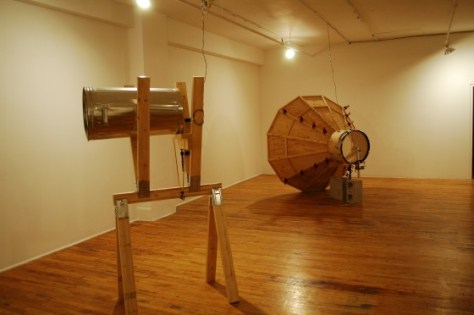
In a slightly longer version, Mr. Flemming’s exhibition, called Instrumentation, involves five linked pieces, plus six other small “display” objects some posters and videos. When you first walk around the wall into the main gallery you are confronted with four objects that if you squint enough look like large roughly built megaphones, ear horns or gramophone amplifiers, take your pick. Actually, three. There’s one that while functioning the same way actually looks more like a room divider for a tall person’s garage or workshop. Each of them make a different noise, although it is kind of difficult to figure out what noise emanates from which one.
Installation view of Instrumentation by Peter Flemming at Skol
Then in the back room is a large console of a vaguely mechanical nature with rotating plastic lids on plywood arms, three goose-necked lamps that change in intensity, some drums and some wires. Lots and lots and lots of wires. According to various websites the console (which really is just a large plywood table, but sounds more impressive if I call it a console) is responsible for making the various noises, dimming the lights and all sorts of other endlessly entertaining things.
On their own, the speakers were mildly interesting visually, mainly due to how they were constructed. Plywood and carpentry clamps were the main materials used in one and the others were similarly made out of items that are easily findable in just about any hardware store. It wasn’t until I ventured into the back room that I got excited. While I’ve never been accused of being part of any maker community (I tend to take things apart and break them instead of creating things) as a card carrying generic guy I’m fascinated by others that do. Which if you think about it makes sense, wince I tend to write about them.
Installation view of Instrumentation by Peter Flemming at Skol
The console had just the right number of mechanical doohickeys and automated gizmos to keep me fascinated for what seemed like hours. Then it slowly dawned on me, I’m not always the sharpest tack on the box, that it was controlling everything, and that was my moment of discovery. But how it was controlling things wasn’t exactly clear. Which obviously meant that I had to spend the better part of an hour studying it in minute detail trying to figure it out. Ultimately I wasn’t successful. Sometimes the machine does win. But I was undaunted. As I get older I don’t have to win everything absolutely every time.
Installation view of Instrumentation by Peter Flemming at Skol
For the curious, there are some very informative videos that do a good job of explaining how the sounds are made, unfortunately I didn’t take notes, so I can’t repeat them here. They’re short enough (I think the five different films are about 15 minutes long in total) that it isn’t difficult to sit through them all. And I was pleased to see that they were not playing on an endless loop when I visited, which made things that much more understandable. Also in what could be called the lobby, or the foyer to the gallery were six objects taken from what I presume was an earlier version of the console and were displayed on pedestals and mounted on the wall like regular run of the mill art objects.
Prior to understanding what was happening, I said that the speakers were “mildly interesting visually.” But once I realized that everything was hooked up a linked together, they became completely fascinating. I poured over them taking pictures from every possible angle trying to break the code. It’s a amazing what a little spark will do. Unfortunately, none of my pictures of the details do any of the works any justice. While I seem to be able to take reasonable pictures of objects, I haven’t quite mastered close-ups, yet.
Installation view of Instrumentation by Peter Flemming at Skol
On the whole Instrumentation was a pretty kick-ass show, taking maker culture at white cubing it. I enjoyed myself immensely trying to follow all the cables and figure out what bit was responsible for what movement, even if I was ultimately unsuccessful. It kind of reminded me of some of Mitchell F. Chan’s work. Personally I’m very glad that I don’t work at Skol being assaulted by the noise everyday would go a long way towards making me even loopier than I already am. But in shorter doses while I’m focused on how it’s being made is a completely different kettle of fish.
One of my favorite buildings in town. Built in 1976, I’d love to know who the architect was, because whatever he was smoking at the time was some powerful stuff.
Slant-end ventilation The PenthouseRésidence Le RigaudSlant-end ventilation (in spring)Résidence Le RigaudSlant-end windows covered with landscapingSlant-end windows covered with landscapingRésidence Le RigaudRésidence Le Rigaud
Continuing on the exhibits I saw last week, while Yves Laroche says the show is called Tempest, it struck me much more as a solo show by Derek Mehaffey as I couldn’t really find anything where the work exhibited was thematically linked, let alone being tempestuous. (Although, if pressed, it’d be easy enough to say that all of Mr. Mehaffey’s work is tempestuous to a certain extent).
When I asked if I could take pictures, I was told “no.” So we’re going to have to do with versions from their website, and my pictures from the street. Another reason why it feels to me more like a bunch of paintings by Mr. Mehaffey than anything show-like, is that what they show on the website and what is shown in the gallery, are reasonable facsimiles, but not close to being the same thing. Kind of like the catalogue and exhibit for Wangechi Mutu at the Musée d’art contemporain de Montréal.
Then, one more thing before launching into the art itself, upon reading the press release, I truly hope that Mr. Mehaffey’s art can’t be seen in “countless art galleries around the world.” That would either imply a level of irresponsibility that is just mind boggling or that his work has been forged enough that he can’t be bothered to fight it anymore. Personally, I hope that it was just slip-up on the part of M. Laroche, when he was writing the press release, and he wanted to give the impression of lots and lots and lots of galleries, instead of giving the impression that Mr. Mehaffey can’t be bothered to keep track of the galleries that show his work.
Other Pile of Person , Mixed media on paper, 11,25'' x 8,5'', image courtesy yveslaroche.com
Yves Laroche Galerie d’art is one of the older art galleries in town having opened in 1991. They moved from Old Montreal to Little Italy/Mile End something like two years ago (although I could have sworn it was more like five years ago) and this was my first visit since the move. The two spaces couldn’t be more different from each other. Back in Old Montreal, there wasn’t a single white wall that I can remember, pieces were hung cheek to jowl, almost salon style. In a word cluttered, which was entirely and completely appropriate given that they had chosen (and continue to choose) to exhibit street art and other objects that are a reaction to, or commentary on the visual overload one gets in a 21st century city (I can’t remember ever seeing any graffiti in the countryside, can you?) Visiting the old space was almost like being an anthropologist and being able to study some previously unknown Amazonian tribe in situ (back when that was a good thing).
The new space is the exact opposite, all white walls, lots of space between the pieces of art. It seems like an attempt at getting uppity, possibly to justify the prices, possibly because as M. Laroche got older, he, like everyone else, got more conservative and did not need his senses assaulted from every angle, 24/7 when he went to work. Possibly because he got a great deal on a long term lease in a place that, unfortunately, did not have any 15 foot high brick walls, or most likely, some other equally valid reason, mine just being guesses.
Installation shot from the street of Tempest by Other at Yves Laroche galerie d'art
When I visited, there were 19 different pieces being shown, although two of them were multiples, W, a linoleum print in an edition of 30 and Crying Boxcar in an edition of 10. As I’ve said previously, Mr. Mehaffey’s work can be called tempestuous. Mostly due to the fact that he makes big things with lots and lots of little things. In the same kind of way that a tempest is made up of lots and lots of tiny rain drops to make a big storm. Each of his large pieces is formed by many smaller drawings, sketches, collages, call them what you will, combined together not to make a larger whole image, but just a larger image with specific and individual parts that, for the most part, are recognizable as being separate from the whole. Kind of like a group portrait, in that we all recognize that there are a bunch of different people in a group portrait, and it is the group that makes the whole.
The major difference being that Mr. Mehaffey will not only use different objects, faces, things within a larger whole, he also will use a completely different method of making the image. One being drawn with marker, another in paint, a third in pencil, etc. And it is this heterogeneity that make his larger pieces absolutely fascinating and wonderful. I’m kind of annoyed that I was only limited to taking pictures from the sidewalk and using what’s on the yveslaroche.com website because neither one allows for closeups to show to amount of detail in any of the larger paintings.
Installation shot from the street of Tempest by Other at Yves Laroche galerie d'art
For purposes of this article, I’m going to call those 19 different pieces the “show” despite the fact that there are 20 different pieces on the website with something like half-a-dozen that don’t correspond. The ones that worked best to me were the larger pieces on non-traditional bases, such as Pile of person 2.
Other Pile of person 2 , Mixed technique on wood cut out, 79'' x 63'', image courtesy yveslaroche.com
Although I’m still trying to decide if the dirt marks on How We Were were intentional or just an oversight.
Other How We Were , Mixed media on canvas, 67,5'' x 53,75'', image courtesy yveslaroche.com
It was nice to see that a bunch of the pieces had sold, I guess both M. Laroche and Mr. Mehaffey will be able to pay next month’s rent. The show itself is up for another two days, and while it isn’t going to change anyone’s life, it’s still a pretty show that can easily occupy 15 to 30 minutes of your time before or after having an espresso and cornetto at the Cornetteria across the street from the gallery.
Other Lighting the Path , Mixed media on panel 61"x42", image coutesy yveslaroche.com