Category Archives: Ramble

Diary of a Neighbourhood: a literary work by Michael Toppings

Howdy!

Sorry Miriam, Diary of a Neighbourhood has got to be one of the worst pieces of public/community art I have ever seen in a long time, if not my entire life. I’m addressing Miriam Ginestier, head of Studio 303 and one of the partners in Michael Toppings project called Diary of a Neighbourhood because I really like her and her organization what they do and how they try to do it. But in this case not one bit, so I want to make extremely clear and 100% sure that she understands that this isn’t personal. Now that I got that out of the way, let me backtrack slightly so that the rest of you (all 10 of you) understand as well.

Yesterday, I was walking down Jeanne Mance, when as I crossed Léo-Pariseau and went to take a picture of MAI, I noticed that there was some writing in their windows. I vaguely remembered having seen writing (standard issue plastic stenciled lettering) in some some the other windows in some of the apartments facing MAI. Now normally, I am a big fan of this type of community-building public art. Bringing art to the masses, one for art – art for all, that sort of thing, but this just fails on so many different levels, that it shows how removed from the actual art made the decision makers and signers of checks are, and it is unfortunate, if not really really sad that CALQ gave Mr. Topping $20K to pull this off (the Canada Council also gave a significant chunk of change, but their database stops at 2010, so I have no idea how much he got – and then upon looking a little further it appears as if he got some cash from someone named Margaret Rind, the city and possibly the Cirque du Soleil as well).

If you want the CliffsNotes version of why Diary of a Neighbourhood sucks the big one, aka is really horrible or is just bad art, I have five words for you: unoriginal and impossible to view. Then to make matters worse not only is it unoriginal and impossible to view, but had Mr. Topping had even a moment to pause and reflect, instead of just slapping some letters up on some windows and then wrapping everything in multisyllabic nonsense designed to confuse bureaucrats and take advantage of the fact that he is an English Canadian in Quebec, he actually could have pulled off something cool, interesting, effective and useful. Pity.

Let’s start with the accusation of unoriginality first. Mr. Toppings’ piece is on Jeanne Mance in between Léo-Pariseau and Prince Arthur, for the most part on the east side of the street. If you were to walk two blocks west over to Hutchison, in between Prince Arthur and Pine you’d see some lines of personal poetry, this time engraved in stone, on the facades of some houses on the east side of the street. Back in 1988, Gilbert Boyer, a Quebecois poet decided that he wanted to write poetry on the sides of houses. (Actually come to think of it, there are lots of examples of officially sanctioned public poetry on the side of apartments.) But before I get hopelessly confused in my own parenthetical statements, M. Boyer decided to break up the lines of his poems onto different buildings, one can still be seen on the facade of 3703 Hutchison. yes, his was only two lines on Hutchison and the rest elsewhere around the city. But it’s close enough both by geography, theoretically and aesthetically that Mr. Topping should be somewhat embarrassed. Art, if anything is supposed to be original.

Now that we got that out of the way, let me explain why it’s unreadable,  and that’s simple enough. For some strange reason Mr. Topping decided to use windows that were on the third and fourth floors along with some lower level windows that were obscured by foliage.

Diary of a Neighbourhood: a literary work by Michael Toppings

Plus, I strongly doubt that in the time that MAI has been around there have been more than two dozen people who have walked along Jeanne Mance and looked up at their windows. So while technically it may be possible to see what’s written on their windows, for all intents and purposes no one is going to.

Diary of a Neighbourhood: a literary work by Michael Toppings

By using the MAI windows, Mr. Topping also sends a mixed message, because they use the exact same type of signage to publicize the events that they organize, it muddles whatever message Mr. Topping is trying to send. Is a list of visual art exhibits and plays part of the artistic intervention? Or not? I don’t know. You tell me.

Diary of a Neighbourhood: a literary work by Michael Toppings

Then, again while I realize that technically a neighborhood can and does include the people who work there. Practically, it means the people who interact with each other in some kind of loosely (or tightly) defined geographic area. So the people working in a neighborhood would be for the most part the store clerks, cashiers, bus drivers, waiters, etc. Faceless bureaucrats working in a low-rise office building (even if it for the most part only has artistic organizations as tenants) really don’t do much to a neighborhood. They show up at about 10 o’clock in the morning, work in their cubicles, eat lunch in the food court or park nearby depending on the weather and how much their salary is, then leave and go home at about 6 o’clock, to their own neighborhoods. Yes, there might be some people who work at 3680 Jeanne-Mance who walk to work. But the vast majority of the couple of hundred or so people who work there drive, bike or take the 80/435 to get to work and as a consequence are minimally part of the neighborhood around Jeanne Mance and Léo-Pariseau. The lines written in the windows of MAI imply a completely different type of story than those on the windows of a house.

Nor do I understand why the church at the corner of Prince Arthur that was turned into condos was not included. Aren’t the people living there as much a part of the neighborhood as the people on the east side of the street?

Diary of a Neighbourhood: a literary work by Michael Toppings

The, don’t even get me started on the voyeuristic nature of this project. In order to read it you have to stare directly into people’s living rooms and bedrooms.

Apparently, there were some events happening as part of this intervention. Unfortunately, I wasn’t aware of them until way too late, so I was unable to participate, but it strikes me that these would be events that were fairly insular in nature and designed and organized around the people already participating instead of being more open inviting and inclusive. There was nothing on the street explaining to the outsider what was happening or why. Given the very strong negative values associated with being a voyeur and/or inquiring into things that are obviously not your business, I’d be hard pressed to believe that anyone besides the aforementioned people in the neighborhood and the people involved in the project took part in any of the events. And as there are over 40 people (not including “all those volunteers making up the mob scene”) mentioned by name on Mr. Toppings website in the credits, and I counted over 60 separate entrances to apartments I would hope that in his reports to the various funding agencies that he got at least 1,000 people to participate in his 21 separate events. While 1,000 sounds like a lot of folk, that’s actually less than 50 per event. With 60 apartments and 40 people involved, that’s a very low threshold to cross.

To me this is a perfect example of what I would call Grant Art. It involves what the grant officer would presume were not regular grant recipients. There were two well established arts organizations willing to help. It was multicultural. Sounds way more complicated than it is. Used large multisyllabic words. And is forgotten as soon as it is over.

Then, to get very specific (I was scanning Mr. Topping’s description of the project, while writing that last paragraph) if Diary of a Neighbourhood is truly “a self-penned literary work.” Then what exactly are the “quotations from a large pool of disparate sources – David Wojnarowicz, Hart Crane, WU LYF, Nietzche, Jeanette Winterson?” Is he implicating himself as a plagarist? And I’m not quite certain what he means when he writes “With the actual neighbourhood as stage, performers infiltrate by assuming the role of resident, rendering portrayals of the everyday and the banal alongside deconstructions and gender inversions of film and theatre classics such as Network and A Streetcar Named Desire.” He self-penned it (whatever that means) then has quotations included, and during the events he’s going to have one person yell out their window

And another one yell

Gimme a break! But as long as I am discussing the content, I might as well add that what bits I was able to read were not compelling in any way, shape or form. It appeared to me as more of “ain’t I cool, that I can everyone (or almost everyone) to do this.” Thank any real literary work. I realize that there is such a category as Experimental Fiction, but until I see otherwise Mr. Topping can’t hold a candle to what Robert Coover, Gail Scott or Georges Perec write. Add to that, the fact that easily a third to half of the entire project is physically unreadable and I just guess that in practice the actual content of this “literary work” was secondary, if not tertiary to whatever the main objectives really were.

Personally, if I had $50,000 (what I guess he raised from the various sources) and really wanted to do “a community-based initiative, implicating the residents of one street in one Montréal neighbourhood. Envisioned as a trans-disciplinary project… [encompassing] public art, print art, installation, street theatre and performance but remains, in essence, a literary work.” I would have thrown a street party to end all street parties, and then simply asked everyone who participated to write down their thoughts and impressions. I would have then published everything and given each participant a copy of the book. But then, maybe that’s why I don’t apply for grants.

Oh, and one last thing. I might be blind, but while I was looking at and taking pictures of the various texts on the windows, while I did see text in French, English, Spanish, Arabic, and Chinese, I did not see the Braille.

Jana Sterbak at Laroche/Joncas

Howdy!

Me and Jana go way back, I wrote about how her work in the 2003 Venice Biennale might have been copied from the George W. Bush White House, and was kind of dismissive of her photograph Generic Man that was hung at the Musée d’art contemporain de Montréal for what seemed like decades, but she is none-the-less an Important Canadian Artist®™ duly recognized by the people who recognize things like that. And somewhere in the dark deepest recesses of my memory I seemed to remember that she had won a prize recently. So I figured it would be as good od a time as any to go see her exhibition at Laroche/Joncas (which is on view until June 9). I quite like what they are doing there and maybe it would be possible for the leopard to change its spots.

If you want the quick and easy version, I was pleasantly surprised to find a piece of art by Ms. Sterbak that I did like. However I must inform you, that there were nine other art objects in the show as well. So perhaps a sign of a benign melanoma that’s better removed than a complete changing of my spots.

But to get to the meat of the matter, the show kind of gave me the feeling it was more like a garage sale than a cohesive show. Of the ten pieces there was stuff that was made in the late 1970s all the way up to 2009. But since there were only ten of them it did not feel anything like an retrospective. More like, here is some stuff hanging around my studio gathering dust, if I were to stick it in a gallery maybe it might sell. As well the show itself is called Back Home, which lend a certain personal touch to the works exhibited, either through them not being here, but literally being back home. Or allowing you to infer that she has been away for a time and has now returned, and decided that she no longer needed to possess any of theses objects. Then there was a general hodge-podge nature to the show. The pieces that were multiples varied from 7/15 to an artist’s proof #1, to 13/14 to all five of the edition. The uniques were drawings and sculptures, I was at a distinct disadvantage when it came time to try and figure out why everything was there.

Personally I think the better way to do something like that is to invite people who have previously bought your work to do some kind of studio visit, get a bottle of wine (or two) and then proceed to tell stories about the art that you want to get rid of. Assuming you invited people with some excess cash, I’m certain it would be extremely effective. Because when I tried to figure out what was the deal with Spare Spine, a five foot gently bowed bronze stick (and while I’m at it, what’s with the insistence on using the Metric system when something was made in Imperial units? 152.4 cm, my eye!) leaning against the wall, I was completely and thoroughly incapable.

Jana Sterbak Spare Spine, 1983, Bronze, 60" x 1" x 1"

But if Ms. Sterbak had been there, regaling me with something along the lines of how it corresponded to the earth’s curvature and/or was buttressing up the entire building, and/or had been used to threaten viewers when she was wearing Vanitas: Flesh Dress for an Albino Anorectic and/or had been used by someone, somewhere doing something, it would have changed it from a five foot gently bowed bronze stick leaning against the wall into something much much more.

As it was, the piece of hers that I liked, was in fact something where I was capable of finding a story. Dissolution a series of eight small photos all in one frame of a chair with an ice seat and back smelting was pretty cool (yes, that will be the one and only pun I use today, promise). Initially, while viewing it, I figured that since it dated from 2001, that it was some sort of documentation of of some kind of performance or something. Now, after some reflection, I’m not as convinced, but while I was there, it definitely was enough of a story to keep me in front of it for longer than any of the other pieces.

Jana Sterbak, Dissolution, 2001, Colour photograph 50 x 95 cm. edition AP#1.

As you might expect, it was very sparse in the gallery. Where normally, people with multiple PhDs in Art History like to go off about “how the art dialogues” and “conversations between pieces” when they are really just mean how two (or more) objects look near each other. In this case things were set up so far from each other that there wasn’t going to be any conversations happening unless one of the pieces suddenly had an urge to shout. Although there is a whole wall of works in the office that look positively cramped in comparison, and due to the placement of the desk, it’s not exactly the easiest thing in the world to get a good look at them.

Installation view of Jana Sterbak's Back Home at Laroche/Joncas

I’m not quite certain what to make of the things that look like kids drawings, the Iron House or the miniaturized lead ball painted to look like a plastic beach ball. I guess something could be said that they are all riffing off of the idea of home. Either things you would find in a home or representations of home, but I’m more inclined to think that’s a stretch and best left to the guys with the multiple degrees. After all Ms. Sterbak is an Important Canadian Artist®™ and explanations like that are best left to the professionals.

Me, on the other hand, I’m glad to see that my antipathy towards Ms. Sterbak’s work has tempered over the years. She no longer makes art that causes large emotional reactions in me, it’s basically there, fine, it’s not bothering anyone, so let’s get on to the next thing.

Instrumentation by Peter Flemming at Skol

Howdy!

Suffice it to say that Peter Flemming‘s work resonates with me (yuck, yuck, yuck! Sorry I couldn’t resist). In short, Mr. Flemming makes resonators. Quite fascinating ones I might add. The show is up at Skol until Saturday.

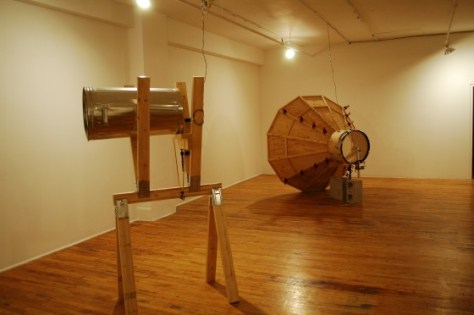
In a slightly longer version, Mr. Flemming’s exhibition, called Instrumentation, involves five linked pieces, plus six other small “display” objects some posters and videos. When you first walk around the wall into the main gallery you are confronted with four objects that if you squint enough look like large roughly built megaphones, ear horns or gramophone amplifiers, take your pick. Actually, three. There’s one that while functioning the same way actually looks more like a room divider for a tall person’s garage or workshop. Each of them make a different noise, although it is kind of difficult to figure out what noise emanates from which one.

Installation view of Instrumentation by Peter Flemming at Skol

Then in the back room is a large console of a vaguely mechanical nature with rotating plastic lids on plywood arms, three goose-necked lamps that change in intensity, some drums and some wires. Lots and lots and lots of wires. According to various websites the console (which really is just a large plywood table, but sounds more impressive if I call it a console) is responsible for making the various noises, dimming the lights and all sorts of other endlessly entertaining things.

On their own, the speakers were mildly interesting visually, mainly due to how they were constructed. Plywood and carpentry clamps were the main materials used in one and the others were similarly made out of items that are easily findable in just about any hardware store. It wasn’t until I ventured into the back room that I got excited. While I’ve never been accused of being part of any maker community (I tend to take things apart and break them instead of creating things) as a card carrying generic guy I’m fascinated by others that do. Which if you think about it makes sense, wince I tend to write about them.

Installation view of Instrumentation by Peter Flemming at Skol

The console had just the right number of mechanical doohickeys and automated gizmos to keep me fascinated for what seemed like hours. Then it slowly dawned on me, I’m not always the sharpest tack on the box, that it was controlling everything, and that was my moment of discovery. But how it was controlling things wasn’t exactly clear. Which obviously meant that I had to spend the better part of an hour studying it in minute detail trying to figure it out. Ultimately I wasn’t successful. Sometimes the machine does win. But I was undaunted. As I get older I don’t have to win everything absolutely every time.

Installation view of Instrumentation by Peter Flemming at Skol

For the curious, there are some very informative videos that do a good job of explaining how the sounds are made, unfortunately I didn’t take notes, so I can’t repeat them here. They’re short enough (I think the five different films are about 15 minutes long in total) that it isn’t difficult to sit through them all. And I was pleased to see that they were not playing on an endless loop when I visited, which made things that much more understandable. Also in what could be called the lobby, or the foyer to the gallery were six objects taken from what I presume was an earlier version of the console and were displayed on pedestals and mounted on the wall like regular run of the mill art objects.

Prior to understanding what was happening, I said that the speakers were “mildly interesting visually.” But once I realized that everything was hooked up a linked together, they became completely fascinating. I poured over them taking pictures from every possible angle trying to break the code. It’s a amazing what a little spark will do. Unfortunately, none of my pictures of the details do any of the works any justice. While I seem to be able to take reasonable pictures of objects, I haven’t quite mastered close-ups, yet.

Installation view of Instrumentation by Peter Flemming at Skol

On the whole Instrumentation was a pretty kick-ass show, taking maker culture at white cubing it. I enjoyed myself immensely trying to follow all the cables and figure out what bit was responsible for what movement, even if I was ultimately unsuccessful. It kind of reminded me of some of Mitchell F. Chan’s work. Personally I’m very glad that I don’t work at Skol being assaulted by the noise everyday would go a long way towards making me even loopier than I already am. But in shorter doses while I’m focused on how it’s being made is a completely different kettle of fish.

Other at Yves LaRoche

Howdy!

Continuing on the exhibits I saw last week, while Yves Laroche says the show is called Tempest, it struck me much more as a solo show by Derek Mehaffey as I couldn’t really find anything where the work exhibited was thematically linked, let alone being tempestuous. (Although, if pressed, it’d be easy enough to say that all of Mr. Mehaffey’s work is tempestuous to a certain extent).

When I asked if I could take pictures, I was told “no.” So we’re going to have to do with versions from their website, and my pictures from the street. Another reason why it feels to me more like a bunch of paintings by Mr. Mehaffey than anything show-like, is that what they show on the website and what is shown in the gallery, are reasonable facsimiles, but not close to being the same thing. Kind of like the catalogue and exhibit for Wangechi Mutu at the Musée d’art contemporain de Montréal.

Then, one more thing before launching into the art itself, upon reading the press release, I truly hope that Mr. Mehaffey’s art can’t be seen in “countless art galleries around the world.” That would either imply a level of irresponsibility that is just mind boggling or that his work has been forged enough that he can’t be bothered to fight it anymore. Personally, I hope that it was just slip-up on the part of M. Laroche, when he was writing the press release, and he wanted to give the impression of lots and lots and lots of galleries, instead of giving the impression that Mr. Mehaffey can’t be bothered to keep track of the galleries that show his work.

Other  Pile of Person , Mixed media on paper, 11,25'' x 8,5'', image courtesy yveslaroche.com
Other Pile of Person , Mixed media on paper, 11,25'' x 8,5'', image courtesy yveslaroche.com

Yves Laroche Galerie d’art is one of the older art galleries in town having opened in 1991. They moved from Old Montreal to Little Italy/Mile End something like two years ago (although I could have sworn it was more like five years ago) and this was my first visit since the move. The two spaces couldn’t be more different from each other. Back in Old Montreal, there wasn’t a single white wall that I can remember, pieces were hung cheek to jowl, almost salon style. In a word cluttered, which was entirely and completely appropriate given that they had chosen (and continue to choose) to exhibit street art and other objects that are a reaction to, or commentary on the visual overload one gets in a 21st century city (I can’t remember ever seeing any graffiti in the countryside, can you?) Visiting the old space was almost like being an anthropologist and being able to study some previously unknown Amazonian tribe in situ (back when that was a good thing).

The new space is the exact opposite, all white walls, lots of space between the pieces of art. It seems like an attempt at getting uppity, possibly to justify the prices, possibly because as M. Laroche got older, he, like everyone else, got more conservative and did not need his senses assaulted from every angle, 24/7 when he went to work. Possibly because he got a great deal on a long term lease in a place that, unfortunately, did not have any 15 foot high brick walls, or most likely, some other equally valid reason, mine just being guesses.

Installation shot from the street of Tempest by Other at Yves Laroche galerie d'art

When I visited, there were 19 different pieces being shown, although two of them were multiples, W, a linoleum print in an edition of 30 and Crying Boxcar in an edition of 10. As I’ve said previously, Mr. Mehaffey’s work can be called tempestuous. Mostly due to the fact that he makes big things with lots and lots of little things. In the same kind of way that a tempest is made up of lots and lots of tiny rain drops to make a big storm. Each of his large pieces is formed by many smaller drawings, sketches, collages, call them what you will, combined together not to make a larger whole image, but just a larger image with specific and individual parts that, for the most part, are recognizable as being separate from the whole. Kind of like a group portrait, in that we all recognize that there are a bunch of different people in a group portrait, and it is the group that makes the whole.

The major difference being that Mr. Mehaffey will not only use different objects, faces, things within a larger whole, he also will use a completely different method of making the image. One being drawn with marker, another in paint, a third in pencil, etc. And it is this heterogeneity that make his larger pieces absolutely fascinating and wonderful. I’m kind of annoyed that I was only limited to taking pictures from the sidewalk and using what’s on the yveslaroche.com website because neither one allows for closeups to show to amount of detail in any of the larger paintings.

Installation shot from the street of Tempest by Other at Yves Laroche galerie d'art

For purposes of this article, I’m going to call those 19 different pieces the “show” despite the fact that there are 20 different pieces on the website with something like half-a-dozen that don’t correspond. The ones that worked best to me were the larger pieces on non-traditional bases, such as Pile of person 2.

Other  Pile of person 2 , Mixed technique on wood cut out, 79'' x 63'', image courtesy yveslaroche.com
Other Pile of person 2 , Mixed technique on wood cut out, 79'' x 63'', image courtesy yveslaroche.com

Although I’m still trying to decide if the dirt marks on How We Were were intentional or just an oversight.

Other  How We Were , Mixed media on canvas, 67,5'' x 53,75'', image courtesy yveslaroche.com
Other How We Were , Mixed media on canvas, 67,5'' x 53,75'', image courtesy yveslaroche.com

It was nice to see that a bunch of the pieces had sold, I guess both M. Laroche and Mr. Mehaffey will be able to pay next month’s rent. The show itself is up for another two days, and while it isn’t going to change anyone’s life, it’s still a pretty show that can easily occupy 15 to 30 minutes of your time before or after having an espresso and cornetto at the Cornetteria across the street from the gallery.

Other  Lighting the Path , Mixed media on panel 61"x42", image coutesy yveslaroche.com
Other Lighting the Path , Mixed media on panel 61"x42", image coutesy yveslaroche.com

Riopelle – Séries graphiques at Centre d’Archives de Montréal

Howdy!

Poster for Riopelle – Séries graphiques by Philippe Legris Design.

Last week I went to see a bunch of shows that I had on my to-do list. One of them was Riopelle – Séries graphiques in the salle Gilles-Hocquart du Centre d’archives de Montréal. The Centre d’archives de Montréal are one of my favorite places to see exhibits. Primarily because there is never anyone there, and secondarily because, for the most part, they produce high quality, well researched exhibits.

Installation shot of Riopelle – Séries graphiques in the salle Gilles-Hocquart du Centre d’archives de Montréal.

This was no exception to either reason. It was so empty that I was in fact able to (illegally) take pictures. Apologies that the pictures aren’t so great and are not comprehensive. I was kind of trying to dodge the two cameras installed on the ceiling. The short version is that it is a very good show, well worth the time spent. A longer more nuanced opinion would go something like this: I’m familiar with a bunch of Jean-Paul Riopelle’s prints. They are nice enough and without getting into too much detail there are obviously going to be some that are better than others.

For the most part, I would strongly suggest not buying any if you come across them. From what I have been told, there is a large possibility that it might be forged. But they are still pretty to look at. Since I did not read the press release before going to see it, I figured that it would be a selection of prints made by Riopelle over the years, presented either chronologically or thematically. While it was presented chronologically, it wasn’t exactly a “selection” of prints.

What it was, was a didactic exhibit that went chronologically through Riopelle’s career presenting examples from all the shows he did (or at least I think it was all the show he did) that were of prints. Since the salle Gilles-Hocquart isn’t the largest room around, it’s technically impossible to exhibit all of Riopelle’s prints. But what the curator, André Hénault, has done is to find examples of the original posters made to publicize the exhibits and placed them side by side with the original prints from which they were based, along with some examples of either the other prints exhibited, the associated book, or other objects.

Installation shot of Riopelle – Séries graphiques in the salle Gilles-Hocquart du Centre d’archives de Montréal.

The wall tags, or panels, are very thorough in explaining the when, the where, the what and the how. Although as it was a glorious day when I went to go see, I did not concentrate all that much on what they said. I figured if I ever needed to know the chronology of Riopelle’s prints, I knew where to find the information. It’s tough to argue about Riopelle’s art. He is a very significant and influential Quebecois artist. Since he dies 10 years ago, it’s doesn’t make any sense to say that this particular print is good, and that one is not good.

Obviously, there are certain prints that are more important than others, there are prints that are better made than others, etc. But that’s the kind of stuff that M. Hénault is there for. Had I really been interested in things like that I probably would have read the wall tags. Next time.

Installation shot of Riopelle – Séries graphiques in the salle Gilles-Hocquart du Centre d’archives de Montréal.

While I quite like most of Riopelle’s work (I don’t think I’ve ever seen something by him that I thought was crap) seeing yet another exhibit of his work is kind of frustrating. It’s like seeing yet another Warhol show, or yet another Picasso show, or yet another Van Gogh show. While they are all fine and dandy, I can’t help but believing that there are other artists who are as deserving of an exhibit, but for whatever reasons are denied.

There are nine other people who signed the Refus Global who made two dimensional art who are way less known than Riopelle (personally I’d love to see a show of work by Madeleine Arbour or Louise Renaud) why they don’t get shown more frequently, I don’t know. While I understand the importance of maintaining the status quo, sometimes enough is enough.

Installation shot of Riopelle – Séries graphiques in the salle Gilles-Hocquart du Centre d’archives de Montréal.

But that’s complaining about stuff that has nothing to do with the art being shown and everything to do with the bureaucracy involved in mounting an exhibit. Two completely different things. Returning to focus on the show at hand, I got a kick out of seeing the original print juxtaposed next to the publicity poster. On one hand, it’s cool to be able to make the comparisons. Given that they are both being exhibited it also makes you kind of think about what is art, and what is historical artifact.

I‘m fairly certain, that there are lots of people who bought the Galerie Maeght publicity posters, framed them and stuck them on their walls, because they couldn’t afford the originals. Does the fact that an object is not unique or limited make it any less pretty or significant?

Installation shot of Riopelle – Séries graphiques in the salle Gilles-Hocquart du Centre d’archives de Montréal.

There are also examples of Derriere le mirroir, the magazine published by the Galerie Maeght, and there is a bunch of other material that is presented bound, as it was initially conceived (the problem with showing bound material is that you can only see one or two pages of a multi-page object – and while I am not exactly clear on who needs to be asked so you can see one, I’m 100% positive that it is possible). It’s exactly that sort of ephemera, or obscure material that helps to flesh out an exhibition and make it more enjoyable. As I’ve said many times, getting a sense of discovery when viewing a piece of art, or an exhibit is extremely important to me, and when the art objects themselves aren’t something fresh and new, as is the case with prints by Riopelle, adding other stuff that isn’t normally seen is a surefire way to bring it on in spades.

Beyond that, the show is a tad cramped, or if you prefer, dense. If you’re planning on reading all the wall tags, I’d suggest planning for at least an hour, and maybe two depending on your level of understanding of French.

Installation shot of Riopelle – Séries graphiques in the salle Gilles-Hocquart du Centre d’archives de Montréal.

Publicité Sauvage 25½, exhibit 5/15

Howdy!

Sometimes even the best intentioned plans get sidetracked. Back in January and February, I was all keen on seeing all 15 exhibits that Publicité Sauvage was organizing for their 25th anniversary. I saw the first three, got the book (thank you very much Emmanuel Galland) and then wasn’t able to get my sorry ass over to Dawson College in time to see the fourth. So my guess would be that other than the organizers, by the end of the year, no one will have seen all 15. Pity.

Installation view of Publicité Sauvage 25½, exhibit 5/15

After kicking myself from here to Timbuktu, getting depressed and sulking around lots, I got got up, got dressed and made my way down to the Cinémathèque Québécoise to see the fifth exhibit. Like the first three (and I presume the fourth) it was more documentary in nature than artistic. Initially, when I saw the first three I had some difficulties, because I was expecting a more artsy show, and adjusting my expectations accordingly on the fly wasn’t exactly as easy as falling out of bed.

Installation view of Publicité Sauvage 25½, exhibit 5/15

But this time I knew what I was getting myself into. I still was left with a small, very small, disappointment, but not from expectations not being met. On the flip side, I was pleasantly surprised to see how popular exhibit number five was at the Cinémathèque Québécoise. It kind of makes sense, people going to see a film tend to arrive early, and as there is no popcorn or candy, people tend to congregate in front of the screening rooms themselves, and that’s exactly where the exhibit was located. Then upon some thought, I realized (and you might, too) that people going to the Cinémathèque Québécoise probably have a higher interest in all things film than your average person, and you have the magic formula for getting people interested and engaged in an exhibit of posters.

Installation view of Publicité Sauvage 25½, exhibit 5/15

The show itself was organized into two sections. Festivals and films. You gotta remember that these exhibits are all based on the idea of exhibiting posters that Publicité Sauvage had initially be hired to post all over town. I don’t know how the selection was made for either them initially being hired, or in choosing what to exhibit now. Although I imagine that there was a certain amount of “natural selection” involved in the exhibit, as I strongly doubt that when they started anyone methodically and consistently did any archiving. It was kind of a given that the posters exhibited at the Cinémathèque Québécoise would be film based.

Installation view of Publicité Sauvage 25½, exhibit 5/15

On the festival side, they seemed to have one example from each film festival in town (and there are a bunch). Visually none of them knocked my socks off. But then when I started looking at the tags a little bit closer, I discovered that the poster for the 15th Montreal World Film Festival had been originally drawn by Federico Fellini, not exactly what I was expecting. And that a friend of mine, Rupert Bottenberg was responsible for the 1999 Fantasia film festival poster.

Poster for the 15th Montreal World Film Festival by Federico Fellini

On the actual film side, I wasn’t able to figure out if there was any similar type of theme with regards to what was exhibited. There weren’t any names that jumped out at me, and since I am such a massive Québécois film buff, absolutely all the posters were instantaneously recognizable and brought a flood of memories streaming back. (For those of you who might be challenged to recognize sarcasm, that last sentence was it – I think if I tried real hard I knew that there was a film called Les Invasions Barbares, and I might have some brain cells that also recall Le Party. But I haven’t seen either one, and all the others are complete blanks.

Fantasia Fest 1999 poster by Rupert Bottenberg

This is where the tiny bit of disappointment set in. I have no idea if these are the best movies that they promoted, or if they did something like choose one per year, or if this is the entire stock they have. I would have liked to see something explaining the choices made and the significance of the choices.

Poster for 30 Ans. Yes Sir! Madame by Yvan Adam

I guess I’m going to have to buckle down and read the darn book to see if it sheds any light. And for those interested, exhibit 7/15 is going to be shown at the Monument National from June 5 to August 5. And if you are interested in the complete list it is here.

Writing on buildings

Howdy!

1629 St Hubert  Montreal, QC H2L 3Z1, Canada
1629 St Hubert Montreal, QC H2L 3Z1, Canada
Place Victor-Morin, in begtween Saint-Antoine and Saint-Louis, west of Bonsecours
Rue Notre-Dame Ouest & Rue des Seigneurs Montréal, QC H3J 1M6 (I think)

More information here.

Sherbrooke Ouest & Kimberly Montréal, QC H2X 1X5, Canada
3465 Rue Durocher Montréal, QC H2X 2E7, Canada
1155 Rue Sherbrooke Ouest, Montréal, QC H3A 2N3, Canada
1339 Rue Sherbrooke Ouest Montréal, QC H3G 1G2,
1379 Sherbrooke Street West Montreal (Quebec), H3G 1J5
3415 Redpath Rue, Montréal, QC H3G 2G2
2295 rue Saint-Marc Montréal Qc H3H 2G9
4100, rue Sherbrooke O, Westmount, QC H3Z 1A5
4890 Boulevard Saint-Laurent  Montreal, QC H2T 1R5
4890 Boulevard Saint-Laurent Montreal, QC H2T 1R5
5145 Boul. St-Laurent Montréal, QC H2T 1R9

Bettina Forget’s One Random Year

Howdy!

My good friend Bettina Forget spent a good chunk of 2011 documenting her life – I only figured it would be fair to view her documentation. As a consequence, I think I am part of a small and select group of people who have seen all six hours, plus of it.


Advertisement for Bettina Forget's One Random Year Short Video

Allow me to back up slightly, I believe that as one of her 2010 Christmas gifts, she got a flip camera. [Edit: Actually, she bought herself a Sanyo Exacti earlier in 2010] One of those tiny and incredibly easy to use video cameras that are almost the size of a cigarette lighter. Maybe not as a consequence, but as a result of having the video camera she decided to film one minute of every day for the entire year. Unfortunately, at the end of November, it broke. But fortunately she had an iPhone so she was able to still film stuff, until she got a new camera in the middle of December.

Now there are scads and scads of people who film, or otherwise document themselves or their world on a daily basis (click here for a selection or here for more) but what set Bettina’s apart from the others – or at least made it different to me – was that she was doing this in order to find if there was some sort of narrative thread in her life.

Bettina Forget's One Random Year Still Frame December 2

I think that the end of 2010 might have been rough for Bettina. She never told me explicitly, but I’m always trying to connect the dots and from my perspective, asking if there is, and then looking for a narrative thread is indicative of some basic questions on why and what is happening in one’s life. Either that, or she got some kind of book deal to fictionalize her life, or possibly needed some reason to learn how to use iMovie or some other video editing software.

As the year progressed she made short videos of each month. Which kind of gave an advance preview of what the finished project would look like (see below for all of them). I was (and am still) on her mailing list, so there were a bunch of times when I realized that it was a new month and as well as remembering that I had to pay rent, I also wondered what Bettina had been up to and what that month’s video would look like. More specifically, how many places would I recognize.

Beyond the folks who look to document stuff daily, there is also a subsection of the arts that invests itself in endurance film projects. For the most part, I try and avoid them. If I am going to do some sort of endurance art, I’m much more likely to choose something aural . But I don’t know if there has been that much cross-over between the daily documentalists and the extreme film folk. Or actually, the type of crossover that would result in One Random Year. Because the documentalists try to make their videos kind of short, you know condense 20 years into 5 minutes.

Bettina Forget's One Random Year Still Frame October 9

Condensing one year into six hours kind of strikes me as being neither fish nor fowl. Anyhows, this just serves as a long winded way to give up some background before we get down to the nitty-gritty of trying to find that narrative thread.

For those of you that aren’t quite certain (the non-English literature majors, the folk whose second (or third) language is English, etc) a narrative is “an account, report, or story, as of events, experiences, etc.” Then a narrative thread would be a sequence of narratives. So no matter how hard she tried there is no way that her life doesn’t have a narrative. If only as a series of sentences, first I did this, then I did this, then I did this, etc.

But the harder thing is to try to make that narrative thread, that sequence of “events, experiences, etc” into some cohesive whole that not only makes sense but can also resonate with other people. Make it larger, more important and significant than just a series of one minute videos strung together. This is where I had an inside advantage. Since I am about as far from a complete stranger to Bettina as you can get, I think there were only something like four days where I was not able to recognize something, someone or alternatively understand what was happening in the whole video. Heck I was actually involved in something like nine of them, either as a subject or being there while she filmed.

Bettina Forget's One Random Year Still Frame June 26
Bettina Forget's One Random Year Still Frame February 8

While I was watching, I was scrawling all sorts of notes about where the shot was filmed, whether it was static or the camera moved, who was in it, if I has seen a similar shot and all sorts of other things like that. But what I ultimately found most interesting was how when someone sat down to watch it with me, how it was almost de rigeur to have a conversation. Not necessarily about what was on the screen and being shown. But sometimes on a tangential topic. Also, Bettina had set up the gallery as a close approximation of her living room, and I found that because of the video I ended up concentrating a lot more on the paintings on the wall than I would have otherwise.

I‘m certain there are scads of people with multiple PhD.s who have come up with some multisyllabic words to describe the effect. But since I don’t read that kind of trash, it’s obvious I’m going to have to try to reinvent the wheel, and I’d call it something like the Muzak effect.

Back when I was a child there were a bunch of companies that I hated to my core. One of them being the Muzak Corp. The idea of something being made to occupy just a part of your brain with background music while you did other more important things was infuriating to me. I thought (and still do think) that when I listen to music it should kind of be front and center in my consciousness.

Well, thanks to Muzak, there actually is now a style of music called Ambient. Having some useless melody noodling around in the background has now become mandatory in North America. Despite my dislike, it appears that they won.

Bettina Forget's One Random Year Still Frame March 6

Anyhows, it appears that there is the same effect in film. For the most part One Random Year is a series of static shots (by my count there were only 17 times when the camera moved). Ambient film, as with ambient music, almost demands that it be talked over. While I can recognize the effect, I’m not entirely certain that I appreciate it. I much prefer to concentrate on what I am looking at, and for that matter hearing, tasting, smelling or touching, as well.

That all being said, I seem to be in the minority. During the six-plus hours I was watching the video, 16 other people came in, wandered around and left. They all seemed quite content to let it fade into the background. For the most part they hung around for about a minute or two (although there were two separate couples, that hung around long enough to experience more than a week of Bettina’s life). All of them were talking or chatting, and when Bettina came and watched a bit with me (or her friend Anne-Marie) the need to talk seemed ever present.

Bettina Forget's One Random Year Still Frame December 26

As I was taking notes (all good art critics always take notes, right?) it quickly became similar to a game of concentration. Not only did I want to try to recognize as much of Bettina’s life as possible, but make note when she redid something a second time or more.

I think that might have come from this incessant need to identify the narrative thread. After all, if you do something a bunch of times, it’s got to mean something, right? Well, by my count (yes, I know, sketchy at best) there were 21 times when she filmed herself making art in 2011. There were 18 vernissages, 12 restaurants, 11 days doing something astronomical, eight times at CKUT, five times working on her laptop at home, four views of her apartment window (although there were a lot of different shots of her apartment and some of other windows in her apartment as well), four of the Parc avenue bus, three of her washing dishes, and two of the same tree.

Bettina Forget's One Random Year Still Frame May 17

I‘ll leave it up to you to decide if that means that Bettina spent about a quarter of her year doing the same sort of things (those repetitions add up to 88 days or about 24% of the year) or if it means that Bettina likes making art about the stars while eating out at CKUT, or something else. Also an awful lot of it is filmed (as you would expect) in and around the Belgo building, where she has her studio and Parc and Laurier, where she lives.

Bettina Forget's One Random Year Still Frame April 12

But this is where the documentalism kind of breaks down. Because she didn’t film the same thing everyday, it’s very easy to place more significance on what was filmed than what wasn’t. But just because a particular part of her day was filmed does not mean that that part was the most significant part of her day. In fact I would venture a guess that for the most part, the things that were filmed were rather mundane.

However, there were two days, June 8 and June 15 which stick out like sore thumbs. One those two days, she did not document something that she had done that day, but instead decided to create something specifically for One Random Year. On June 8, she is holding a game of Boggle and shaking the cubes that starts out spelling L-O-V-E and then with successive shakes disintegrates into a series of Es and Os.

This in and of itself wouldn’t stick out so much, as it is only about one minute in a more than six hour film, if it hadn’t been for the video the following week. On June 15, we see the word “LOVE” painted on something white. Then slowly and very deliberately, Bettina uses a large brush with white paint to obliterate the word and make it disappear. The combination of the two of them, so close to each other was kind of like a flashing light with a loud siren on top of a firetruck to me. Absolutely every other segment in the film is documentary in nature. Recording something that she did. These are the only two days where she filmed (I think) she thought. When I asked her if June 15 had been her anniversary, she said “no.”

Bettina Forget's One Random Year Still Frame June 15

I should also make mention of how the gallery was set up. There was a couch some plants, a second chair (I think) the TV, some of Bettina’s paintings on the wall behind the TV and along the two walls perpendicular to the TV were six, individual month long calendars, each with a still frame from that day’s video. I’m not sure if the calendars added anything to the show, other than making it appear to be more installation-like.

Overall, One Random Year was a great experience, and highly worthwhile. It makes it as obvious as the nose on my face that it is impossible to have an abstract structure to one’s life (or at least that would be what I would consider the opposite of the narrative thread to a life), but the next time around it would be interesting to see the results in a non-chronological order. Maybe stringing them together by color, content, character or something else. There are an infinite number of ways to tell a story. While I’m a big fan engaging the artist, I’m an even bigger fan of engaging the viewer. But I’m not certain that, despite having a video camera, I’m going to start filming a minute of my day, each and every day for the next 365 days.


Bettina Forget's One Random Year Short Video for January

Bettina Forget's One Random Year Short Video for February

Bettina Forget's One Random Year Short Video for March

Bettina Forget's One Random Year Short Video for April

Bettina Forget's One Random Year Short Video for May

Bettina Forget's One Random Year Short Video for June

Bettina Forget's One Random Year Short Video for July

Bettina Forget's One Random Year Short Video for August

Bettina Forget's One Random Year Short Video for September

Bettina Forget's One Random Year Short Video for October

Bettina Forget's One Random Year Short Video for November

Bettina Forget's One Random Year Short Video for December

Bettina Forget's One Random Year Short Greatest Hits Video

Je Suis Un Autre by Catherine Gaudet with Dany Desjardins and Caroline Gravel

Howdy!

Last month I went to La Chapelle to see Je Suis Un Autre by Catherine Gaudet with Dany Desjardins and Caroline Gravel. According to the press fluff that accompanied the show (and the program) Ms. Gaudet was attempting to show the multiplicity of beings along with the ambiguity that is hidden under the surface (my bastard translation of “cherche à mettre à jour la multiplicité et l’ambiguïté de l’être qui se cachent sous leur vernis.

First off, there seems to be some history behind the concept of “Je Suis Un Autre.” Doing a simple Google search, first tosses up something written by Arthur Rimbaud that is written way to academically for me to even be able to concentrate on it for more than 30 seconds.

By the way, for the squareheads in the house, “Je suis un autre.” Translates as “I am another.” And once you sink your teeth into that concept you can keep running for miles and miles if you so desire. I don’t desire. I’m a big fan of Satchel Paige‘s fifth rule for staying young, so feel free to do with the concept of The Other as you see fit.

But then a little further down on the Google results page I came across this doozy.

I don’t think the Zug Im Veins song has anything to do with anything at all, but can serve as a kind of touchstone about the theory behind Quebecois dance. For the most part, from where I’ve been sitting, they seem to presume that they exist in some kind of bubble. More frequently, the choreographers just explain what they are trying to do and how they accomplished it. Very rarely will you hear or read about where some creation came from. The sources of inspiration, the antecedents, the parallels. Or if they are there and I am just missing them, would someone please whack me upside the head and point them out to me next time? Please and thank you.

Because there is a song by Georges Moustaki which does have everything to do with the performance by Dany Desjardins and Caroline Gravel

Je suis un débutant aux tempes qui blanchissent
Un beatnick vieillissant patriarche novice
Jardinier libertin aux goûts d’aventurier
Voyageur immobile et rêveur éveillé

Je suis de ces lézards qui naissent fatigués
Un optimiste amer un pessimiste gai
Un homme d’aujourd’hui à la barbe d’apôtre
Je peux être tout ça pourtant je suis un autre

Je suis toi je suis moi je suis qui me ressemble
Et je ressemble à ceux qui font la route ensemble
Pour chercher quelque chose et pour changer la vie
Plutôt que de mourir d’un rêve inassouvi

Avec eux je m’en vais partout où le vent souffle
Partout où c’est la fête et partout où l’on souffre
Mais lorsque je m’endors au creux des herbes hautes
Je me retrouve seul et je me sens un autre

Je suis venu ce soir la guitare à mon cou
Partager mes chansons et rêver avec vous
Crier d’une voix sourde toutes mes révoltes
Et parler de mes peines d’un air désinvolte

J’ai laissé au vestiaire un reste de pudeur
Pour mieux me découvrir devant les projecteurs
Et chanter les amours qui sont un peu les vôtres
Qui sont les miennes même si je suis un autre

Which when dumped into Google Translate becomes

I am a beginner at the temples that whiten
A beatnik aging patriarch novice
Gardener libertine tastes of adventure
Stationary traveler and daydreamer

I’m one of those lizards that are born tired
An optimistic pessimist bitter gay one
A modern man with the beard of an apostle
I can be all that I am yet another

I am you I am who I like me
And I like those who make the journey together
To search for something and to change lives
Rather than dying of a dream unfulfilled

With them I go wherever the wind blows
Wherever the party and everywhere where people suffer
But when I fall asleep in the hollow of grass
I find myself alone and I feel another

I have come tonight to the guitar around my neck
Share my songs and dream with you
Shouting in a hoarse voice all my rebellion
And talk about my troubles with an air of casual

I left the locker room a remnant of shame
To better find me in front projectors
Sing and the loves that are a bit yours
Which are mine even if I am another

Sorry, but they haven’t quite figured out how to do machine translations that rhyme.

Anyhows this is just a very long winded way of saying that Ms. Gaudet writes in the program (and in the press fluff that accompanied the show) “…je suis une zone ambiguë et floue, je suis tout et son contraire. Je suis végétal, animal, matière en devenir.” (for the blokes: I am fluid and ambiguous, I am everything and its opposite. I am vegetable, animal, stuff not yet made.) Which if you don’t look too closely is pretty much the same gosh darn thing that M. Moustaki sings (sorry that I wasn’t able to find a copy of the song). I (and by extension the other members of the audience) shouldn’t be having to do research to figure out where a performance is coming from. Heck, maybe even next time, they can figure out some way to incorporate the song into the performance.

Speak of performing, I should at some point get around to talking about it, dontcha think? Judging from the promo videos

and

And how they are not at all related to anything I remember seeing, my guess would be that this was not an easy show to get to stage, and when it is performed at the OFFTA later this year it’s going to be still different.

For the most part, I will take the harsh, rude, nasty and unkind side and say that I don’t think Ms. Gaudet succeeded in showing how bodies react when freed from feelings, emotions and consequences. Which isn’t to say Je Suis Un Autre was a bad performance, quite the contrary. A full month after the fact and I still get all warm and fuzzy when thinking about it. Ms. Gravel and M. Desjardins were extremely tight (I don’t know what it is but when when I see people jumping up and down at the same time and only hear one thump every time they land I get goosebumps on my arms, the hair on the back of my neck stands up and I scrawl in really big letters on my notepad “OMG! They’re AWESOME!!!!” I think it might have something to do with my inability to jump up and down and make only one thump when I land) and there were a bunch, not quite a plethora, but a significant number of tableaus that I thought were quite nice.

My take on the piece is kind of like when I tried to make crab cakes. For some reason, I forgot to strain the (frozen) crab meat. As a consequence when I went to fry the mixture and it ended up being more like a mash than a cake. Everyone, without exception, told me it was delicious and scrumptious. But to me it wasn’t crab cake, it was fried crab mash. Sometimes in a performance you got good dancers doing bad moves precisely. Other times you might have bad dancers doing great moves badly. Then there are still times when you have great dancers doing great moves precisely. That was the case here. The only fault I would find is in the explanation of the moves. Which was like me trying to pass off my mash as cakes. Trying to pass off the movements as giving some concept of “other” just did not come through in any way, shape or form. Even if it wasn’t Rimbaud’s or Moustaki’s concept of the other.

But thankfully there’s this guy Rick Allison.

He also wrote a song called “Je Suis Un Autre.” But his take on being an other, was more pedestrian and simple. In the song he basically outs himself as a liar. While I would not go so far as to call Ms. Gaudet a liar, I do think that she might have worn some blinders while working on the piece that prevented her from seeing it from a distance.

Ms. Gaudet and Fred Gravel, the lighting designer for the show, are members of what I would call a loose collective of choreographers and dancers, 2e Porte à Gauche. From where I sit at their performances, they seem to me to be similar to the cool kids in high school. No matter what they do, everyone thinks it’s amazing and wonderful. Their parties are always the most popular, and your mom always asks you why you can’t be more like them.

I don’t think I’ve ever read a negative or bad review of something done by one of the members of the 2e Porte à Gauche, unless it was one I had written myself. Given the amount of dance that happens here in Montreal, it seems to me that they get an inordinate amount of press (specifically covers on Voir). But then again, I have not done any systematic study, and as I am fond of saying, I have been wrong in the past, and I will be wrong in the future.

So, what’s the upshot of all of this? I dunno. Since Je Suis Un Autre will be performed as part of this year’s OffTA, I’d strongly suggest going to see it. But I also have some sinking suspicion that the performance there is going to be very different from the performance I saw last month. Which means you gotta have faith in M. Desjardins’ and Ms. Gravel’s ability to dance, since if Ms. Gaudet is going to create some kind of new performance each time until she gets it right, and just reuse the name then I’m not really going to have any confidence in what she calls it.

Kind of like Ella’s version of Mack the Knife, where she forgets the lyrics. Yes, the song is a great song, but it is her performance of the song that is absofuckinglutely incredible. And just to hammer home the point; can you name the person who translated the Kurt Weill’s lyrics into English? When you have great performers, just about anything they do is wonderful. It doesn’t matter what the title is, nor the theory behind it.

Didn’t think so.

Lucy Lost her Heart by Mark Lawes at Usine C

Howdy!

I’m real tardy on this one. I don’t know quite exactly what happened, but something like a little over a month ago, I saw this very nicely done performance, from of all places, Calgary. I don’t quite know what happened in between then and now, that caused me to postpone writing this for so long (actually, I’m being disingenuous, I know exactly what was up, I’m just not quite prepared at this time to be completely transparent about it, bear with me, if you will) but this morning I received a copy of Canadian Whisky by Davin de Kergommeaux and I made a solemn vow to myself. I would write up all the other reviews that I had been lollygagging about while reading Canadian Whisky by Davin de Kergommeaux in order to have a completely clear conscience.

So not only will I be catching up on Lucy Lost her Heart by Mark Lawes at Usine C, but there also should (will?) be reviews on Blowing Up the Brand, the Berlinde De Bruyckere show at DHC, The Marcel Brisebois biography, Michael Merrill’s exhibit and catalogue from the Visual Arts Centre, some overly academic book on graffiti that I was sent, Je Suis Un Autre, Bettina Forget’s One Random Year, Soak, Kiss and Cry, Compagnie Käfig, Publicité Sauvage’s catalogue and exhibits and the Alvin Ailey American Dance Theatre.

Hmmmm, I think it might be a good thing that I am a very slow reader. Unfortunately, I’m not a very fast writer. But if you hadn’t figured it out already, “baited breath,” breathless anticipation,” and flat, outright drooling don’t even become close to expressing how much I’ve been anticipating Canadian Whisky by Davin de Kergommeaux.

I also apologize, because I now realize that I might refer to some of the other shows while reviewing the one at hand, and while a month or so might be bad in terms of a performance, my behavior has been completely and utterly unprofessional when it comes to the books (I don’t have exact dates, but I think I might be more than a year behind schedule with regards to things that are bound). But, with some luck (and some understanding PR folk) I’ll be able to get everything back in order in something like two weeks. Bear with me, and I hope that the catching up is entertaining.

But lets get back to business. If you want the short version I liked Lucy Lost her Heart by Mark Lawes at Usine C. If you want the long version, keep scrolling.

A couple of things to point out in advance of me opinionating on things, A) after reading a number of negative reviews of Lucy Lost her Heart by Mark Lawes at Usine C I wondered if anyone had bothered to keep track of the positive versus the negative reviews of shows at Usine C. Usine C is pushing whatever is beyond the edge of the envelope with regards to theatre and dance and performance and that sort of stuff, and while I have not done a systematic study, my guess would be that negative reviews are the norm, and they have become accustomed to it. B) There’s some sort of new hybrid-type of performance that really needs to find a name soon. Because a hybrid performance with some dance, some theatre, some video and some other stuff is not likely to appeal to a dance critic, nor a theatre critic, nor a film critic. C) I wish I would have had the opportunity to ask Mr. Lawes if he knew about Centralia, PA and D) given the current state of affairs here in Canada how can you not just unconditionally love some bilingual hybrid performance art that pushes the envelope and comes from Calgary?

Now that I’ve got that off my chest (especially the part about Centralia, PA – despite reading that Wayne, AB served as the inspiration for the performance, I feel extremely strongly that Centralia, PA echos the concept better) let’s get it on with regards to the actual performance that I saw (or what I can remember about it a month after the fact).

The thing that strikes home hardest, is that in my notes I wrote, “this is pretty cool.” During a performance, when I am writing my notes, I’m never quite certain if I want to be like the Danny Gallivan and try and describe every gosh darn movement that happens on stage, or if I want to be more like Dick Irvin Jr. and just relax and explain why and how things are happening. So when I discover in my notes, that I actually wrote something opinionated, I gotta take a step back and accept it, even if I don’t remember writing it. Because for the most part, I end up writing more play-by-play than color.

Then combine that with the fact that more than a month after having seen the hybrid performance (does anybody else have a better term that can be used? Please!) upon re-reading my notes I can actually remember the performance (and while I wouldn’t quite say the words “Broadway Smash!” I would say “Two Thumbs Up”) leads me to believe that Mr. Lawes and Co. are on the right track.

I guess at this point, it would be as good as any to try and explain the plot: In short; five people are stuck in an abandoned mine and can’t quite find their way out. I’m not quite sure if the plot really is the be-all-and-end-all, From where I was sitting it seemed to me to be more like some sort of vehicle to further Mr. Lawes‘ idea of what should be contemporary performance.

As an example Stephen Turner, playing the part of Pierre; for the most part I have self-identified as a dance critic, and went into Lucy Lost her Heart by Mark Lawes at Usine C as if I was covering a dance, but what are you going to do when one of the performers looks like they have a BMI of 35?

Stephen P Turner, photo courtesy stephenpturner.com

Where I was brought up, dancers were supposed to have BMI’s of 15 or less. And it is exactly this pushing of the boundaries that makes Lucy Lost her Heart by Mark Lawes a success.

I think that for the most part, trying to make sense out of the story ultimately is an exercise in frustration. As far as I could tell, it wasn’t really intended to do more than impart a feeling, a sensation or an emotion depending on where you are in the performance. Letting it flow over or around you kind of like a river is how I ended up dealing with it. Yes, each of the characters has a name and a history, but ultimately it doesn’t really matter. Hence why I identify it more with the history of Centralia, PA instead of Wayne, AB.

I also gotta say that there is a tremendous difference (for the good) when a performance (hybrid, or not) is done with live music. Chris Dadge did a great job as both musician and narrator kind of, not exactly holding things together, but more like making sure that they didn’t stray too far away.

Which is not to say that the other performers, Raphaele Thiriet, Ian Killburn, Isabelle Kirouac and Mike Tan weren’t carrying their weight. Just that they were playing music or painting rocks. In an ensemble piece, like this one, there are certain times when the sum of the individual parts is less than the total of the whole. And that was most definitely the case with Lucy Lost Her Heart.

Whether you decide that it is some kind of post-apocalyptic 21st century hybrid performance, or that it is “a surreal landscape of stories and dreams … in a world where inventing stories makes the future possible.” Or something else entirely, it is an interesting hybrid performance that pushes boundaries in a bunch of really good ways. Some of which don’t even take place on stage.