Howdy!


Howdy!
Howdy!
This is the third part of a video of the talk I gave (with Kate Puxley) at the Stewart Hall Art Gallery on, about and around the Copy / Paste exhibition.
Howdy!


Howdy!
This is the second part of a video of the talk I gave (with Kate Puxley) at the Stewart Hall Art Gallery on, about and around the Copy / Paste exhibition.
Two more to follow in the coming days. Part one is here.
Howdy!
This is the first part of a video of the talk I gave (with Kate Puxley) at the Stewart Hall Art Gallery on, about and around the Copy / Paste exhibition.
Three more to follow in the coming days.
Howdy!
Apologies for the lack of articles, I’ve been somewhat busy with this:


The Stewart Hall Art Gallery is in Pointe Claire, 176 Lakeshore to be exact, it is open seven days/week from 1 o’clock in the afternoon. The show is up until April 29th and we are having a catalogue launch on the 19th at 7 o’clock in the evening, consider yourself invited.
Howdy!
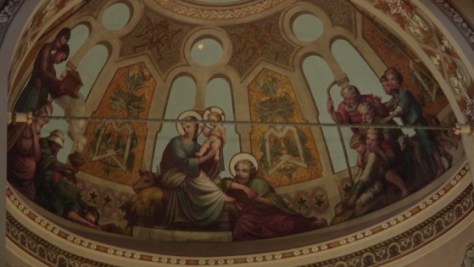
I’m a big fan of the Chapelle Notre-Dame-de-Lourdes. Used by (what I presume) are locals it kind of gives me a sense of what life in Montreal must’ve been like back in the 1940s and 50s. Back when everybody, and I do mean everybody, went to church. I have never seen the place empty, and they hold at least six different services every day.


For the squareheads, blokes and Protestants in the house, the inscription reads:
Those of you who pass by / high society or street people / people who contemplate God / or those who have forgotten / enter into this House of the Father / prostrate yourself in front of him / adore the incarnation of his son / and remember supreme being / is the Father, the Son and the Holy Ghost / And before you leave / gaze upon Mother Mary.


Built by Napoléon Bourassa in between 1873 and 1882. Louis-Philippe Hébert did a bunch of the sculptures, while Toussaint-Xénophon Renaud and François-Édouard Meloche did some of the painting. It has the first organ built by Casavant Frères and La Vierge dorée was added in commemoration of its 50th anniversary.




Howdy!
It kind of went over big back in the middle of January when the first show opened. But it’s going to be extremely difficult to keep up the hype for an entire year. It being the year-long, 15 exhibit, one book celebration of Publicité Sauvage‘s silverish anniversary (see if you can find the typo on the anniversary website).
They rolled the exhibitions out at Foufounes Électriques at the beginning of January, quickly added Café Campus in February and organized a third and larger one at the Écomusée du fier monde that just closed last week. So this seems as good of a time as any to start on the reviews.
I initially thought of reviewing each exhibit separately. But after seeing how sparse the one at Foufounes Électriques was I kind of made the executive decision to group some together. Hence the reason why I can’t tell you how many separate reviews there will be. Sorry.

I was quite surprised when I got to Foufounes, somehow I had not only expected bigger, larger, more. I had also expected older. 25 years is a long time, a very long time. And I had thought that there would be more than the dozen and a half, or so posters that they exhibited.

I felt like I was going on some sort of mission, not quite like the stations of the cross, but more like seeing all of Damien Hirst’s spot paintings. After all this was/is Montreal cultural history we’re talking about.

While I was looking at them I was trying to remember if I had actually seen any of the shows or events that they were talking about. Sadly for the most part I hadn’t. While Foufs was a great place to see bands from out of town (off the top of my head I can remember seeing KD Lang, Tackhead, Nirvana and Jonathan Richman there) for the most part I would go see local bands in either smaller, cheaper venues or bigger more impressive ones where they would really be able to puff out their chests and say “we made it!”. So while I saw the Ripchordz, I never saw them a Foufs.
So as an exercise in nostalgia this particular exhibit did not strike any chords with me.

I was also surprised to discover that the posters in the exhibits were not the same as the posters reproduced in the book (I’ll get to the book later in a separate post) hence the vagueness with some of the dates. I was also surprised to discover that not all the posters on display were for events that had taken place at Foufs.
Now, if I were writing for a more mainstream publication, this is the place where I would launch into some sort of brief history of Foufounes Électriques and Café Campus. But I’m not, so you can click on the links and/or read the book that accompanies the exhibitions.

The Café Campus part of the exhibit was similarly sparse. I actually got to see it during the daytime, which meant that the lighting was much better (but not sufficiently better to make my camera skills any better) and I think since I was already kind of glomming onto the concept, it made more sense to me.
That, or now that I think about it, I’ve always had a much stronger connection to Café Campus than I did to Foufounes Électriques. If there were someway to go back and calculate time spent, money spent, or amount of enjoyment received, I’m 100% positive that Café Campus would win on all three counts, or in any other measurement that could be counted. Somehow it seemed (and still seems) more locally grounded to me. Or it just might be due to th efact that I was never much into the goth scene.

The other thing that struck me was how small most of the posters were. I think that because they are relics of an ephemeral event those that stand out in my memory take on some sort of oversized significance in my brain, and therefore I expected the same kind of oversized poster.

Which leaves us with the first large scale and more general exhibit. The “good causes” posters at the Écomusée du fier monde. They were charging $6 to get in, and believe-you-me, it wasn’t worth it. There were about 40 or so posters there.
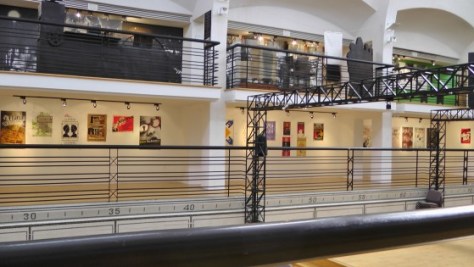
While the lighting was head, hands and shoulders above anything at Café Campus, somehow the idea of paying about 10¢ per poster seen didn’t quite sit right with me. And since it is down now, and for the future if there are any Publicité Sauvage posters you want to see, head on up to the Archives nationales du Québec, they have most of them, and while there might be some bureaucracy and red tape to slog through, they won’t charge you a dime. If they ask you “why” you want to see the posters, tell ’em you need to fact check this article…
Like the two previous iterations, there was a paucity (how’s that for using two two-bit words in one sentence!) of posters from the 1980s and 1990s – although now that I know what’s in the book and what’s in a show are two separate things, I’m going to be taking much closer and careful notes.
Things were grouped together with something obvious linking them. Either the organization

Or by cause

And while this was a nice touch, I still found myself trying to make connections to my past. Did I remember the poster? Had I attended the rally? Since my memory is sketchy at best I kept drawing blanks which then forced me to look at the posters as works of art, separate from the events that they promoted and it occurred to me that quite a few weren’t.

Look at the set of posters above. There’s one, the one for La Journée de l’air pur which could be, to me, considered as a work of art. The rest were specifically designed so as to get a specific bit of information across. And to do so in an engaging way. While that can and will make for some pretty things, for the most part, it isn’t the driving force behind making art. Yes, there are exceptions, but you get the point.
This is not to say that you shouldn’t go to see the 12 other exhibits – the fourth one is up right now someplace in Dawson College until the 24th of March – no in fact quite the opposite. You should go and see the exhibits. They are the tools in the fight against collective amnesia. And fighting a collective amnesia is a very good thing.
I just wish that instead of the roughly 15 years worth of posters that are being exhibited, there truly were selection from all 25 years. I also wish that all of them were as large, if not larger than the exhibit at the Écomusée du fier monde. 25 years is a lot of time, there should be a lot of posters to show the passage of time.

Howdy!
I‘ve been twice to see the show, and might just go a third time before it closes on April 15. If you want the short version, it’s a very nice show. A little small, but a fascinating way to spend 90 minutes or so.
The longer more nuanced version goes as follows: When I first heard about Imperfect Health: the Medicalization of Architecture at The Canadian Centre for Architecture, I kind of scratched my head. I couldn’t quite figure out the what and the how of what they were going to exhibit. But my curiosity got the best of me and I was pleasantly surprised.
Once there, it kind of becomes obvious as to how and what gets displayed. There are are pictures of trees (lots of pictures of trees, depending on who you believe, trees are either good for your health or bad for your health) ranging from Robert Burley’s photographs of parks designed by Frederick Law Olmsted (good for your health) to Cesare Leonardi’s awesome drawings of trees (bad for your health). There are floor plans for old age homes, plans for a pig apartment building and lots of other cool things that all have some connection between design (more so than architecture) and health.

To get the crotchety stuff out of the way quickly and early. Given that The Canadian Centre for Architecture is in Montreal, I was disappointed that there wasn’t more local content. It’s not like every city in the world can boast that they have park designed by Olmstead. But sadly, there was no picture of Mount Royal and given that there are not one, but two hospitals being built here now, I would have thought that they might have incorporated something from those projects into the exhibit.
There is a preponderance of information in how buildings can be bad for your health – a significant portion of one room given over to asbestos, which is really the only local content, and a whole other section devoted to dust and materials that cause allergies – while at the same time there are also numerous plans of buildings that are supposed to be good for your health (from OMA and SANAA specifically) I would have loved to have seen some information on older medical architecture. Something like how the Royal Victoria Hospital developed, or the evolution of hospital wall colors, or pill design, or, or, or. You get the picture. Something slightly more historical.
I wasn’t obsessive about note-taking but it struck me that for the most part there was nothing prior to 1960 or so. I don’t know if that has anything to do with what actually got archived, and therefore was available, or if there was some executive decision not go further back. Because of the heavy emphasis on contemporary practices and the fact that it wasn’t as large and sprawling as previous exhibits at the CCA, I was left imagining the gaps. What type of stuff could have been there.

The stuff from the 60s was tremendous. There was a section devoted to Sun City, AZ the “first and finest planned retirement community for active seniors.” They had a selection of floor plans

and a video on the history of Sun City that I wouldn’t watch there, because they insisted on playing it on an endless loop, which as I have said before (and will say again) makes no sense when the film or video that you’re watching has a beginning, a middle and an end. But was able to find it on YouTube.
The Sun City film was part of the exhibit on aging. The exhibit itself was loosely built around six health related topics: allergies, asthma, cancer, obesity, epidemics, and aging. As an introduction to each section there was a bulletin board with a variety of clippings, reprints from websites and other assorted ephemera. Some worked better than others. I never really ever thought that I would see a page printed from The Globe and Mail’s website as something displayed in an exhibit at the CCA.
In no particular order, some of the things that I particularly enjoyed were the photographs of elevators in the fat room (I’m actually in the process of taking some of my own, more to follow later), the photographs by Bernd and Hilla Becher (I never get tired of seeing their work). Sophie Handler‘s Resistant Sitting project (pdf alert, and if she happens to read this, congrats to Dr. Handler on her recent PhD). And The Heterogeneous Home by Ryan Aipperspach, Ben Hooker and Allison Woodruff
As part of the asthma room they had a copy of this picture from Kirill Kuletski’s Speleotherapy series.

While each object in the show was presented in order to raise questions, I think that the allergy room was the least effective. There were samples, under plexiglass of building materials that could potentially cause allergic reactions, and other samples for you to handle that wouldn’t cause allergic reactions. I would guess that they were there in order to facilitate the younger viewers to the exhibition. But I haven’t been young for a while, so as you might expect I found them a tad juvenile.
And speaking of questions, one occurred to me last night. The exhibit comes down fairly hard and strong in it’s condemnation of asbestos, and I’m fairly certain that everyone, myself included, knows that breathing in asbestos fibers will cause cancer. But the reason it was used so much as a building material was because of it’s fire-resistant properties among other things. I wonder how many people would have died in burning buildings if asbestos had not been used, and how would that compare to the number of people who died (or will die) due to asbestosis?

One of the prettier, but more obtuse parts was from Ms. Calvillo. He attempts to map the atmosphere are quite nice. But the attendant documentation in the exhibit was somewhat sparse. In doing further research after the fact I came across this article by Javier Arbona that did manage to explain her work in plainer language and also had a link to the website for In the Air.
And that I think is one of the other small faults I would note about the exhibit. It seemed to me that far too much of it was the internet made material. Kind of like the exact opposite of their previous exhibition 404 ERROR The Object is Not Online.
All of this is not say that Imperfect Health: the Medicalization of Architecture at The Canadian Centre for Architecture is flawed or not worth it. As I wrote at the top, “it’s a very nice show. A little small, but a fascinating way to spend 90 minutes or so.” it raises questions, and for the most part I always think that raising questions is a good thing. But like with anything that I am fond of, I always wish there was more. Or that things were slightly more nuanced (or in other cases slightly less nuanced). But you get the idea, there is always something that could be done to take something very good and make it exceptional, or to go from great to amazing.
Your level of enjoyment of the exhibit will be roughly inversely proportional to the amount of time you spend on line looking at and reading about theoretical architecture. Or exponential to the amount of time you spend in the galleries of the CCA taking notes and then entering them into Bing or some other search engine. Given that I don’t do much of the former and a lot of the later, it worked out quite well for me. But as the kids say, “your mileage may vary.“
Howdy!
Once again I’m late to the party. The exhibit was up from October 6, 2011 to January 8, 2012. I’m just realizing now, how backlogged those rhymes about the Triennale Québécoise and other things made me. Like Marie Chouinard’s The Golden Mean (Live) I saw it at the end of November, 2011. Jeez! It’s a good thing that there is a history of reviewing shows that you can no longer see, otherwise y’all would think that I am one of the most irresponsible people in the known universe. But before I go find a whip so I can flagellate myself, we gotta get to the verse:
Ed Burtynsky takes really big photographs.
For the most part I don’t think he does anything by halfs.
Big political statements
I hear they cost many many cents.Mostly on concerns about the environment
Places with natural resources and the changes they underwent.
I really liked the images of the refineries,
Sometimes you gotta think duodecimally and not in binaries.His pictures of highways were also very impressive,
The Golden State Freeway, like La Joconde is something I won’t outlive.
But condemning Talladega and Sturgis
Is where, from my beliefs, he diverges.They’re images designed to make you pause and reflect,
I think it is the earth that he wants you to protect.
But it is possible to be too politically correct.
Yes, big photographs are good. I still get weak in the knees thinking about the Andreas Gursky show I saw back in 2002 in Chicago. Big (for the most part) is synonymous with good, especially when talking about photographs.
But this one raised more questions than it answered. The first one being, that it was sponsored by Scotiabank. The very same Scotiabank that has a mutual fund of $170 million dollars invested in “equity securities of Canadian resource based companies, including companies that operate in the oil and gas, gold and precious metals, metals and minerals, and forest products industries.” – The One Sheet (pdf). Does this mean that Mr. Burtynsky is allowing himself to be used for greenwashing purposes? Or is he just willing to take money from whomever without thinking about their ethics? Or something else? I dunno, as I said his show raises more questions than it answers.
The second question that came to my mind as I was looking at it, was how much oil did Mr. Burtynsky use in order to get his pictures? There are shots that could have only been taken from a helicopter. There are other ones where he went to rather obscure places (Sturgis, South Dakota, Walcott, Iowa, Baku, Azerbaijan, Chittagong, Bangladesh) which would have either required some serious long distance driving or flying. And while I’m fairly certain that in order to take his pictures he doesn’t travel alone, I gotta think that he has a rather large carbon footprint.
The reason I ask questions like these, is because according to the press release the images in the show “deliver a social and environmental message that is both disturbing and thought-provoking.” So I can’t be accused of being the only person linking the concern for the environment and the images. What’s that line about glass houses and stones?
But enough about the theoretical questions, what are the pictures like? ‘Cuz isn’t it possible to appreciate them aesthetically without giving one good gosh darn hoot about any political message that Mr. Burtynsky is trying to make? Short answer: For the most part they are very good. As I mentioned up above “Big (for the most part) is synonymous with good, especially when talking about photographs.”
The longer, nuanced and more detailed answer is as follows: Spread over two floors, it presents something like four or five dozen images that vary in size from 68″ x 78″ to 29½” x 36½”, with most of them being 51″ x 63″. Organized thematically, they span three of the four sections that he lists on his website; Extraction & Refinement, Transportation & Motor Culture and The End Of Oil (somehow Detroit Motor City section didn’t make the cut at the McCord, I can’t understand why).
Now while I don’t know too much about photography, there was the aforementioned Gursky show I saw in Chicago and if my memory serves his teachers at art school were Bernd and Hilla Becher. Don’t quote me on this, but if they weren’t the first people to take large pictures of industrial things, they definitely were the folks who made it hip. Mr. Burtynsky definitely owes them something. What I’m not sure. Because he doesn’t copy them (at least as far as I can tell) but at least as far as recognizing that he is mining a field that they were instrumental in making.
Mr. Burtynsky, does them one better, his are larger and in color. Have I mentioned that big is good, when it comes to photographs?
For the most part his images are very formally set up. If I were to make a gross generalization about Mr. Burtynsky’s landscape photographs, I’d say that the picture would be taken from a high vantage point, if not a helicopter, some sort of scaffolding was used, there would be an immense foreground, taking up something like ¾ of the image. There would be mountains in the background, or something mountain-like taking up the other ¼ of the image. The sky (and this is where my knowledge of photography is woefully lacking) is completely washed out, to the extent that I would make a pinky bet that Mr. Burtynsky’s skies are very familiar with Photoshop (or Gimp).

The foreground is some kind of large collection of something industrial. Endless repetition of form with minor variations since each object is distinct. And since they are so large and there are so many objects in the picture it’s quite easy to literally get lost in it. On one side that’s the fun part. On the other, once you realize that there is a formula it kind of makes me think that while Mr. Burtynsky is making some sort of commentary on 20th century industrialization, he is at the same time being very mechanical in how he makes his pictures.

You get the picture.
One other thought that occurred to me as I was looking at the pictures. Not a single one was signed, and there was no information on how many prints had been made. Not that that would detract from the image itself, but it’s just that if I want to buy into the concept that the images Mr. Burtynsky makes are art and not just some mass produced industrial object that happens to look pretty, it would be nice to have his John Hancock on it and know that there were only XXX copies made. But I would guess I’m in the minority here. Or maybe he signed and numbered them on the back.
As I wrote in my notes, there really is no movement in the pictures. There was also a distinct lack of people in the pictures. While I didn’t keep count, there couldn’t have been more than half-a-dozen people. I wonder if Mr. Burtynsky has ever done portraits, and if he has, I’d love to see them. I’d guess that he would ask his subjects to dress in tuxedos. (ba-da-boom!) His images are that formal.
I always find it a tad awkward when I come across an exhibit that has an agenda, like this one does. Even if it is an agenda that I agree with. I find that trying to force an idea on someone by using an art exhibit extremely difficult. In order to do so, the the exhibit, for the most part, has to be incredibly simplistic. It tends to be repetitive as well, and I find that in order to make their point they end up being dumbed down to the point where the idea that they are trying to promote becomes more suitable for five year-olds than adults. As you might have guessed, I’m not five years-old.
But enough of that, and lets concentrate on the pictures. As I mentioned in the ditty, his pictures of highway interchanges are quite cool.

I think part of the allure comes from the fact that he is using something like a helicopter to take the pictures. The pictures he gets are not the type of pictures that are available to M. & Mme. Tout le monde. And that I think is something incredibly significant. That sense of discovery, seeing something for the first time, is a sensation that shouldn’t be ignored. If he took similar pictures, as formal in their composition but from the perspective of a driver, they would not be one tenth as powerful.
Beyond that, if you are in London, England, I think that’s where the show is now, and it is probably going to continue touring and making more people aware of Mr. Burtynsky’s name. The catalogue for the show won some kind of award, but I’m not clear on how it is awarded, so I guess I should assume that it is legit, and not something where you toss the organizers some cash and you get a medal.
Being aware of Ed’s name is a good thing. It makes people aware of Canadian art just a little bit more. I just hope wish that he would push the envelope a little more, instead of playing it safe. He knows how to handle a camera, I’d like to see some images from him that prove that.