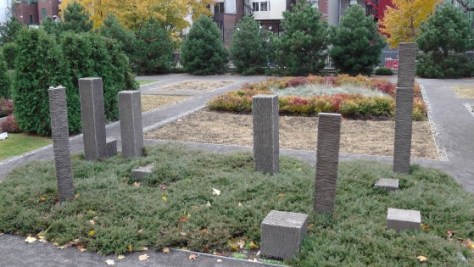
Le jardin punk by Roger GaudreauLe jardin punk by Roger Gaudreau
In the spring and summer, the grass does not get mowed so you need to look close in order to find it.
Le jardin punk by Roger GaudreauLe jardin punk by Roger Gaudreau
And while Le jardin punk is fine as a name, I think I would have preferred if M. Gaudreau had punned off of Rocher-Percé in the Gaspé.
Le jardin punk by Roger GaudreauLe jardin punk by Roger GaudreauLe jardin punk by Roger GaudreauLe jardin punk by Roger GaudreauLe jardin punk by Roger GaudreauLe jardin punk by Roger GaudreauLa forêt civilisée by Roger Gaudreau
I’m not as much of a fan of this as I am of Le jardin punk.
La forêt civilisée by Roger GaudreauLa forêt civilisée by Roger Gaudreau
To me it only works as a foil.
La forêt civilisée by Roger GaudreauLa forêt civilisée by Roger GaudreauLa forêt civilisée by Roger GaudreauLa forêt civilisée by Roger GaudreauLa forêt civilisée by Roger GaudreauLa forêt civilisée by Roger Gaudreau
Empty room at Le Windsor before the Lundström fashion show to benefit the Colorectal Cancer Association of Canada
I wasn’t quite certain what to expect, but I figured despite my looking like a fish out of water, whatever happened it was unlikely to hurt, and as it was for a cause, maybe it would help my karma point score.
The Backdrop for Photographs of Important People
I wasn’t important enough to have anyone ask to take my picture, but I did manage to bumble my way through the event using mine, although I almost ran out of battery power.
The Heavy Organza Dress in Fuschia from the Lundström Fall 2012 Collection
As it was a fancy fundraiser, there were lots of folk dressed to the nines. Most of the early part of the evening was dedicated to wine and finger food. There was a silent auction and a live auction and I was told that the tickets cost $350/ch.
From the Lundström Fall 2012 Collection
According to the program there were 33 outfits, although I was unable to keep track of everything as the models sashayed by. I also was quite struck by how all the models seemed to have the same expression on their face and how they appeared angry or unhappy.
The Lundström Fall 2012 CollectionThe Lundström Fall 2012 CollectionThe Lundström Fall 2012 CollectionThe Lundström Fall 2012 CollectionThe Lundström Fall 2012 CollectionThe Lundström Fall 2012 Collection
Before I go to another fashion show, I’m going to have to learn what tulle, ponte di roma, lurex, dupioni and a lot of other technical terms mean. It also seems that the fashion industry and the art world aren’t exactly in sync when it comes to definitions of colors.
Glitter La Parka in Black from the Lundström Fall 2012 CollectionGlitter La Parka in Black from the Lundström Fall 2012 Collection
The show stopper.
But really what caught my eye were the shoes that were worn to the event. I’m fairly certain that more than one person thought I had a foot fetish, but I digress.
If you’ve been reading the previous parts, you probably think that I’m not a big fan of The Triennale québécoise 2011. How ’bout I start moving the pendulum in the other direction and talk about some kick-ass art? Stuff that is worth the price of admission ($12 last time I checked, but did you realize that the admission to the Musée d’art contemporain de Montréal has gone up 50% in the past four years? Way more than inflation, it used to be one of the bargains in the city, now I think twice about what they are showing before giving them money, but I digress). Two words: Charles Stankievech.
Back in 2007 I saw something of his called Timbral and was pretty gosh darn impressed. Something about felt and banging away on a piano always makes me go weak in the knees.
Then I heard something about him going to the Yukon and kind of thought to myself (quietly) that making a trip up there to see his work was perhaps, a little bit too far to go – but you never know. I know some people up north, and stranger things have happened. But basically didn’t give him much thought, following the standard issue cliche, out of sight, out of mind.
But lets backtrack for an instant. If, upon entering the Musée d’art contemporain de Montréal, after buying your ticket, you take the stairs (and yes, I will talk about Dean Baldwin’s boat, later), turn to your right (and yes, I will talk about Thérèse Mastroiacovo‘s work, later too) and then right again, Charles Stankievech’s piece is going to be something like the fifth one you see. If you take that route it’s the first one that gets its own room. (There are eight basic routes you can take through the Triennal.) You can’t miss it.
As you walk in there is a recessed shelf, with an open copy of The Purple Cloud by M. P. Shiel glassed in with a purple/pink/rose colored light, open the door, turn the corner and there you are. Smack dab in front of a wall-sized video of an exploded smoke grenade in, what I presume is, the Yukon.
When I saw it, I lucked out in my timing (the whole piece is maybe 5 minutes long, if it’s lucky) in that as I walked in, the smoke grenade had just been detonated and the purple cloud that spewed from it was still a long way off in the distance.
As I sat there, the smoke gradually was blown towards the camera, until it covered the entire screen, and then dispersed. Simple enough, right? Well, maybe, but not so fast.
First there is the score by Tim Hecker, a very low rumbling, kind of like what you would imagine something like a convoy of really big trucks would make if you put your ear to the wall of a tunnel they were in, combined with something that sounds like a methadone induced bird call along with some sort of vaguely ethereal and shimmery orchestral effect. Probably better if you were to go and listen to it yourself.
The score is so effective, that I would almost go so far as to say that it should be called a piece by Mr. Hecker with video done by Mr. Stankievech. Almost.
Second, after doing some cursory research into the book, it turns out that it’s all about the last man on earth, who just so happens to be at the North Pole, and that a purple cloud has been the reason that everyone died.
I’m not quite certain what to make of all these antecedents. But it gives me pause. I’m not as convinced that Kirby and Olitski are as significant as Shiel, but that might come from a lack of first hand knowledge of either one, and somehow I wish Mr. Stankievech and Mr. Hecker could have somehow incorporated Charles Wright into the mix.
Despite what I want, the piece is called Loveland. It’s one of the more compelling piece in the Triennal. Part of the reason it is so compelling is due to the the low rumble of the soundtrack which gives a sense of foreboding. This sense of foreboding is reinforced by the movement of the purple cloud towards the camera. And then toss in the rather bleak Yukon landscape, and you can’t help but think that something, most likely bad, is going to happen. It is that sensation that that keeps you riveted. It was the combination of effects that made me feel like I was someplace else, in some hazy dream/nightmare-in-waiting.
I’m certain that I could go on at length about some sort of doomsday/last person on earth scenario along with amorphous purple forms that swallow everything, but that would require reading the book and playing the game, both of which while I’m certain would be entertaining aren’t exactly high on my list of things to do. So I won’t. I’ll leave that for some future PhD. student, I’d much rather watch Loveland.
Basically, art makes you think, good art makes you think hard, and very good art makes you think long and hard. I’ve spent most of the past four days thinking hard about Mr. Stankievech’s Loveland…
And then finally, so that the research wasn’t all for naught, here are some other songs called Loveland that I was able to find on YouTube.
A more realistic painting of Place Jacques Cartier.More cubo-futurist buildings of Montreal.Another vaguely realistic 19th Century Montreal street scene.
I would imagine that there were at least two separate painters/designers (duh!)
More cubo-futurist churches.The last cubo-futurist church painting.
But then, I came across this mural inside 4141 Sherbooroke O.
Some kind of faux renaissance painting in the lobby of 4141 Sherbrooke O.Some kind of faux renaissance painting in the lobby of 4141 Sherbrooke O.Close up of some kind of faux renaissance painting in the lobby of 4141 Sherbrooke O.
And I kind of think that they were both made by the same painter, although I’m not entirely certain. I can definitely make a case both for and against.
If you want to see the flip side to Lynne Marsh‘s Philharmonie Project (Bruckner: Symphonie No. 5 Movements 1 & 4) it’s relatively simple
Click on “play.” To back up slightly for those of you who might not know what I am talking about. As part of the The Québec Triennial the Musée d’art contemporain de Montréal decided to spread its wings and exhibit art outside of the museum. One of the pieces chosen for the extra-muro treatment is Lynne Marsh‘s Philharmonie Project (Bruckner: Symphonie No. 5 Movements 1 & 4). It is a four channel video projected on one screen in a small dark room off of the Espace Culturel Georges-Émile-Lapalme at Place des arts that has three sets of bleachers installed campfire style around the screen.
As is written in the press release Ms. Marsh “turned her camera [sic] on the crews shooting a concert by the Berlin Philharmonic Orchestra as it plays a piece by Anton Bruckner.” That piece is his fifth symphony conducted by Bernard Haitink on March 12, 2011. If you have an extra €9.90, you can watch the entire concert here. (It’s the only performance of Bruckner’s Symphony No. 5 that has been filmed by the Berliner Philharmoniker prior to the Triennial).
Or more explicitly, there are four cameras trained on a bunch of different people in the broadcast booth, each of whom has a different responsibility during the broadcast. (And what is it with red and blue checks in the control room? The two main characters wear them; one on his shirt, the other on his scarf.)
I’m not certain why Ms. Marsh chose to only use the first and the fourth movements. I can only guess that it was either due to technical glitches while recording the second and third movements. Or perhaps a rights issue, and the Berliner Philharmoniker preferred not give her a complete recording. I don’t know enough about German Copyright law to venture an idea based on that, so I’ll stick to “something screwed up with the cameras, and there was this deadline, and, and, and…” But to remind you, I have been wrong in the past, and I will be wrong again in the future, so there is no guarantee that I am right, now.
When I went to see it, there was this homeless guy hanging out on the bleachers watching it. I guess I kind of like the idea that Ms. Marsh makes art that is for everyone. But at the same time, it was cold outside, the room was dark and I’m not certain if we woke him up or not. So I’m not 100% certain if he was there because he enjoyed it and was interested in seeing it, or if he was there for other reasons. Anyhows, he was the only one there besides us, and for that I’d have to blame the museum and Place des arts. A small dark room off of the Espace Culturel Georges-Émile-Lapalme (aka the hallway in between Salle Wilfred Pelletier and Theatre Maisonneuve) is not exactly screaming out “look at me!” to all the passers by. And with the amount of flashing, flashy and bright videos all over the place in Place des arts, it’s quite easy to not even notice the room, let alone get the nerve up to hangout with the homeless while watching the technical side to parts of a symphony by Bruckner.
Given that Ms. Marsh’s Philharmonie Project (Neilsen: Symphony No. 5) Dry Run (see below) was done in close collaboration with Johanna Meyer-Grohbrügge and Sam Chermayeff of June14 I’m very surprised that the seating and its placement are so common and utilitarian.
While I can understand in theory why the museum tried to spread its wings for the Triennial, in practice placing anything that is even potentially art-like in Espace Culturel Georges-Émile-Lapalme is going to end up as a train wreck. The recent renovations have ruined Pierre Granche’s sculpture Comme si le temps… de la rue and as evidenced by the crowds lack of people watching Lynne Marsh‘s Philharmonie Project (Bruckner: Symphonie No. 5 Movements 1 & 4) I can only shake my head.
Unlike Rafael Lozano-Hemmer’s Architecture relationnelle 18. Intersection articulée Ms. Marsh’s piece was installed so as to be crowd unfriendly. As you enter into the dark room with the homeless man, you are first confronted by the backs of the bleachers that are at least five feet high, effectively creating a third barrier between you and the piece (the first being entering into a dark room in public, the second being entering into a room with someone who is homeless already there). Then as with most “Art” video installations, this is on an endless loop, which to me means that whomever is responsible for exhibiting the video has completely and thoroughly abdicated all responsibility towards making the artwork understandable. [Ed Note: To their credit, there is a 9:12 second gap at the end in order to make the entire loop 60 minutes. But there is no signage anywhere explaining when things start, and when I was there it started at 10 after the hour – I guess someone hit play a little late that morning]
OK, in some cases there actually are videos on a loop that do not have a beginning, a middle and an end, but as Ms. Marsh’s piece is based completely on a piece of music that does have a beginning, a middle and an end, to force the viewer to enter during the middle of the performance watch the end and then wait another 9 minutes for the beginning is just plain ridiculous. And that’s not even taking into consideration the fact that Ms. Marsh has truncated the performance itself by lopping off two movements.
As I mentioned earlier, multi-channel videos focusing on what happens behind the scenes of some insanely large public spectacle is not exactly an original idea. Which then leads me to ponder Ms. Marsh’s use of the first and last movements from Bruckner’s 5th symphony. (If you’d like to hear them, click on these: Movement 1: Introduction (Adagio) — Allegro. Movement 4: Finale (Adagio) — Allegro moderato).
I’m not exactly the best musicologist, but with a little bit of Google-Fu it’s possible to discover all sorts of things about Bruckner’s fifth symphony. According to Gabriel Engel [pdf alert] Bruckner “saw the Fifth as the deeply personal expression of a genius doomed to utter loneliness by the scorn and neglect of
a misunderstanding world. He caught in the Adagio the true spiritual keynote of the work. Its brooding main theme was the despairing utterance of abandoned genius.” It would have been nice if some of that personal expression had seeped through into Ms. Marsh’s video. Engel continues, “Far more than any of his other symphonies it is a polyphonic work, the composer’s proud description, ‘my contrapuntal masterpiece,’ testifying to the extraordinary care with which he had fashioned its many-voiced strains.”
Given the multichannel nature of Ms. Marsh’s video it would have been fairly simple to have used the video to, if not copy or follow the counterpoint, to create her own, but sadly she chose not to. Two of the cameras are entirely static and the other two for the most part do slow pans across a very limited field of vision.
If you’re interested in reading the score, click on this.
Lynne Marsh, Philharmonie Project (Neilsen: Symphony No. 5) Dry Run (picture taken from the catalogue to the Quebec Triennal 2011)
Interestingly enough in the catalogue to the Triennal, the pages committed to Ms. Marsh’s work also show images from something called Philharmonie Project (Neilsen: Symphony No. 5) Dry Run and in Marie Fraser’s essay that makes mention of Ms. Marsh she alludes to there having filmed the technicians during a performance of something by Mahler as well. Unfortunately Ms. Marsh’s website is not up to date so there is no information about it there. However, concurrently with the Triennal, she is exhibiting something called Philharmonie Project (Neilsen: Symphony No. 5) at Program in Berlin. According to the notes “the Philharmonie Project is a study on the staging of power systems, the cultural expression of mass consumption and the support structures that enable it to happen.” Which somehow gets translated for Quebec in the pages dedicated to Ms. Marsh in the catalogue of the Triennal as Ms. Marsh’s “practice is fuelled by a reflection on how these social spaces and their ideological orientation can be reconfigured through the camera lens.” I’m not so certain that I agree with either one. Earlier in the catalogue to the Triennal, Marie Fraser quotes Ms. Marsh as likening “the filming to a choreography, a dance where the rhythm and intensity of the music are translated by the action of the cameramen. Each image is precisely rendered: this is the camera as performer.”
If this was the case, then someone would be selling tickets to watch the cameras and not selling tickets to hear the music (or watch the soccer game, stock car race, etc.) What Ms. Marsh is doing is shedding light on what goes on behind the scenes, which while interesting to some, ultimately can’t compare to the the original cultural event or performance. In the same way many more people will see Hamlet than will ever see Rosencrantz and Guildenstern Are Dead.
And then as long as I am questioning things, given that the Triennal is a highly political exhibit, I’m not quite certain what to make of the fact that Ms. Marsh has been in both. Especially since she is no longer considered a “young” artist, and she’s got a gig as a senior lecturer at the University of Hertfordshire.
I haven’t quite come up with any specific theory or idea on or about the Triennal. But I also haven’t written anything about any of the art actually in the museum yet, either. I’m certain it’ll come, I just hope it’ll come sooner rather than later, because if I end up writing something like this for each of the artists involved, I’ll never get it done by the end of the week.