Category Archives: Ramble

Love | Death | Devil – The Piece by the Ben J. Riepe Kompanie

Howdy!

Do you remember John Tenniel’s rabbit illustrations for Alice’s Adventures in Wonderland by Lewis Carroll?

John Tenniel's rabbit illustration from Alice's Adventures in Wonderland

That was the first thing I thought of when I saw the program for Love | Death | Devil – The Piece by the Ben J. Riepe Kompanie

Photo : Ursula Kaufmann

Nothing like a rabbit wearing a ruff to bring back memories from my childhood. Which then led me to The Jefferson Airplane.

Which led me to the brown acid, which enabled me to make some sense, or gain some comprehension and understanding of Love | Death | Devil – The Piece by the Ben J. Riepe Kompanie. In short it’s a bad acid trip.

It played at La Chapelle last week and was a very big deal. It was the North American premiere, and quite possibly the first time that the Ben J. Riepe Kompanie itself had performed in this side of the Atlantic. Back in the 1980s I used to say that all the cool stuff either originated here or made it’s way here from New York or Paris. The Ben J. Riepe Kompanie preformed Love | Death | Devil – The Piece in Chennai, Dhaka and Würzburger before making it to Montreal. This is not a good thing.

Nothing against any of those cities, but I’m not certain that I am comfortable with the idea of Montreal being culturally behind a town of about 150,00 people in northern Germany or the capital of Bangladesh. Call me culturally prejudiced or worse if you wish, but I’d kind of like to think that Montreal hasn’t fallen that far.

Liebe.Tod.Teufel - Das Stück photo by Ursula Kaufmann

But enough of that, I’m not here to discuss cultural policy, I’m here to talk about the Ben J. Riepe Kompanie‘s Love | Death | Devil – The Piece. From as much as I can gather it is a compilation of what I would call the greatest bits from Love, Death and the Devil. As far as I can tell Love, Death and the Devil is kind of like the Ring Cycle in that it consists of five separate performances that do not necessarily have to be seen consecutively. (Image 1: The Chessboard Room, Image 2: The Dark Chamber, Image 3: Love, Sex and Vanity, Image 4: The White Chamber, Image 5: Labyrinth.)

Going through the Ben J. Riepe Kompanie‘s YouTube videos you can easily see things (costumes, moves, dialogue, etc.) that are common to things in the Images and The Piece. But let me back up a bit. When the show starts there’s a guy at a table in the back and a woman beside a stuffed deer on the other side of the stage also in back. The rest of the stage is bare except for some microphones.

Liebe.Tod.Teufel - Das Stück photo by Ursula Kaufmann

What carries the performance, is that for just about the rest of the show, everyone is wearing some sort of animal mask. Besides the bunny masks, ape masks, sheep masks and there were probably some animals that I missed. The dancing itself isn’t so much dancing as structured and controlled movement. There’s some screaming, some simulated sodomy, some weird yoga poses and talking through a megaphone.

In other words it’s kind of rough, violent without any real bloodshed and the type of show that can make you wince if you aren’t quite prepared for it. But trying to find a plot or narrative was beyond me. I’m fairly certain that there wasn’t supposed to be one. But I’m still at a loss of trying to figure out the point.

Since I am not familiar with the Ben J. Riepe Kompanie or seen any of their previous work I was left scratching my head. It is obviously absurdist, with a strong dose of nihilism, angst and perhaps some surrealism, too. But no matter which angle I looked at it from, nor how hard I squinted I couldn’t quite wrap my brain around how it was depicting death, love or the devil for that matter.

Part of this obviously has to do with the fact that it is movement and not a play. But I also can’t help but wondering if the “greatest bits” nature of the piece is also a factor. Kind of like trying to make sense of the Variatio 4. a 1 Clav. from the Goldberg variations and the E flat-minor fugue from The Well-Tempered Clavier after hearing them played like they were parts of the same piece.

Overall I’m not quite sure what to make of the piece. On one hand I do recognize that just because Mr. Riepe is speaking a language that I don’t completely understand doesn’t mean he isn’t making sense. But on the other hand it isn’t like I don’t understand it totally (kind of like my relationship with the language of Molière) and what parts I do understand don’t really make sense to me, if you get my drift.

Which brings us back to Alice’s Adventures in Wonderland. It’s been a while since I’ve read it, and longer since I studied it closely. But I’m certain I can find enough connections to make it worthwhile.

The first one that literally jumps up at me (ok, the second, after the rabbit) is where Fa-Hsuan Chen gets lifted up by her head. In chapter five, Alice meets the caterpillar and after eating some of the mushroom her head grows instantaneously. The third one is… OK, maybe there isn’t that much a similarity between Alice’s Adventures in Wonderland and Love | Death | Devil – The Piece.

Liebe.Tod.Teufel - Das Stück photo by Ursula Kaufmann

Actually I might be confusing my Lewis Carrol and my Charleton Heston. With all the ape masks I might be able to find some commonalities with The Planet of the Apes.

But like Alice and to a lessor extent Planet of the Apres, The Piece has it’s own internal logic and once you are party to it, everything comes together and makes sense. They just forgot to invite me to the party.

Métro Joliette

Howdy!

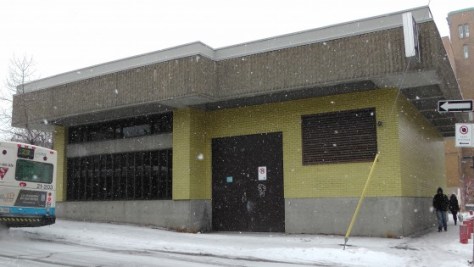
Last month I the opportunity to go to the Joliette metro station. As you might have suspected, I found it very cool (the general critical consensus is that it isn’t all that hot). Finished, just in time for the 1976 Olympics, it was one of two metro stations designed by Marcel Raby. M. Raby was an architect for the city of Montreal and the only other thing that I can find that he worked on was the dome of Marché Bonsecours in 1978 after it had had a fire. But my guess would be there is lots more, it’s just not on the internet.

More information about it here: metrodemontreal.com, Wikipedia, STM, P45.

The southern entrance to Métro Joliette.
The rear of the southern entrance to Métro Joliette.
The northern entrance to Métro Joliette.

While quite a lot of people don’t like the yellow bricks and the rather pedestrian nature of the buildings. I was enchanted by the color on a gray and snowy day. And just about pee’d my pants in delight when I discovered the back entrance which leads to an alleyway (ruelle in Montreal-speak).

Continue reading Métro Joliette

Publicité Sauvage: 25 ans et demi – Part One

Howdy!

It kind of went over big back in the middle of January when the first show opened. But it’s going to be extremely difficult to keep up the hype for an entire year. It being the year-long, 15 exhibit, one book celebration of Publicité Sauvage‘s silverish anniversary (see if you can find the typo on the anniversary website).

They rolled the exhibitions out at Foufounes Électriques at the beginning of January, quickly added Café Campus in February and organized a third and larger one at the Écomusée du fier monde that just closed last week. So this seems as good of a time as any to start on the reviews.

I initially thought of reviewing each exhibit separately. But after seeing how sparse the one at Foufounes Électriques was I kind of made the executive decision to group some together. Hence the reason why I can’t tell you how many separate reviews there will be. Sorry.

Publicité Sauvage Posters from 1990, 2001, 2002

I was quite surprised when I got to Foufounes, somehow I had not only expected bigger, larger, more. I had also expected older. 25 years is a long time, a very long time. And I had thought that there would be more than the dozen and a half, or so posters that they exhibited.

Young Gods poster (circa late 90s)

I felt like I was going on some sort of mission, not quite like the stations of the cross, but more like seeing all of Damien Hirst’s spot paintings. After all this was/is Montreal cultural history we’re talking about.

Four Publicité Sauvage posters from dates unknown.

While I was looking at them I was trying to remember if I had actually seen any of the shows or events that they were talking about. Sadly for the most part I hadn’t. While Foufs was a great place to see bands from out of town (off the top of my head I can remember seeing KD Lang, Tackhead, Nirvana and Jonathan Richman there) for the most part I would go see local bands in either smaller, cheaper venues or bigger more impressive ones where they would really be able to puff out their chests and say “we made it!”. So while I saw the Ripchordz, I never saw them a Foufs.

So as an exercise in nostalgia this particular exhibit did not strike any chords with me.

Publicité Sauvage posters from 2002, circa 1990s, and probably 1995

I was also surprised to discover that the posters in the exhibits were not the same as the posters reproduced in the book (I’ll get to the book later in a separate post) hence the vagueness with some of the dates. I was also surprised to discover that not all the posters on display were for events that had taken place at Foufs.

Now, if I were writing for a more mainstream publication, this is the place where I would launch into some sort of brief history of Foufounes Électriques and Café Campus. But I’m not, so you can click on the links and/or read the book that accompanies the exhibitions.

One of my favorite posters from Café Campus.

The Café Campus part of the exhibit was similarly sparse. I actually got to see it during the daytime, which meant that the lighting was much better (but not sufficiently better to make my camera skills any better) and I think since I was already kind of glomming onto the concept, it made more sense to me.

That, or now that I think about it, I’ve always had a much stronger connection to Café Campus than I did to Foufounes Électriques. If there were someway to go back and calculate time spent, money spent, or amount of enjoyment received, I’m 100% positive that Café Campus would win on all three counts, or in any other measurement that could be counted. Somehow it seemed (and still seems) more locally grounded to me. Or it just might be due to th efact that I was never much into the goth scene.

Some more Publicité Sauvage posters from Café Campus.

The other thing that struck me was how small most of the posters were. I think that because they are relics of an ephemeral event those that stand out in my memory take on some sort of oversized significance in my brain, and therefore I expected the same kind of oversized poster.

Mark your calendars now. Les Imprudanses (the poster on the left) are going to be at Maison de la culture du Plateau-Mont-Royal on the 23rd.

Which leaves us with the first large scale and more general exhibit. The “good causes” posters at the Écomusée du fier monde. They were charging $6 to get in, and believe-you-me, it wasn’t worth it. There were about 40 or so posters there.

The first part of the Publicité Sauvage exhibit at the Écomusée du fier monde.

While the lighting was head, hands and shoulders above anything at Café Campus, somehow the idea of paying about 10¢ per poster seen didn’t quite sit right with me. And since it is down now, and for the future if there are any Publicité Sauvage posters you want to see, head on up to the Archives nationales du Québec, they have most of them, and while there might be some bureaucracy and red tape to slog through, they won’t charge you a dime. If they ask you “why” you want to see the posters, tell ’em you need to fact check this article…

Like the two previous iterations, there was a paucity (how’s that for using two two-bit words in one sentence!) of posters from the 1980s and 1990s – although now that I know what’s in the book and what’s in a show are two separate things, I’m going to be taking much closer and careful notes.

Things were grouped together with something obvious linking them. Either the organization

Publicité Sauvage's ATSA posters at the Écomusée du fier monde.

Or by cause

Publicité Sauvage's posters on understanding at the Écomusée du fier monde.

And while this was a nice touch, I still found myself trying to make connections to my past. Did I remember the poster? Had I attended the rally? Since my memory is sketchy at best I kept drawing blanks which then forced me to look at the posters as works of art, separate from the events that they promoted and it occurred to me that quite a few weren’t.

Publicité Sauvage's posters on environmental awareness at the Écomusée du fier monde.

Look at the set of posters above. There’s one, the one for La Journée de l’air pur which could be, to me, considered as a work of art. The rest were specifically designed so as to get a specific bit of information across. And to do so in an engaging way. While that can and will make for some pretty things, for the most part, it isn’t the driving force behind making art. Yes, there are exceptions, but you get the point.

This is not to say that you shouldn’t go to see the 12 other exhibits – the fourth one is up right now someplace in Dawson College until the 24th of March – no in fact quite the opposite. You should go and see the exhibits. They are the tools in the fight against collective amnesia. And fighting a collective amnesia is a very good thing.

I just wish that instead of the roughly 15 years worth of posters that are being exhibited, there truly were selection from all 25 years. I also wish that all of them were as large, if not larger than the exhibit at the Écomusée du fier monde. 25 years is a lot of time, there should be a lot of posters to show the passage of time.

The second part of the Publicité Sauvage exhibit at the Écomusée du fier monde.

Imperfect Health: the Medicalization of Architecture at The Canadian Centre for Architecture

Howdy!

I‘ve been twice to see the show, and might just go a third time before it closes on April 15. If you want the short version, it’s a very nice show. A little small, but a fascinating way to spend 90 minutes or so.

The longer more nuanced version goes as follows: When I first heard about Imperfect Health: the Medicalization of Architecture at The Canadian Centre for Architecture, I kind of scratched my head. I couldn’t quite figure out the what and the how of what they were going to exhibit. But my curiosity got the best of me and I was pleasantly surprised.

Once there, it kind of becomes obvious as to how and what gets displayed. There are are pictures of trees (lots of pictures of trees, depending on who you believe, trees are either good for your health or bad for your health) ranging from Robert Burley’s photographs of parks designed by Frederick Law Olmsted (good for your health) to Cesare Leonardi’s awesome drawings of trees (bad for your health). There are floor plans for old age homes, plans for a pig apartment building and lots of other cool things that all have some connection between design (more so than architecture) and health.

Imperfect Health: the Medicalization of Architecture, installation view at the CCA. © CCA, Montréal

To get the crotchety stuff out of the way quickly and early. Given that The Canadian Centre for Architecture is in Montreal, I was disappointed that there wasn’t more local content. It’s not like every city in the world can boast that they have park designed by Olmstead. But sadly, there was no picture of Mount Royal and given that there are not one, but two hospitals being built here now, I would have thought that they might have incorporated something from those projects into the exhibit.

There is a preponderance of information in how buildings can be bad for your health – a significant portion of one room given over to asbestos, which is really the only local content, and a whole other section devoted to dust and materials that cause allergies – while at the same time there are also numerous plans of buildings that are supposed to be good for your health (from OMA and SANAA specifically) I would have loved to have seen some information on older medical architecture. Something like how the Royal Victoria Hospital developed, or the evolution of hospital wall colors, or pill design, or, or, or. You get the picture. Something slightly more historical.

I wasn’t obsessive about note-taking but it struck me that for the most part there was nothing prior to 1960 or so. I don’t know if that has anything to do with what actually got archived, and therefore was available, or if there was some executive decision not go further back. Because of the heavy emphasis on contemporary practices and the fact that it wasn’t as large and sprawling as previous exhibits at the CCA, I was left imagining the gaps. What type of stuff could have been there.

Imperfect Health: the Medicalization of Architecture, installation view at the CCA. © CCA, Montréal

The stuff from the 60s was tremendous. There was a section devoted to Sun City, AZ the “first and finest planned retirement community for active seniors.” They had a selection of floor plans

Sun City Model Home Info

and a video on the history of Sun City that I wouldn’t watch there, because they insisted on playing it on an endless loop, which as I have said before (and will say again) makes no sense when the film or video that you’re watching has a beginning, a middle and an end. But was able to find it on YouTube.

The Sun City film was part of the exhibit on aging. The exhibit itself was loosely built around six health related topics: allergies, asthma, cancer, obesity, epidemics, and aging. As an introduction to each section there was a bulletin board with a variety of clippings, reprints from websites and other assorted ephemera. Some worked better than others. I never really ever thought that I would see a page printed from The Globe and Mail’s website as something displayed in an exhibit at the CCA.

In no particular order, some of the things that I particularly enjoyed were the photographs of elevators in the fat room (I’m actually in the process of taking some of my own, more to follow later), the photographs by Bernd and Hilla Becher (I never get tired of seeing their work). Sophie Handler‘s Resistant Sitting project (pdf alert, and if she happens to read this, congrats to Dr. Handler on her recent PhD). And The Heterogeneous Home by Ryan Aipperspach, Ben Hooker and Allison Woodruff

As part of the asthma room they had a copy of this picture from Kirill Kuletski’s Speleotherapy series.
Untitled by Kirill Kuletski

While each object in the show was presented in order to raise questions, I think that the allergy room was the least effective. There were samples, under plexiglass of building materials that could potentially cause allergic reactions, and other samples for you to handle that wouldn’t cause allergic reactions. I would guess that they were there in order to facilitate the younger viewers to the exhibition. But I haven’t been young for a while, so as you might expect I found them a tad juvenile.

And speaking of questions, one occurred to me last night. The exhibit comes down fairly hard and strong in it’s condemnation of asbestos, and I’m fairly certain that everyone, myself included, knows that breathing in asbestos fibers will cause cancer. But the reason it was used so much as a building material was because of it’s fire-resistant properties among other things. I wonder how many people would have died in burning buildings if asbestos had not been used, and how would that compare to the number of people who died (or will die) due to asbestosis?

Nerea Calvillo, architect, in collaboration with C+ arquitectos and In the Air. Toxic topography of Budapest, Hungary, 2008. In the Air  Exhibition print from digital drawing. Production support from LABoral
Nerea Calvillo, architect, in collaboration with C+ arquitectos and In the Air. Toxic topography of Budapest, Hungary, 2008. In the Air Exhibition print from digital drawing. Production support from LABoral

One of the prettier, but more obtuse parts was from Ms. Calvillo. He attempts to map the atmosphere are quite nice. But the attendant documentation in the exhibit was somewhat sparse. In doing further research after the fact I came across this article by Javier Arbona that did manage to explain her work in plainer language and also had a link to the website for In the Air.

And that I think is one of the other small faults I would note about the exhibit. It seemed to me that far too much of it was the internet made material. Kind of like the exact opposite of their previous exhibition 404 ERROR The Object is Not Online.

All of this is not say that Imperfect Health: the Medicalization of Architecture at The Canadian Centre for Architecture is flawed or not worth it. As I wrote at the top, “it’s a very nice show. A little small, but a fascinating way to spend 90 minutes or so.” it raises questions, and for the most part I always think that raising questions is a good thing. But like with anything that I am fond of, I always wish there was more. Or that things were slightly more nuanced (or in other cases slightly less nuanced). But you get the idea, there is always something that could be done to take something very good and make it exceptional, or to go from great to amazing.

Your level of enjoyment of the exhibit will be roughly inversely proportional to the amount of time you spend on line looking at and reading about theoretical architecture. Or exponential to the amount of time you spend in the galleries of the CCA taking notes and then entering them into Bing or some other search engine. Given that I don’t do much of the former and a lot of the later, it worked out quite well for me. But as the kids say, “your mileage may vary.

The LMMC’s 121st Season. 2012-2013

Howdy!

Last week I was cordially invited to the press conference to announce next year’s LMMC season (fondly referred to as “The Ladies,” it used to stand for Ladies Morning Music Club. Now, like KFC and BMO, I think they only go by the acronym). Anyhows, they are the premier chamber music series in town, their concerts always start at 15h30 on Sundays, an extremely civilized time, and I’ve got some pretty kick-ass seats, too.

LMMC Committee 2012-2013. Top row left to right: Régine Langlois, Corinne Bergeron, Ghislaine Charbonneau, Monique Prévost Bottom row left to right: Louise Robertson (Honorary Secretary), Constance V. Pathy (President), Michèle Nepveu

A subscription costs $235 (taxes and all services fees included). Which is kind of like a $17 ticket with a $3.50 service charge and tax for each concert. There is no better bargain in the city. Next year’s performers are

Arnaldo Cohen, September 9
The Emerson String Quartet, September 30
Pieter Wispelwey, October 21
Takács Quartet, November 11
Marie-Nicole Lemieux, December 2
Rachel Barton Pine, February 10, 2013
Fauré Quartett, March 3, 2013
André Laplante, March 24, 2013
Pavel Haas Quartet, April 14, 2013
Setzer-Finckel-Wu Han Trio, May 5, 2013.

Tickets go on sale to new subscribers sometime in April. But it probably wouldn’t hurt if you got your money to them before then. Thankfully, there is no conflict with either Super Bowl XLVII or the Daytona 500 next year, so I will be able to see all ten concerts without worry or anxiety.

Cupcake Camp

Howdy!

Last Sunday, my friend (and yours) Eva Blue organized a training edition of Cupcake Camp. It was a fundraiser for Kids Help Phone and La Tablée des Chefs.

There were a lot of people.

The line up for Cupcake Camp (Training Camp) 2012

And an awful lot of cupcakes…

Cupcakes at Cupcake Camp (Training Camp) 2012

Continue reading Cupcake Camp

Interesting views of Montreal

Howdy!

Some snapshots I’ve taken relatively recently that are kind of unclassifiable

Stained-glass mural by Nicholas Sollogoub in the McGill Metro.
Widow's Walks on Centre Street.
On Axis looking up McGill College.
Door on Saint Andre.
Apartments on Coursol.

Continue reading Interesting views of Montreal

Rebecca Halls | Raqib Brian Burke at Tangente

Howdy!

Now we’re really on the ball! It’s a Monday morning and I’m writing about something I saw last Thursday. Almost timely… They had a double feature at the Monument National (where Tangente is camping for the most part this season) and due to a screw up on my part I got to see Rebecca Halls and Raqib Brian Burke perform.

I’m impressed that Ms. Halls agreed to be on the bill with Mr. Burke. Although she didn’t have to follow him, she was first. Still a potentially frightening situation. I’ve heard stories of how in the early 1970s the band Chicago had Bruce Springsteen open for them on a tour, and after something like four shows, Bruce Springsteen was politely asked not to perform anymore because his show was so much better than that of Chicago’s. While not quite as polarizing as Bruce Springsteen and Chicago. Ms. Halls definitely suffered in comparison.

While I missed the initial Hula-Hoop craze in the late fifties, I did have at least one as a youngster. Then when the neo-hippies started doing it at Burning Man and other festivals, I also missed it, but was aware that Hula Hoops had come back. Now, I’m not completely incompetent at hooping, but then again I never really saw much point in practicing enough to become like super duper good at it. When I was younger I always thought the pogo stick was a much cooler toy – and now that I think of it, I just might have to get myself a pogo-stick this summer. But I digress…

OK, maybe not.

As usual, I tried to go into the show with no to low expectations, so it was only after seeing it that I read in the program (again, no press kit) “As she uncovers her Icelandic Heritage, the dancer takes the audience on a nostalgic journey through cycles of time, planetary motion and the natural world.” And that I think is as good a place as any to try an explain the difficulties I found in the piece.

For the most part hooping is one movement with a bunch of variations. And those variations aren’t terribly major. Hoop on the foot, hoop on the arm, multiple hoops, hoops that are lit up, you get the picture. As a consequence it’s rather tough to impose any sort of narrative on a performance without either some other props, or a script.

Ms. Halls at one point did change her costume, but that was about it as far as props were concerned and it seemed to me that the show was about spinning hoops, and being spun (at one point a harness descends and she puts it on so that she can spin in the air). Unless I was blind (which is quite possible) I did not see any hoop labelled “Mars,” “Jupiter” or “Saturn.” That planetary motion thing really didn’t come through all that clear.

In my notes I do make reference to a video of a “cold and still north.” But given that we happen to live in an cold and still northern place, I was didn’t quite make a connection to Iceland until after I read it. Similarly I didn’t make any connections to a natural world nor the cycles of time.

That all being said, I’m certain that Ms. Halls’ hooping technique was impressive. However the tone was kind of set by the film that was played before her performance which got no applause whatsoever. Kind of surprising considering how polite Montreal crowds normally are. But after that there was no applause for any of the individual feats she performed, which given how hooping is a very physical activity must have been frustrating for her. I don’t know if it has to do with how small the theatre was at the Monument National or if there was some other reason. But at pretty much every other hooping performance I’ve seen, the audience does break into applause when a particularly impressive feat is accomplished.

All of which is a kind of long lead in to Raqib Brian Burke’s performance, which was the second part of the show. For the longest time I thought that Whirling Dervishes spun as fast as Tasmanian Devils did.

Probably something having to do with never really taking a comparative religion course and watching just a little bit too many Bugs Bunny cartoons when I was younger. Now that I’m older, I realize the errors of my youth. it also helps that I got to actually see someone do it live and in the flesh.

What can I say? Well, I’m not going to try and explain why or how he does it. It’s pretty gosh darn simple, spinning around and around. But what continues to amaze me even at this late date, is while everything I have read says that the folks doing the twirling around are the ones who get into the spiritual state. I actually found myself, as a viewer, in some kind of state of bliss. I can barely remember my walk home, but I can very clearly remember the sense of awestruck serenity that I had while watching the performance.

Something probably should also be written about Eric Powell who played the music that Mr. Burke preformed to. Although again to be brutally honest, I was so blown away by Mr. Burke that I have to refer to my notes to even conjure up a vague idea of what and how Mr. Powell played. At various times sounding like a Geiger counter or an electric ukelele or some kind of electronica throat singing or probably a bunch of other things that I didn’t write down, at the time it all sounded exactly and completely appropriate.

If I’m going to question anything, it would be whatever part Mira Hunter had. She’s Mr. Burke’s daughter and got the headliner status as choreographer and the person responsible for the video (I also imagine that she came up with the title). In my notes, I wrote “video comes on / But there is no need for video / he is riveting.” Which is not say that she did anything bad or that her participation lessens the performance. Just that I wasn’t capable of appreciating the nuances that she added.

This is actually a video of a whirling performance by Mr. Burke and his daughter (and some other folk as well) out in Vancouver. Whether it is the tilt of the head, the way the arms are held, or just that it is so gosh darn simple, I don’t know. But Mr. Burke was something completely awe inspiring on Thursday night. I’d draw the line at converting to Sufism, but you don’t know how close I got.

If you want more information about whirling, and all of that, try The Rumi Society (BC) and Mevlevi Order for a start. And then there are these dudes from Turkey.

Lisbeth Gruwez | Voetvolk, Birth of Prey at Usine C

Howdy!

Color me confused, today. Last week (see? I’m almost all caught up on the dance. Unfortunately, I way backlogged on the art…) I got to see Birth of Prey by Lisbeth Gruwez and Voetvolk at Usine C. It’s a piece that they created in 2008. They flew over here from Belgium specifically to perform it. And then flew back. In other words this was not part of a North American tour or anything. They are also touring a piece that was created this year, called, It’s going to get worse and worse and worse, my friend. I have no clue as to why the fine folk at Usine C decided that the older piece was the one that they wanted to present. But that’s neither here, nor there.

Although now with a little bit of reflection it could be because contortion is “the new black” in contemporary dance. Earlier this season, Angela Laurier performed at Usine C. I’m never one to identify upcoming trends, so I could be very wrong on this one. After all Birth of Prey was created in 2008, which could also mean that contortion has “jumped the shark.”

If you hadn’t figured it our by now, in Birth of Prey for the most part Ms. Gruwez does a kind of 21st century contortion act. Not the 19th and 20th century type where the performer twists various body parts into positions that would make most people wince, and for the most part confined to sideshows and boardwalks. The first word that comes to mind to describe her style is “refined,” quickly followed by “discreet” and “focused.” Hers is much more about individual muscles and bones, than the whole body.

Specifically the trapezius, the latissimus dorsi, the intertransversarii and the multifidus spinae. (Are there any other back muscles? Did I miss any?) There are parts where she does things that could be considered more dance-like and more singing-like, but for the most part it was the control she has on the individual muscles of her back that fascinated me.

If you watch all 21 minutes of the video, you’ll get a real good idea of what the show is like. But please don’t confuse watching a 560 pixel wide video on your computer screen with the real thing. Sorta like confusing CliffsNotes with the original. When you take a step back you can realize that they are in fact two separate things.

The first obvious difference between the video and the real, live stage performance was that for the performance, we had to enter into Usine C using an entrance more normally used for props and actors than the audience. Normally when at Usine C, you walk up a set of stairs to enter into the large theater from the top and then walk back down to your seat. For Birth of Prey we entered at stage level and then walked up to our seats.

For those audience members who had previously been to Usine C the variation on the entry was, while not quite disconcerting, slightly confusing. Added to that was that while we entered the entire stage was completely covered in smoke, from some kind of smoke machine, and I definitely was dislodged from my normal theater performance routine. Which was as I presume, its intended effect. Making me much more aware, questioning what was about to happen, and paying precious little attention to the normal chit-chat that happens pre-show. I have absolutely no idea how full the theater was, nor if there were any vedettes in attendance – both things that I normally write down in my notes because the extent of my notes before the show started were “Enter from the side, with lots of smoke. WHY?” And the “why” was written approximately four times larger than anything else on the page.

Then we were informed that the show had started because some rather loud generic guitar/drum, not quite punk, not quite boogie, music was played. I always like dance to live music, even if the music isn’t the greatest. This music while immediately reminding me of the late and lamented Deja Voodoo

Although I am 100% positive that if you grew up in a different town, there is some other guitar drum duo that you personally remember. But I do appreciate that Dave Schroyen & Maarten Van Cauwenberghe reminded me of Gerard van Herk and Tony Dewald. I hadn’t thought about van Herk Dewald in far too long. Although now that I am thinking about them, I do remember one Deja Voodoo barbecue where my houndstooth check overcoat with a vertical slash pocket got stolen. Something like 30 years ago, man! how I liked that coat. I’m still convinced it is going to reappear (like, magically) in my life. I bought it for $2 in Schenectady, New York. But I digress…

But back to the performance; once the music started, I (and I presume everyone else) started to peer into the smoke. I knew that something was going to happen, I just had no idea what. have you ever seen a newborn gerbil? Newborn hamster?

Baby Gerbil
Baby Gerbil
Baby Hamsters
Baby Hamsters

Well that’s kind of what Ms. Gruwez looked like as she entered the stage. Although now that I think about it, I can probably come up with a bunch of other hairless tubular living things that she would also look like. It’s amazing how some theatrics, smoke and serious lighting presented by someone who knows what they’re doing can look like something else.

But, once she got to center stage, it was all Ms. Olympia all-the-time, almost like what I would imagine a performance by Iris Kyle would be like (if there were loud generic guitar/drum, not quite punk, not quite boogie music played).

And that’s the point. I have absolutely no desire to see Ms. Kyle (or anyone else for that matter) win the 2012 Ms. Olympia Championship. However, Ms. Gruwez’s manipulation of her musculature was completely and utterly riveting to the point where I was hanging on the next move of her latissimus dorsi. Go figure.

At various points she got up and attempted to sing, but whatever. I wasn’t there to hear her sing, scream or shriek. And she did scream and shriek. There were also some points where she actually looked like she was doing modern (or contemporary) dance. But just about anything was going to fail in comparison to what and how she manipulated her back.

Then, there was the point about three-quarters of the way through the show when through the smoke I suddenly saw something like a small rivulet of blood that flowed absolutely perfectly right down her spine. I think at some point I was able to see some kind of tube, but given all the other theatrical tricks it might have just been smoke and mirrors. I dunno.

There were a couple of other salient points. During the performance that I saw Mr. Van Cauwenberghe broke a string at the absolute perfect moment – in between two very different sections that were separated by a scream from Ms. Gruwez – so from an audience perspective it was just like an extended pause while he changed strings. But it did occur to me to wonder why they didn’t just travel with two guitars. I also didn’t quite understand why she started singing Helen Kane‘s signature song.

I‘m positive that there’s some kind of connection between the animal nature of the performance and the title, as in some sort of evil being born – but ultimately I think this one comes down to just how spectacularly Ms. Gruwez is able to manipulate her body, and then some sort of title, music and theory were wrapped around it after the fact.

In short, in comes down to getting a seat front row center, focusing on Ms. Gruwez’s scapulae for 50 minutes and not blinking.

Je by Dominique Porte at the Monument National

Howdy!

Back at the beginning of the month I was fortunate enough to get to see Je by Dominique Porte at the Monument National. Touted as a solo autobiographical dance, there must’ve been something in the water back at the time everyone was applying for grants because in January Jose Navas, also did a solo autobiographical dance.

As long as I’m musing about funding sources, one thing I probably should get off my chest. I was interviewing Paula De Vasconcelos recently (more on the interview in another article, later) when she mentioned one possible reason for all the solo dance performances with no sets to speak of. Funding being stretched. While I am all for government funding of the arts, and dance in specific, I’m not so certain that funding a large number of bare bones projects is the way to do it. But I digress.

There was a fair bit of hype surrounding the show before it even started. Articles in Voir, La Presse, The Gazette, and Le Devoir among others. After the show, I could only find two reviews, in Dfdanse, and Le Devoir. I’m not sure what to make of that. But I can’t help but thinking that it might be better if there were more reviews and less previews. But I’m not about to start telling anyone else what they should write about.

The show itself takes place on a relatively bare stage. On the left, there are some large piles of paper. On the right some venetian blinds that quickly become a video screen, a smaller pile of paper and some electronic gadget set up, that quickly proves itself to be a video camera that projects live images on to the blinds.

The whole thing starts very casually when everyone in the audience realizes that Ms. Porte is on stage. No dimming of the house lights, no mention of turning off cell phones, nothing like that. It actually is so casual that it even appeared that Ms. Porte nodded at people she knew as a way of saying “hi” from the stage. Then she starts writing and it gets projected on the screen.

This is where I wish I knew more about the brain and cognition. Somehow, no matter how hard I try the words stay in my memory much longer and stronger than any of the movements. Unfortunately I don’t know if this is due to how my brain is wired. Nor do I know if everyone’s brain is wired the same was as mine. And finally it might not even be due to how my brain works. But I’m not about to start doing research on how the brain works at this time.

JE de Système D / Dominique Porte photo by Sandra Lynn Bélanger

Personally, I’m inclined to think that it is me and my brain. If I think back to other memories of movements, such as baseball games from my youth or parties or other events like that, I am much more likely to remember a written description than to actually have some sort of image burned in my memory. Then again, I could be wrong.

But enough of this dilly-dallying around the subject at hand. I probably should get around to trying to write about what I saw. From the title (translated as I for those that are not up to snuff on their French) through all the preview articles, everyone was pretty much in consensus that this was a performance not only by, but very much about Ms. Porte as well.

Obviously, I’m not going to argue that it wasn’t, because I’m not really in a position to. But without knowing an awful lot more about Ms. Porte’s life it’s extremely difficult to identify the salient points. It’s kind of like trying to find a narrative in the paintings of Paul-Emile Borduas.

I‘m fairly certain that she copped some of her own choreography from pieces that she had previously made – I think within the context of dance that’s 100% alright – it’s just that since I am not as familiar with her work as I should be and that my brain prefers to remember text over images, I’m at a slight disadvantage in being able to identify them.

I also wish that there had been some sort of chronology of her life provided in the program (as per usual, there was no press kit). If you haven’t realized by now, I was trying really hard to impose some sort of plot on the piece and came up woefully short. A month later, I’m still trying to stretch it into some sort of linear narrative, a full month after seeing it (and still having the same difficulties) ‘cuz that’s what I like, darnit!

JE de Système D / Dominique Porte picture by Sandra Lynn Bélanger

So what is there beyond plot and narrative? Well, by my count there were 11 different sections. All of them were danced particularly well. While I obviously can’t recognize a plot, I can recognize good dancing. I just wish I knew the vocabulary better so that I could better describe why and how Ms. Porte danced so well.

But let me give it a shot. Somewhere in the middle (according to my notes, it was the fifth section, the one that starts with her writing “revenir a un page blanche,” literally “return to a blank page” but more likely just a more poetic way of stating that she was starting over) in between the point where she falls down on her side and when she ends up with her hands and feet on the ground and her butt in the air, I wrote in my notes “nice sequence.” On the video above, I think it is the part around 2:40 or so with the solo piano that sounds like George Winston.

OK I know, I need some more practice.

So I dunno, despite Je not having an easily recognizable narrative. Despite my not knowing a whole heck of a lot about Ms. Porte’s history. Despite my inability to write clearly about dance (in a pathetic attempt at some sort of excuse, it was dark and I was probably riveted) I still kind of think that it was a pretty kick-ass performance. I probably could foam on uselessly for another 500 words or so, but I figure it probably would be best to wrap it up here, and see if I can’t score another interview with Ms. Porte.