Category Archives: Ramble

Roadsworth by Roadsworth and Bethany Gibson with a foreword by Scott Burnham

Howdy!

A book review. Click here for details on the book.

I’ve read the Roadsworth book twice now. This is also the second time I’m writing a review. My first one was crap – take my word for it. I’m kind of torn about the book, which is quite possibly the reason why my first try at a review wasn’t good. On one hand I want to like it very much, on the other it could have been so much better. Neither animal, vegetable or mineral, it falls somewhere in between a catalogue of Peter Gibson’s work, a biography about Peter Gibson, and a pretty book of pictures taken by Peter Gibson. But let me back up a little bit.

A bunch of years ago (late 2004 to be exact) I met Peter Gibson. He (like me) has a second name, his is Roadsworth. When I was running Zeke’s Gallery I came across some of his work, took pictures of it and published them on the Zeke’s Gallery blog. Each time I came across another one, it was kind of a big deal. At the time there were some folk working with me, and when they would find another one of his pieces we’d all kind of jump up and down with glee and then I’d ask them to take a picture of it so as to try and compile some sort of online portfolio or something.

Anyhows, after publishing a bunch of pictures, Peter introduced himself to me, and me being the inquisitive person that I am, I asked him if I could interview him; for the record, on the blog. Much to my pleasure, he said “yes.” If you’d like to read it (all 17,000+ words…) it’s still kicking around (Part One, Part Two, Part Three, and Part Four). I’ve tried on a number of occasions to re-read it, but something always ends up dragging me into the present. I figure at some point I might get my act in gear and try to use them for something off-line, at which point I will probably be forced to re-read them (along with other things from my past) but until then, I think it far better to concentrate on the here and now.

All of which is a long-winded way of getting to the fact that after he got busted I decided that I wasn’t too fond of the idea of the city of Montreal attempting to put Peter in jail. So I did what I could to help to prevent it. About halfway through the book (unfortunately it does not have page numbers) he explains my involvement. Also, I should probably mention that this is about as far from an “objective” review as you can get as I am also thanked on the penultimate page of the book.

I’m not certain what it was exactly that first attracted me to his work. Knowing that my memory is crap, I can try to use hindsight to make some connections, but your guess is as good as mine if it is in fact “The Truth,” or just something that happens to make sense to me at this moment… I do know that I have always had an interest in what was on, and how the actual street/sidewalk was made. From playing skully and hopscotch as a young child, to carving my name in freshly poured concrete as a teenager and young adult, to duct taping “Zeke’s Gallery” on the sidewalk as an ersatz sign as a full-fledged adult, to critiquing sidewalk aesthetics as a middle aged man (soon come, promise) I’ve always paid attention to what was below my feet – heck, I don’t think I have stepped in dogshit in over 30 years. I also have a sneaking suspicion that my bicycle riding might have some bearing on it (after all, when riding a road bike an awful lot of your time is spent looking at the road.

While I’m fairly certain that Peter was not the first artist in the world to use the street/sidewalk/road as his canvas, he quite likely was the first one in Montreal. As such he definitely stood out from the crowd. Off the top of my head, other than the straight green line painted down Sainte-Catherine street to mark the route of the Saint Patrick’s day parade, I can’t think of any other official or unofficial redesign of Montreal streets prior to Peter’s interventions. The very nature of being “first,” enables an awful lot. Whether it is winning a race or garnering outsized attention, being first always helps.

The book itself reads kind of like an oversized business card or perhaps an embellished CV. Which in itself is made even more obvious by the inclusion of an artsy embellished CV at the end of the book, conveniently labeled “chronology.” While the book doesn’t quite go from birth to the present, it also reads somewhat like a biography. Peter was born in Toronto, moved to Montreal to go to school, starts stenciling illegally, gets busted, becomes famous, ends up stenciling legally, rides off into the sunset with his girlfriend, roll credits (ok, I made those last two bits up, but you get the picture).

As I was reading it, I wrote down some of the more interesting passages, such as: “There is an experiential harmony in the process of understanding Roadsworth’s work – a harmony between learning his language and reconsidering our own understanding and behavior within the city.” Perfect grant application vocabulary that doesn’t really say or add anything about the work.

For the most part, the most effective pieces done by Peter are those that are 2D visual puns. They are short, sweet and to the point. Adding to existing signage or features of the urban landscape he tweaks things. Similar to Henny Youngman or Don Rickles in that his best work is effectively a one-liner that makes you laugh. Trying to imbue it with a deeper meaning or more significance just really doesn’t work.

Another interesting passage; he “creates brief moments where the imbalance of presence among the elements sharing the streets is redressed.” Or “a rare element of poetic discovery of the potential stored within the normally anonymous pavements.” Or “Roadsworth awakens and reveals a dormant energy contained within the street and the urban ephemera.” I could go on, but you get the point. Thankfully there are pictures, lots and lots of pictures. And to be fair, the whole book isn’t written in grant-speak.

One surprising thing for me to discover was that when he ‘really’ got busted by the cops, it wasn’t completely out of the blue. They had picked him up once and given him a warning, caught him a second time and given him a ticket before The Bust in November 2004. That was one of the things that had always bugged me about Peter’s getting busted. It seemed to me to be way too hard and heavy for a first time.

In 2001 I was exhibiting art by Maclean, which included, ostensibly the ‘first’ Art/Arrret sign he did. Before you get completely lost and your eyes glaze over, let me back up slightly. In Montreal, for those who don’t know, Stop signs say “Arret.” Maclean had decided that he was going to use red duct tape to cover up the first R and the E of the word “Arret.” In effect telling cars to stop for art. It was extremely simple, very catchy, effective and garnered a fair bit of attention.

As a consequence of him putting duct tape on stop signs, Maclean was invited to “chat” with the cops. After his “chat” he decided to stop putting duct tape on stop signs. I had previously thought for some reason or another that wasn’t the case with Peter. Call me naïve, simpleminded or just plain silly. I’ll definitely cop a guilty plea to that.

The middle of the book goes into some detail about some of his larger pieces locally (at the Darling Foundry, Place D’Armes metro and the Canadian Centre for Architecture). Mostly about the process and circumstances. It does veer off into some territory that could be called theoretical and preachy. Then towards the end it loses all sense of narrative and becomes more of a picture book.

Which brings me to my main point, I don’t think I’ve ever seen anyone write of or about, nor heard anyone speak of or about specific works by Peter. It always seems to be gross generalizations. With writers, some books are better than others. With actors some performances are better than others. With artists some paintings are better than others. With Peter I haven’t heard a peep about his zippers versus his owl versus his bike paths versus his flocks of birds, etc.

It’s all the more surprising since Scott Burnham, the guy who was supposed to co-curate the 2009 Montreal Biennale but bailed at the last minute, writes the foreward to the book. It would have been a perfect place to do a serious critique of Peter’s work. But instead he decided to use an awful lot of extra syllables to say not a whole heck of a lot. (Most of the quotes I took were from the foreward). I’m already on record as to what I think of Peter’s most recent work, someone else should go back over his earlier work and try to explain how it all fits together.

It would have been nice to know when and where all the pictures were taken, instead of just presenting them as stand-alone objects. Which makes me think, that despite all the preaching about integrating Peter’s work with the environment and how context is king, that in fact instead of being a “street” artist, he really would like to have the photographs of the work he has done considered as art.

Given Peter’s inherent ambivalence, I shouldn’t be surprised that the book is like New Shimmer (It’s a floor wax! No, it’s a desert topping!) but because it tries so hard to be so many things, it ends up leaving me kind of empty.

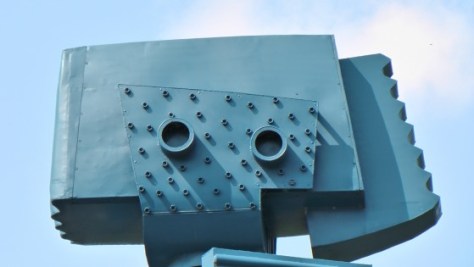
Metro de la Savane

Howdy!

Continuing our inquiry into obscure metro stations…

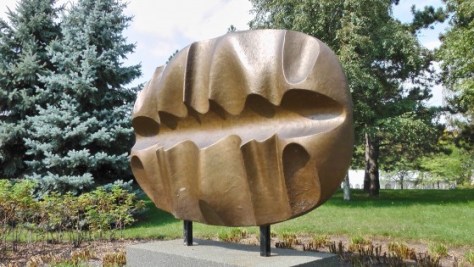
Calcite by Maurice Lemieux

More information on Maurice Lemieux can be found here.

Metro de la Savane (Bougainville side)

The fence reminds me an awful lot of a musical staff and notes.

Metro de la Savane (Bougainville side)

I also find it weird that they thought that this side would be the back, when in fact it is the main entry path to the station.

Metro de la Savane (Bad landscaping view)
Metro de la Savane (dead tree view)
Metro de la Savane (living tree view)
Metro de la Savane (de Sorel & Decarie)
Metro de la Savane (Bougainville and de Sorel)
Metro de la Savane
Metro de la Savane

Opened in January 1984, is was designed by Guy de Varennes and Almas Mathieu. Guy de Varennes appears to have built a bunch of things in Haiti. While Almas Mathieu did a bunch of churches, schools and hospitals here in Quebec.

Continue reading Metro de la Savane

Fountains in Verdun and Park Jean Drapeau

Howdy!

At the Mairie d’arrondissement de Verdun, I don’t know when it was made, nor who made it, but as far as I can tell, it is the only fountain in all of Verdun.

And this too, is a fountain that I don’t know very much about. Although given its location, I would presume that it was made in 1966 or so.


+This is the 15th in an occasional series of videos on the fountains of Montreal+

Montreal en Paysages by Philippe Poullaouec-Gonidec and Sylvain Paquette

Howdy!

This one has been sitting on various flat surfaces of my apartment and hanging out in my knapsack since last April. I really have to learn to avoid academic treatises in French, but somehow like crack I seem to be addicted to them.

I don’t remember exactly where and when I first heard about Montreal en Paysages by Philippe Poullaouec-Gonidec and Sylvain Paquette, but initially, I thought it was going to be like some sort of bound version of a Flickr Group. You know kind of like any one of these: the It can’t be more Montreal than this pool, the Montreal pool, the Montreal Daily pool, the Montreal Street Photography pool, the Montreal street photography (Revisited) pool, the Montreal Street Art / Art Urbain de Montréal pool, the Montreal ! Group pool and/or the Guess Where in Montréal? pool.

You know some sort of fancy-ass picture book, slash, coffee table book that by merely being in the same room as you makes your IQ 20 points higher and makes you incredibly irresistible to other human beings.

But not quite, actually, not even close. In short, as you might have guessed from my first sentence, it is an academic treatise written in French on how to evaluate, quantify and qualify urban landscapes, with, what I would guess you could call, a focus on Montreal. Which is a pity, because it could have been something so much more, so much enjoyable and much less dry.

I don’t know how it is that I am consistently drawn to these sort of books. I actually try to foster a perception of myself as a rather pig-headed, unilingual, American who is only interested in fast cars and beer. In order to surprise people when the conversation turns to something else, such as the music of Eliot Carter or the nose on a Pinot Noir. But I am always undermining myself, similar in a fashion to one of those people who always gets involved with someone from the wrong side of the tracks.

Does anyone know is there is a local chapter AFBRA? Academic French Book Readers Anonymous? A 12 step program designed to stop me cold turkey. Something with a buddy system, so that when I get the urge to read something like Artur ?mijewski. Scénarios de dissidence, I can call someone who can talk me out of it. Prevent me from having to slog through 150 pages of a multi-syllabic discourse designed in such a way as to be either pedantic or didactic or even worse, both. I could save myself so much trouble.

But enough about my wishes. What about the book? Well first off, on a purely physical level it is 8¼” x 9¾” x ½”. It weighs 35.2 oz and the front cover is a pale green veering towards an aqua/teal side with read and beige highlights.

The cover of Montréal en paysages by Philippe Poullaouec-Gonidec et Sylvain Paquette
Montréal en paysages by Philippe Poullaouec-Gonidec et Sylvain Paquette

But enough about the outside, as everyone knows, you can’t judge a book by it’s cover.

But sometimes most of the time it is comforting to know what a book looks like and feels before reading it.

…un premier chapitre dresse un aperçu des principaux défis et enjeux de développement des villes en début de XXIe siècle… Le second chapitre précise, dans un langage simple et concis, les principales définitions, les divers intérêts et les arguments de pertinence qui soutiennent notre démarche… Le troisième chapitre évoque la diversité des charactères et des particularités qui marquent les paysages et les cadres de vie montréalais. Le quatrième chapitre cherche a rendre compte et a illustrer concrètement la nature des multiples enjeux et valeurs associes aux territoires urbains a partir d’une perspective sociale et culturelle. Le cinquième chapitre constitue le coeur de l’ouvrage. Il décrit de manière détaillée et a l’aide de nombreux exemples les différentes étapes du processus de gestions des paysages propose. Enfin, le dernier chapitre illustre un série de possibilités d’actions paysagères susceptibles de répondre aux enjeux déclares sur le territoire montréalais.

Fortunately, Like any good academic tome, they do state quite clearly at the beginning (in this case page 15) what they plan on doing.

For the blokes in the house, a translation via Google:

… a first chapter provides an overview of the key challenges and issues of urban development in the early twenty-first century … The second chapter outlines, in simple and concise, the main definitions, the various interests and relevant arguments that support our approach … The third chapter discusses the variety of characters and characteristics that mark the landscapes and places to live in Montreal. The fourth chapter seeks to realize in practice and illustrate the nature of the multiple issues and values ??associated with urban areas starting from a social and cultural perspective. The fifth chapter is the heart of the book. It describes in detail and with numerous examples the various stages of landscape management offers. The final chapter illustrates a series of possible actions that address the landscape issues stated in the Montreal area.

From the top it all sounds hunky-dory. But then things slowly start to go to hell in a hand-basket. On page 33, they state that Montreal is the “2e ville froncophone du monde.” Or in the language of the Queen the second largest French speaking city in the world. Now I’m never quite certain what to do with books that have egregious errors in them. or at least mistakes that are large enough for me to catch. On one hand I can take the side that “they were busy,” “the fact-checker was sick that day,” or “oops! It was a typo” and gloss over it. Or I can think that “ok, there’s this glaring error, so how many other less obvious mistakes are there, that I am not catching?” And this one left me torn. Montreal hasn’t been the 2nd largest French speaking city since the 1970s.

There’s this city called Kinshasa, in the Democratic Republic of the Congo which just so happens to have a population of more than 10 million people, which is just a little bit more than the 3 million plus that live in and around Montreal. Granted it’s presented in a table which might have just been copied from someplace else (oops! In that case it’s plagiarism) which can mean that the information in it isn’t the most important.

But then I came across some other small mistakes, errors or glitches in other places in the book, such as their examples of types of landscapes on pages 93 to 97 which if they had chosen different photographs would have changed the perspective 180 degrees.

For example they say that Villeray-Saint-Michel-Parc-Extension is a dense place and illustrate their point with a picture of some duplexes. But if they had used this picture
Une ruelle de Villeray
Or a picture taken in Parc-du-Boise-de-Saint-Sulpice they would have been able to prove the exact opposite.

Or their point that Rivière-des-Prairies-Pointe-aux-Trembles is unconcentrated. But if they had chosen to use this picture
tours d'habitation Gouin est 090323
It looks even denser than some parts of the downtown core.

Or the picture on pages 160 and 162 which is labelled as being from souvenir shop in Old Montreal but in fact is taken in this store at 3445 Saint Laurent.

When there are footnotes and a bibliography, things like this make me think that someone wasn’t doing their homework. Not that I’m saying anything, just saying, you know?

By the pivotal fifth chapter, where they pretty much pull out every darn method of analyzing (or what seems like every darn method of analyzing) a city and its cityscapes my eyes just about rolled completely backwards in my head. Everything seems very tautological, kind of just running around in circles not really saying much.

In theory, this is a great book, using Montreal as an example of how to qualify and quantify what should be considered significant and worthy within the context of a contemporary urban environment, however in practice it gets bogged down by way too much baggage coming from trying to be completely inclusive.

But in practice it’ll serve me much better as a constant reminder that I should run as fast and as far away as possible from any and all academic treatises written in the language of Moliere. Especially since it appears to have increased 100% in value since it was published, someone in France is trying to sell a copy for more than €80!

Obviously, as a caveat, if you happen to be a French academician, your views and mine are likely to differ greatly. While you might miss, or gloss over some of the mistakes, the bibliography looks really sexy and there is a hope that you might actually be able to enjoy it. If you’d like to hear M. Poullaouec-Gonidec and M. Paquette discuss their book, they were interviewed on Radio-Canada back in April and acquit themselves admirably.

Me, I’m going to try to read only murder mysteries from now on…

Laurie Anderson performs Delusion at Usine C

Howdy!

On Tuesday night I went to Usine C to see Laurie Anderson perform Delusion. It occurred to me as I was heading over there that I had never seen a bad performance at Usine C. Although afterward I realized that in fact while most of the shows I have seen at Usine C have been amazing, there have been some clunkers, not many, but some.

The reason I bring this up, is that I’ve never really been a big fan of Laurie Anderson. I saw her perform once in the 1980s and it didn’t really impress me. So I was kind of hoping that the venue would have a strong influence on her, or on my impression of her performance.

Unfortunately whatever power Usine C had previously had over performances there, wasn’t working on Tuesday. In a nutshell Ms. Anderson told some stories that wandered all over the place while a bunch of videos played around (and once on) her. Occasionally picked up her fiddle and sawed away at it aimlessly.

When I was transcribing my notes, I was very surprised to discover that for the most part I had not written down anything about the actual content of her stories. I had notes about the stage (16 lights scattered about) notes about the videos (looks like Kentridge) notes to myself (don’t forget to buy milk) but not an awful lot on what she said.

And two days after seeing her, I don’t really remember much either. You could make the point that the ephemerality was intentional, but on the other hand you could also make the point that she was just making a lot of hot air move through space. If there was some unifying theme to what she said, I would have to venture a guess that it was about mortality.
Somewhere at the beginning she quotes from the sermon in Moby Dick: “for what is man that he should live out the lifetime of his God?” Although the whole quote is

O Father!- chiefly known to me by Thy rod- mortal or immortal, here I die. I have striven to be Thine, more than to be this world’s, or mine own. Yet this is nothing: I leave eternity to Thee; for what is man that he should live out the lifetime of his God?

And then somewhere towards the end she talks about three types of dying where she quotes David Eagleman: “you die three times, once when your heart stops, again when your body is buried or cremated, and then the last time someone says your name.

In between there’s some Nikolai Fyodorovich Fyodorov, some Halldór Laxness and some Søren Kierkegaard. (Thank god for wikipedia, doing research for this review wasn’t easy!)

Contrary to what was written in the Gazette, there were French surtitles. I found this very strange. Ms. Anderson obviously pays particular attention to her phrasing, breath and the timing of her speeches. By using the surtitles it was possible to read what she was saying before she said it, which ended up lessening the impact of what she said. While I have never gone karaoking, I seem to remember reading or hearing somewhere that there are karaoke machines that time the display of the words, or maybe I just dreamed it, but I definitely think that Ms. Anderson should invest in one of those machines for the next time she decides to use surtitles.

At one point she starts to recite “Twinkle, Twinkle, Little Star” and whomever did the translating of her text wasn’t completely bilingual, because they ended up translating it literally.

Scintiller, Scintiller, petite étoile,
Comment je me demande ce que vous êtes.
Au-dessus du monde si haut,
Comme un diamant dans le ciel.

Instead of using the proper French nursery rhyme

Ah ! vous dirai-je, maman,
Ce qui cause mon tourment ?
Depuis que j’ai vu Clitandre,
Me regarder d’un air tendre ;
Mon cœur dit à chaque instant :
« Peut-on vivre sans amant ? »

What can I say about the videos? There were leaves, lots of leaves. Someone taking pictures of a body on the floor (I wrote a note asking if the woman with her back to the camera was Ms. Anderson), a dog’s eye view of a field gone to seed (which enabled me to discover that in fact dogs are not colorblind). The aforementioned animated videos that copped from William Kentridge and some footage from NASA that might have been the Moon, or perhaps Mars, I’m not sure which as I have never visited either. For the most part they did not serve to move the narrative forward, nor was I able to really make any direct connection between the video and the narration (except perhaps for the one of the body on the floor).

I was quite struck by one of the videos which was a simple loop (I think all of them were looped) of a pane of glass with drips of water running down. Just like the windshield of a parked car during a light rain or drizzle. I might have to go and make something like that myself.

At this point I should probably mention something about the music. Ms. Anderson played an electric fiddle. And sometimes pitch shifted her voice. But this review is veering dangerously close to becoming a Laurie Anderson performance, winding all over the place, not really saying anything and feeling self-important, so I should probably wrap it up fairly quickly. Thankfully someone snuck a video camera into a performance she gave in Israel, while it isn’t the same as being there. It can give you a fairly reasonable idea of what the show was like.

Me, I’m just very happy that I didn’t fork out for a plane ticket to see it during the Olympics.

Baron de Hirsch Cemetery

Howdy!

Last month I did some wandering around Baron de Hirsch Cemetery. It’s not a place I get to frequently, and while wandering around sort of realized I have no clue about any funeral traditions, Jewish or otherwise. While there, I discovered that Danny Kucharsky had written a book about the Baron de Hirsch Cemetery a couple of years ago. No matter how hard I try, I can’t really seem to get excited about it…

The Baron de Hirsch Cemetery
Unmarked Children's Graves at The Baron de Hirsch Cemetery
An Unmarked Child's Grave at The Baron de Hirsch Cemetery
Unmarked Children's Graves at The Baron de Hirsch Cemetery
An Unmarked Child's Grave at The Baron de Hirsch Cemetery
Unmarked Children's Graves at The Baron de Hirsch Cemetery
Joe Davis' monument at The Baron de Hirsch Cemetery

Continue reading Baron de Hirsch Cemetery

Babel (Words) by Sidi Larbi Cherkaoui, Damien Jalet and Antony Gormley – Eastman VZW

Howdy!

From Genesis 11:1-9,

1 And the whole earth was of one language, and of one speech. 2 And it came to pass, as they journeyed from the east, that they found a plain in the land of Shinar; and they dwelt there. 3 And they said one to another, Go to, let us make brick, and burn them thoroughly. And they had brick for stone, and slime had they for mortar. 4 And they said, Go to, let us build us a city and a tower, whose top may reach unto heaven; and let us make us a name, lest we be scattered abroad upon the face of the whole earth. 5 And the Lord came down to see the city and the tower, which the children built. 6 And the Lord said, Behold, the people is one, and they have all one language; and this they begin to do; and now nothing will be restrained from them, which they have imagined to do. 7 Go to, let us go down, and there confound their language, that they may not understand one another’s speech. 8 So the Lord scattered them abroad from thence upon the face of all the earth: and they left off to build the city. 9 Therefore is the name of it called Babel; because the Lord did there confound the language of all the earth: and from thence did the Lord scatter them abroad upon the face of all the earth.

For better or worse, Sidi Larbi Cherkaoui, Damien Jalet and Antony Gormley didn’t quite follow that script. Instead they kind of use it as a launching pad for their production.

Mostly dance, but not all dance, it comes across as a highly charged and extremely political piece of performance art. Personally, I’m not so certain that the politics and the non-dance parts needed so much time, but as you might have expected, no one asked me.

But let me back up a little. The show is performed by 12 dancers, one actor and five musicians (who also do some acting). They do about 30 separate vignettes that are held together by the five, large, box-like, aluminum, (or at least I presume that they are made out of aluminum, since they are moved around an awful lot) structures that are used as scenery and props during the show.

It starts off with everyone marking out their space, turns into a lecture about real estate, some people start manipulating others like puppets, they build a skyscraper, board a plane, get into arguments, and apologize among other things. This is the video that was published on YouTube last February as a promo for the show:

And this is the video that was published on YouTube last June as a promo for the show.

There are some bits in the February video that were not performed when I saw it on Friday, and everything I saw on Friday is not represented in the June video, but you get the picture. In short (and extremely simplistically as well) it’s a plea for us to all get along despite our differences. Kind of like the song by War from 1975.

The first thing that struck me about the dancers (Navala Chaudhari, Francis Ducharme, Darryl E. Woods, Damien Fournier, Ben Fury, Paea Leach, Christine Leboutte, Ulrika Kinn Svensson, Kazutomi Kozuki, Sandra Delgadillo Porcel, Leif Federico Firnhaber, Mohamed Toukabri and Paul Zivkovich) was how tight they were. Everyone hit their marks at the same time and in a troupe that large, mainly composed of independent performers, it is quite the feat.

Although I don’t know if in fact I saw Moya Michael, Helder Seabra, Jon Filip Fahlstrom and James O’Hara in place of, or as well as the fine folks above, because in my program their names only appear in parenthesis and there was no mention if they were only there as injury replacements (as you can see the piece is extremely physical) or if they were there as alternate performers. I’m not certain I like this move towards nameless performers where the directors, choreographers and all the other folk who do not appear on stage get the glory. Especially for a performance where there are very specific characters. But I digress.

The second thing that struck me was how painful and superfluous the lectures by Mr. Woods were in comparison. Not to slight his performance – in actual fact, his performance of them was spectacular. But if you stick the words “Sidi Larbi Cherkaoui” into Google, the first things that come up talk about dance and choreography. Not writing, not comedy, not theater. And while I do recognize that just because someone in very good in one thing does not preclude them from being very good at something else, M. Cherkaoui is most definitely not a comic, nor is he a comic writer. And I don’t think M. Jalet is either. So I don’t understand why they chose to stick in an attempt a comic theater in the middle of their very impressive dance performance. It just doesn’t make sense. And come to think of it, I doubt that either one of them spoke English as a mother-tongue, although that would not necessarily disqualify him (them?) from writing kick-ass stuff in English, just make it tougher. Heck there are some times I can’t write English to save my life.

However once you start to think about the concept and the ideas behind Babel (words), it strikes me (and perhaps you as well) that M. Cherkaoui and M. Jaret might have decided to sacrifice some dance in order to get their point across. But it’s just like like eating a whole big bag of potato chips before dinner. There’s only so much you can consume, and no matter what you think, the potato chips are not going to be as tasty and delicious as a good dinner. There’s only so much time for a performance at Place des Arts before the unions require time-and-a-half and that and the other costs end up making a ticket unaffordable. No matter what you think, the spoken word part of a dance show is not going to be as visually spectacular and breathtaking as the dance itself.

Because as M. Cherkaoui states on his website: “Equality between individuals, cultures, languages and means of expression” are something that is very important to him. And my guess is that despite the eclectic backgrounds of all the dancers, actually choreographing 12 different types of dance styles (one for each dancer) so that they can be identified by the way that they dance, isn’t quite as easy as it sounds. As a consequence, falling back on the actual languages and religions that the dancers know and either practice, or were born into is a nice and easy safety net to get the point across.

As you might guess, I wish that there had been more dance. By my notes there were four (maybe five) vignettes (tableaus, scenes, whatever) that absolutely made my head explode (in a good way). The opening with the hands, the fight right after that, the second hip hop solo (I unfortunately did not note when the first hip hop solo was, and it is quite possible that it impressed me as well, but that I just didn’t write it down) and what I called “the chainsaw” which was another group number towards the end, which started out with the dancers appearing to pretend to start a chainsaw. Beyond that there was an awful lot of chanting, some comic lectures, some comedic dance bits, and then the one bit that wasn’t dance, but was spectacular. The building of the skyscraper – which is movement, just movement of objects not of a body. But yes, it was quite cool seeing them build the structure. And movement in certain circumstances can be considered dance.

Speaking of bodies, using my best Google-Fu I was unable to come up with pictures or other things that would have enabled me to identify Damien Fournier, Sandra Delgadillo Porcel, Mohamed Toukabri, Paul Zivkovich, Moya Michael, Helder Seabra, Jon Filip Fahlstrom and James O’Hara. And while I could guess as to who did what, I am loathe to be wrong on something like that, because if I was it would undermine everything else I wrote. So I’ll leave it as a polite request to whomever creates the programs for Danse Danse; would it be possible to get pictures in future programs? Please and thanks.

But that does mean I was able to identify the nine other performers. Woo-Hoo! Paea Leach, despite not having a completely identifiable character, was very impressive as a dancer. You can get an idea of how she moves here (unfortunately, she won’t let me embed the video here, pity). I can’t quite put my thumb on the reason why, but she moved with a certain authority, and about halfway through the performance I realized that in the group pieces my eyes had been watching her more than not. So I can only presume that I was either completely and totally smitten with her like a 16 year-old schoolboy, or that she is a kick-ass dancer. Given that I have absolutely no desire to be, let alone act like a 16 year-old schoolboy, I go with the later.

Ulrika Kinn Svensson was at the opposite end of the spectrum. Her character was completely and thoroughly identifiable. Wearing what appeared to be at least eight inch platform shoes that made her tower over everyone. To which was added shiny black plastic (or patent leather) boots that came halfway up her thighs she was hard to miss. Depending on what “scene” you’re watching, she functions as a sex-kitten, narrator, tour guide or gate. But what left me slack-jawed was that even though she was in a pair of boots that would have made Kiss or Funkadelic proud she was able to dance as well.

Christine Leboutte also had an easily identifiable character, the washerwoman. Although I have no clue as to why there was a washerwoman. She’s got a great voice (if I remember correctly, when I was searching about for information about her, some website mentioned that she taught Damien Jalet how to sing).

One other thing that impressed me with the piece was how M. Cherkaoui and M. Jalet had choreographed what I call “girl lifts.” Or in other words women lifting other dancers. For most of time immemorial, the chicks have been lifted up and the guys have done the lifting. I think the first time I saw a woman lift another dancer it might have been Louise Lecavalier, but I don’t know for certain. Anyhows it has taken over 25 years for it to get closer to the mainstream, Navala Chaudhari did them on admirably on Friday night.

Then also going by my sketchy memory, I think it was Ben Fury and Leif Federico Firnhaber (that’s almost as good a name as Juan Tyrone Eichelberger) who did the aforementioned hip hop solos.

Which only leaves me Francis Ducharme and Kazutomi Kozuki as dancers who I was able to identify and therefore need to be mentioned. Unfortunately the things about their characters that stand out to me most are the comedic bits, that while memorable didn’t really strike me as particularly good. M. Ducharme, as the hometown boy, could do no wrong, and had everyone rolling in the aisles with laughter during his caveman routine. Kozuki-san also worked as a foil to Kazunari Abe (or Shogo Yoshii) in the parts that required some really fast Japanese to be spoken.

In the videos, I’m certain that you can catch more than glimpses of them and decide for yourself if you like the way that they dance.

Babel (words) is now the second piece I’ve seen that was choreographed by M. Cherkaoui and this one didn’t leave me as angry as the first one, and it is quite easy to see how and why everyone thinks he is such a wonderful and amazing choreographer. I only wish that he would stick to choreographing. Because his attempts at comedy and proselytizing fall incredibly short in comparison.

And then the final video version of Babel (words) from about July of this year…

BABEL (words) (long trailer) 2010 from Damien Jalet on Vimeo.

Armand Vaillancourt at the Galerie Lounge TD

Howdy!

Last week I went to see the Armand Vaillancourt exhibit at the Galerie Lounge TD in the Maison du Festival Rio Tinto Alcan. Off the top; I think that M. Vaillancourt is the bomb. Kick-Ass. About as close to godlike status you can get when you’re agnostic, atheistic or just can’t be bothered. So as advance warning, it is not likely that I am going to be objective.

The first thing that surprised me was that I wasn’t the only person in the gallery. I had heard that there had been some sort of peinture-en-direct event the week previous and figured that the folks behind the Jazz Festival, the Francofolies, the Hydro-Quebec festival of electricity (now that I write that name in jest, why hasn’t any Jewish, Hindu or Persian organization raised a fuss about Spectra completely co-opting Hanukah, Diwali and Chaharshanbe Suri? – For the agnostics, atheists and folk who just can’t be bothered in the house, Hanukah, Diwali and Chaharshanbe Suri some fairly heavy duty religious holidays that are also known as Festival of Light. The Spectra folk do this thing called the “Festival en lumiere” in order to rationalize how much money Hydro-Quebec gives them, that happens in February. Not that I’m saying anything. But just saying…

But I digress. Apologies. As I was saying, I completely and utterly expected to be the only person in the room, seeing as there hadn’t been any advertising that I had seen talking about how this was your last chance to see the Armand Vaillancourt exhibit. You know, the kind we’re about to be bombarded with for the Jean-Paul Gaultier show at the MBAM… But I wasn’t. There was actually a healthy crowd. I would venture a guess of about two dozen folk wandered in and around me during the hour that I hung out there. But as long as I’m being the extreme cynic, I’m convinced that all of them, all two dozen were heathen tourists from beyond our borders who wouldn’t know kick-ass art if it hit them in the ass and just were mindlessly following some hack tourist guide book that had taken journalistic shortcuts by republishing press releases issued by Spectra. Or maybe Spectra has started publishing tour guide books. I don’t know, but it was very surprising.

What wasn’t surprising, was that most of the work being exhibited was for sale and at very healthy prices I might add. Unfortunately I didn’t see any red dots signifying works that had sold. But that just might mean that the Spectra folk who are responsible for the gallery don’t know about red dots and how they are used to signify that a particular piece of art has in fact been sold. Although when I inquired at the desk (which thankfully was not staffed by a 20 year-old woman in a black micro mini skirt and 12 inch heels) if there was a list of all the works in the show, I was told that all the information was on the wall tags. Which would lead me to believe that if I had indeed (or one of the tourists) wanted to purchase a piece I would have been given M. Vaillancourt’s telephone number and told to contact him myself. So my best guess would be that a) nothing sold and b) that the Spectra folk don’t know about red dots.

But enough about the organization of the show, what about the art? Well, it was mostly made up of painting and prints. There were a couple of sculptures scattered about the room along with a couple of political pieces as well. The paintings and prints expressing quite clearly that M. Vaillancourt is an amazing sculptor. The political pieces show he has a great sense of humor but is better served earning his living as a sculptor than as a stand up comedian.

Installation view of the Armand Vaillancourt exhibit at the Galerie Lounge TD

There’s not much that can be said about the colorful abstract paintings. Well actually there is an awful lot that can be said about them. Things like the colors, the method of application to the canvas, the density, the patterns that they create and lots more. So if I were to be more precise, there’s not an awful lot that I want to say about the colorful abstract paintings. And even less about the monochromatic abstract prints. They are perfectly suited for hotels, large corporations and benefit auctions, all places where people like having “serious” art but really don’t spend all that much time looking at it and where the name “Armand Vaillancourt” will elicit sage head nodding and depending on what benefit auction or large corporation certain feelings of Quebecois pride.

American Imperialism by Armand Vaillancourt

One look at the political pieces and you get the point. They’re the proverbial one-trick pony. Which depending on your point of view is either exactly how they are supposed to work; get the point across quickly, easily and forcefully. Or their downfall; simplistic, lacking any depth and cartoonish. I tend to think of them as both. Sort of like a three-dimensional editorial cartoon designed to bring attention to some cause through the use of M. Vaillancourt’s name. It would be nice to have shown some of the more obscure causes that M. Vaillancourt supports instead of going for well-known and easy ones. But no one asked me.

Place Publique by Armand Vaillancourt (I think)

Which pretty much leaves us the maquettes or sculptures. There were four of them. If I remember correctly, they were called something like “Place Publique” or something else equally memorable (as an aside I made the complete and utter faux-pas of neither taking notes, nor taking pictures of the wall tags. I was totally unprofessional. Does anybody have a wet noodle handy? And sorry, I promise it won’t happen again.

Place Publique by Armand Vaillancourt (I think)

But now that I have that out of the way, I gotta say that despite the silly cutouts of people from magazines, that they were drop-dead gorgeous and amazing. I, honest to god, caught myself on a couple of times doing one of those reverse whistle intakes of breath and even once letting out a long low whistle. If they hadn’t been playing so much music from the 1980s in the place where I’ve been writing this, I might have even gone so far as to quote the band Berlin.

All but one were on stainless steel bases and used (what I presume) were recycled bits of metal to create forms based on symmetry and repetition. They kind of prove (to me at least) that M. Vaillancourt is a master of the form (or should I write that Master of the Form?) At some point I’m going to have to ask him how he came up with the ideas for them and how difficult it was to make them. From the monochromatic prints it is possible to see how they would lead to the maquettes. And I truly hope that they are indeed maquettes and not fully realized sculptures, because they would be breathtaking if blown up to monument size.

Place Publique by Armand Vaillancourt (I think)

Unfortunately my snapshots don’t do them the justice that they deserve. Some of them were placed directly in front of windows and I haven’t quite figured out what buttons I need to push on my camera when objects that I want to photograph are back lit and I also am not in the habit of carrying around a set of lights with me. Next time, I promise.

Beyond that, there wasn’t much. It kind of left me torn, one one side I really really liked the maquettes or sculptures. On the other side everything else kind of seemed “meh.” And while “I think that M. Vaillancourt is the bomb. Kick-Ass. About as close to godlike status you can get when you’re agnostic, atheistic or just can’t be bothered.” This show did nothing really to support my belief. I dunno, maybe the out and out commercialism in the “Galerie Lounge TD” or the way that everything was set up more as if it was a store than an art gallery had a stronger influence than I would like to admit.

Some Public Art on Île Sainte-Hélène

Howdy!

Earlier this month I was out and about on Île Sainte-Hélène (hence the video of the fountain at the Biosphere…) and while I was there I snapped some shots of some of the non-Calder public art that was there.

Part of the Korean Pavillion from Expo 67

If you want to see what it originally looked like, try this.

Bird Houses on the pond in front of the Biosphere.
Signe Solaire by Jean leFébure

Jean leFébure‘s website is here.

Puerta de la Amistad by Sebastián

Sebastián‘s website is here.

Ville imaginaire by João Charters de Almeida

João Charters de Almeida‘s website is here.

Phare du Cosmos by Yves Trudeau

Yves Trudeau’s wikipedia page is here.

Girafes by Robert Roussil

My new nominee for most obscure piece of public art in Montreal. Not only is it on a part of Île Sainte-Hélène where no one goes, it is half obscured by a bush! Took me over half an hour to find it. Robert Roussil‘s website is here.

Kwakiutl Totem by Tony and Henry Hunt

The Kwakiutl website is here. Tony Hunt‘s website is here. And Henry Hunt’s wikipedia page is here.

Wallace Fountain by Charles-Auguste Lebourg

Initially I was extremely disappointed. I was thinking it would be some grandiose fountain spewing and spouting water all over the place. Then to only find a trickle… But there is this extremely informative article on wikipedia explaining all about Wallace Fountains and their purpose. Charles-Auguste Lebourg’s wikipedia page is here.

L’Arc by Michel de Broin

Michel de Broin‘s website is here.

Sadly, when I was there, Obélisque oblique by Henri-Georges Adam was not viewable due to construction. I couldn’t find Migration by Robert Roussil. The Moai Head was being restored. And Oh Homme by Yvette Bisson was marked on the map, but was nowhere to be found, and does not appear on the website.

I’ve written to the Bureau d’art public asking about the three and as soon as I have any news, I’ll let you know.

Update, September 28: Oh Homme, Obélisque oblique and the Moai Head are all currently being restored. Obélisque oblique will be returned in 2013, the Moai Head within the next year, and it isn’t known when or where Oh Homme will be returned.

De La Rue aux Etoiles – The Burgers

Howdy!

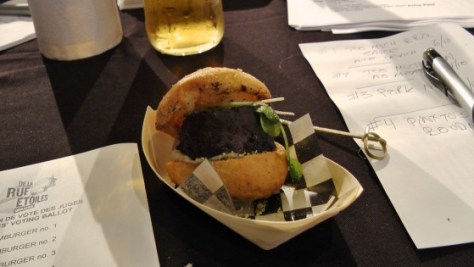
Last night I participated in the Dans La Rue fundraiser, De La Rue aux Etoiles as a judge because they were serving burgers. Or so I was told. In fact it was a phenomenal event, basically a cocktail dinatoire (doesn’t it sound much better in French?) where they served a bunch of appetizers (or as is the current style, tapas) that just so happened to be on a bun.

Thankfully, no one called them sliders. After 10 of them, I was just a tad stuffed.

We (Ryk ‘E Coli’ Edelstein, Jean-Philippe Tastet, Lesley Chesterman and Peter Iliopoulos) were served our burgers without knowing which restaurant made them. Although in certain cases it was fairly easy to identify a certain chef’s handiwork, however in other cases we were completely and utterly wrong.

From Le Boucan: A Jalapeño smoked burger. Stuffed smoked jalapeño wrapped in bacon and served in a bun with homemade condiments
From Barroco; a pork and truffle burger. Braised pork served on a homemade bun, topped with peppercorn pecorino cheese and a truffle and cauliflower remoulade
From Le St-Urbain: An Osso bucco burger. Braised veal shank burger on a smoked duck fat and pecorino bun
From Le grain de sel: A boudin mini-hamburger with banana chutney, aioli, chocolate and ancho chiles
From Pintxo: Foie gras burger
From Bice. Angus beef and mozzarella burger

This was the first ‘real’ burger…

From Chez l'Épicier: A double burger of seasoned duck and foie gras with figs
From Kitchenette: Fried chicken chili cheeseburger

The roasted peppers with cheese were delicious.

Fom Café Ferreira: A spicy three meat burger with Serra cheese on a Portuguese bun
From Le Jolifou: Smoked apple wood salmon with sweet cherry bomb pepper crystals and an aioli chipotle sauce

Ryk ‘E Coli’ Edelstein ended up in knots as his vote was the tie-breaker between Barroco and Ferreira. Le St-Urbain, Kitchenette and Barroco were the top vote getters by the public.