There were a couple of pieces of art that he owned that he had loaned to the Musée des beaux-arts de Montréal, I wonder how long they are going to stick around?
Three Hearts on a Rock by Jim Dine, loaned to the Musée des beaux-arts de Montréal. by Georges MarcianoThree Hearts on a Rock by Jim Dine, loaned to the Musée des beaux-arts de Montréal. by Georges Marciano
And do you think that the bailiffs were stymied by all the construction?
Le tournesol polychrome by Fernand Léger, loaned to the Musée des beaux-arts de Montréal. by Georges MarcianoLe tournesol polychrome by Fernand Léger, loaned to the Musée des beaux-arts de Montréal. by Georges Marciano
And what with all the talk about corruption in Montreal happening these days, I wonder if anyone at city hall or the museum cared that there was a lien on M. Marciano’s property when he proposed lending his property (because before he loaned the statues to the museum, he loaned them to the city first…) My take on the situation back in April 2010 here. Macleans take here.
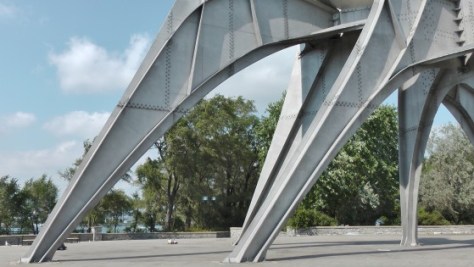
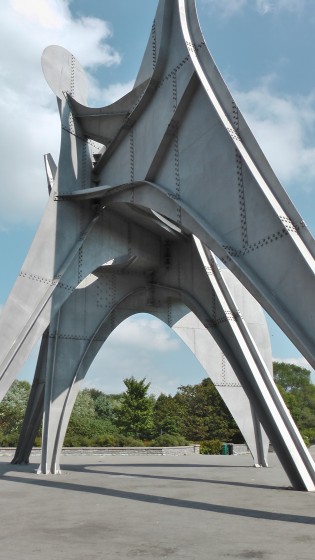
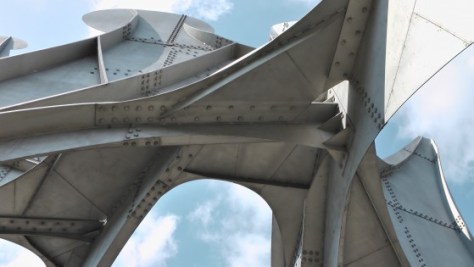
Earlier in the week I went to Île Sainte-Hélène (more on that later) but while I was there I became a picture snapping fool! Besides these, of Alexander Calder’s Man, Three Disks (L’Homme), I also got pictures of most of the other public art and a whole bunch of roses (who would’ve thunk?!?).
Alexander Calder's Man, Three Disks (L’Homme) at Parc Jean Drapeau on Île Sainte-HélèneAlexander Calder's Man, Three Disks (L’Homme) at Parc Jean Drapeau on Île Sainte-HélèneAlexander Calder's Man, Three Disks (L’Homme) at Parc Jean Drapeau on Île Sainte-HélèneAlexander Calder's Man, Three Disks (L’Homme) at Parc Jean Drapeau on Île Sainte-Hélène
Anyhows, Man, Three Disks (L’Homme), by Mr. Calder has got to be one of the more iconic statues, monuments pieces of public art in Montreal. But until earlier this week, I had never seen it, due to its location and the fact that I am not a real big fan of contemporary disco music (actually come to think of it, I’ve never been a fan of contemporary disco music even in the 1970s, 80s, 90s and 00s – I think it takes me about 15 to 20 years or so before I like any dance music. If I remember correctly I didn’t get a copy of Amii Stewart’s Knock on Wood until the late 90s, but I digress).
Alexander Calder's Man, Three Disks (L’Homme) at Parc Jean Drapeau on Île Sainte-HélèneAlexander Calder's Man, Three Disks (L’Homme) at Parc Jean Drapeau on Île Sainte-HélèneAlexander Calder's Man, Three Disks (L’Homme) at Parc Jean Drapeau on Île Sainte-HélèneAlexander Calder's Man, Three Disks (L’Homme) at Parc Jean Drapeau on Île Sainte-Hélène
But as I was saying, Man, Three Disks (L’Homme), by Mr. Calder is a pretty gosh darn impressive piece of work. I’ll leave it to you to do the reading up on it that can be found on the internet (one, two, three). One thing I did not know is that it was moved from its original location in 1991. At some point I’m going to have to go back to Île Sainte-Hélène (for other reasons) and see if I can find where it was originally.
Alexander Calder's Man, Three Disks (L’Homme) at Parc Jean Drapeau on Île Sainte-HélèneAlexander Calder's Man, Three Disks (L’Homme) at Parc Jean Drapeau on Île Sainte-HélèneAlexander Calder's Man, Three Disks (L’Homme) at Parc Jean Drapeau on Île Sainte-HélèneAlexander Calder's Man, Three Disks (L’Homme) at Parc Jean Drapeau on Île Sainte-Hélène
And finally, if you want to see other pictures of it (both in its original location and the new one) try these.
Alexander Calder's Man, Three Disks (L’Homme) at Parc Jean Drapeau on Île Sainte-HélèneAlexander Calder's Man, Three Disks (L’Homme) at Parc Jean Drapeau on Île Sainte-HélèneAlexander Calder's Man, Three Disks (L’Homme) at Parc Jean Drapeau on Île Sainte-HélèneAlexander Calder's Man, Three Disks (L’Homme) at Parc Jean Drapeau on Île Sainte-HélèneAlexander Calder's Man, Three Disks (L’Homme) at Parc Jean Drapeau on Île Sainte-HélèneThe view of Montreal from Alexander Calder's Man, Three Disks (L’Homme) at Parc Jean Drapeau on Île Sainte-Hélène
Turn up the volume and boogie!
The electrical junction box box for le Piknic Electronik
A short and mostly silent viseo I made on the exhibit at the Musée d’art contemporain de Montréal. Déjà, La Grand Déploiement de la Collection was the first time that the permanent collection had been exhibited in all eight galleries of the museum.
Episode 301 [11:30]
Watch
The exhibition ran from May 26 to September 4, 2011 and was curated by Josée Bélisle.
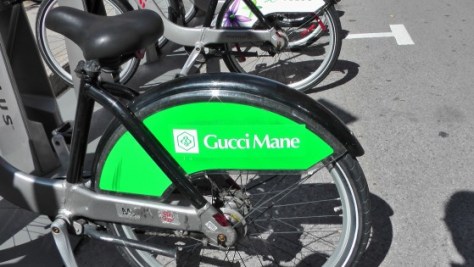
Someone has a really good color matching program and likes hip hop and bixis.
Project Pat on the back of a Bixi.Gucci Mane on the back of a Bixi.Souljah Boy on the back of a Bixi.Wu Tang on the back of a Bixi.Lil B on the back of a Bixi.
Did I miss any? Has anyone seen any others?
Labelle on the back of a Bixi.
OK, I made that one up myself. Labelle is part of the Desjardins advertisement campaign on the back of the bixi bicycles that our hip hop fan is mocking. But they also happen to be one of my mostest favorite bands in the entire know universe.
One of my favorite Montreal sculptures is Comme si le temps… de la rue by Pierre Granche. Unfortunately, in the most recent set of renovations to what used to be the Hall des Pas perdus of Place des Arts, but that they now call Espace culturel Georges-Émile-Lapalme they have just about killed it.
Comme si le temps... de la rue by Pierre Granche
A little background; back in the early 90’s the Musée d’art contemporain de Montréal was planning on moving from Cité du Havre to downtown and getting themselves a brand spanking new building in the process. As the law stipulated, 1% of the project had to be dedicated to creating art. Even if it was a museum they still had to make more art specifically for the place (that’s one of the things I like most in theory about the 1% for art law, is that it ends up creating site specific work).
Anyhows, Pierre Granche [pdf alert] a sculptor and a teacher (he was one of the people responsible for the Universite de Montreal‘s visual arts department – and now that he’s dead, they no longer have one. Make of that what you will…) submitted a proposal and won. (I’m still going to have to try and find out who was one the jury.) And in 1992, what ended up getting built was Comme si le temps… de la rue.
The view from the bar of Comme si le temps... de la rue by Pierre Granche
Basically it was a bunch of aluminum cutouts in a semi circle with a waterfall. It was open to the sky and viewable from the esplanade of Place des Arts, which gave a viewer the chance to have a complete overview of the entire piece (which is not a small piece by any stretch of the imagination). And there is a skylight looking down into the Musée d’art contemporain de Montréal’s restoration workshops.
I never gave it much thought, always figuring that at some time in the future I would hunker down and give it the time, energy and thought that it required.
Well that time is now (actually, Sunday night, as I try to write these posts in advance of posting them). Because I was passing by over the weekend and from where I sit the powers that be (in reality Consortium Menkès, Schooner, Dagenais, Le Tourneux/Provencher, Roy Jean-Pierre Le Tourneux, concepteur Claude Bourbeau, chargé de projet) have completely and thoroughly killed, destroyed, ruined and entirely screwed up Comme si le temps… de la rue [pdf alert] by Pierre Granche.
In short, by placing a roof over it and turning off the waterfall, they have stripped the sculpture of all meaning, significance and comprehensibility. it is now no more than the equivalent of a fancy-ass and extremely expensive indoor lawn ornament for the Deschamps bar at Place des Arts.
Another view from the bar of Comme si le temps... de la rue by Pierre Granche
From the seats at the the Deschamps bar, it is completely and thoroughly impossible to get any perspective on the piece. By being so close to it, you literally can’t see the forest for the trees.
The third view from the bar of Comme si le temps... de la rue by Pierre Granche
The roof of the bar prevents you from seeing the tops of the sculptures. And by being so close you can no longer gain any perspective on the base. And perspective was what Comme si le temps… de la rue was all about. There are two extremely large and two merely large aluminum sculptures that depending on which way you swing could represent either the ancient Egyptian god Sobek, or the ancient Egyptian god Set. There are also a couple of construction cranes, and seven things, that again (depending on which way you swing) could either be some sort of vaguely sphinx-like objects, or if you squint really heard could be viewed as some kind of deer or reindeer-like domesticated animal.
The plaque for Comme si le temps... de la rue by Pierre Granche
My quick and dirty translation of the plaque for the blokes in the house
Pierre Granche’s installation offers a mythical vision of Montreal. Inspired from Greek Theatre and Egyptian iconography, it works a representation of the urban fabric between Mount Royal and the St. Lawrence River through the use of a waterfall. Sculptured female figures used as a columns in an Egyptian style with bird’s heads refer to the history of art and architecture in a totem pole fashion. The sphinxes with deer antlers make their presence known on the outskirts of a city in action. And finally, the bird’s eye view of the work was from the esplanade of Place des Arts Preview, reflects the city as the top of Mont Royal.
OK, how many mistakes can you spot? If I were a tourist wandering through Espace culturel Georges-Émile-Lapalme I’d be scratching my head in wonder, trying to figure out what the heck they were talking about. Waterfall? Bird’s eye view? There ain’t none, no more.
And while I’m at it, there isn’t any Greekness (theatre or iconography or anything else) in the piece. When they are writing in French they use the word cariatides or in squarehead speak: caryatid, or in plain English “a sculpted female figure serving as an architectural support taking the place of a column or a pillar supporting moldings and bands on her head.” (Thanks Wikipedia!) And they speak of it as the parts that are Greek. One problem though, a column by definition supports something. And these objects don’t support a darn thing. Comme si le temps… de la rue is 100% Egyptian in its influences.
A slightly different interior view of Comme si le temps... de la rue by Pierre Granche
And as long as I am disputing the “official” wall plaque. Those aren’t deer antlers on the sphinxes either. I don’t think that there ever was a 37 point buck that ever lived… anywhere.
One of the sphinx-like objects in Comme si le temps... de la rue by Pierre Granche.
However, if you go with the idea that the two extremely large and the two merely large sculptures are representations of the Egyptian god Set, the god of chaos and foreign lands. Then I think we’re getting someplace. The early 1990s in Quebec were a volatile place. Quebec was on the cusp of a referendum to separate, the Bloc Quebecois were founded in 1991. In between 1990 and 1993 there were 46 major buildings built in Montreal. The Montreal Expos were sold in 1991 and subsequently became one of the best teams in major league baseball in the early 1990s. 1992 was also the 375th anniversary of the founding of Montreal. There were a ton of things happening in Montreal at the time and there was most definitely a sense of chaos in the air (if you don’t trust me, ask someone else who lived here then).
Interior view of Comme si le temps... de la rue by Pierre Granche
Also if you look closely, on each of the Sets, there is a cityscape, with some sort of root structure. I’m not quite certain what to make of the root structures. But if you flip them upside down, they become the deer antlers on the sphinxes. And there are no known instances of deer appearing in ancient Egypt. But maybe, kind of, perhaps it has something to do with some sort of family tree-like structure? I dunno.
But we’re getting off the point here. Comme si le temps… de la rue is all about Montreal. There’s a representation of the mountain on the largest Set, and the waterfall was a direct reference to the river.
Detail of Comme si le temps... de la rue by Pierre Granche showing the mountain on Set's head.Detail of Comme si le temps... de la rue by Pierre Granche showing the (now dry) waterfallDetail of Comme si le temps... de la rue by Pierre Granche showing the drain
And while we’re showing lots of pictures, here are some of it from above.
As you approach to view of Comme si le temps... de la rue by Pierre GrancheA horrible view of Comme si le temps... de la rue by Pierre GrancheStill another horrible view of Comme si le temps... de la rue by Pierre Granche
And then in consideration of the unilingual people in the house, Comme si le temps… de la rue translates as “As if time… from the street.” You can fill in the blank yourself, but by referring back to ancient Egyptian times Granche endows Montreal with a similar sense of history. Despite it being made when Montreal was only 350 years-old, if you squint hard enough (or maybe click your heels three times or go to the Neighborhood of Make-Believe) you can pretend that Montreal has been around for more than 5,000 years, just like Egypt.
Then my last question is, if it was made for the construction of the Musée d’art contemporain de Montréal and is directly on top of their restoration workshops, why does it belong to the Place des Arts collection? Shouldn’t it belong to the Musée d’art contemporain de Montréal?
About a week and a half ago I went uptown to see this show. Last week it got this review.
While I was there, I took these pictures.
The Fruit Cellar of Miss H. by Thea HainesCollaborating with her Story Incarnation II by Vanessa YanowCollaborating with her Story Incarnation III by Vanessa YanowStand in for Home by Amanda McCavourStand in for Home by Amanda McCavourSome Good (That Did) by Suzen GreenCrochet?, Dropstich, Antiquated Notions by Lizz AstonRobsart by Jennifer Smith-WindsorTears Have Been Shed by Jennifer Smith-Windsor
And a video
My only complaint would be that the shows at Studio Beluga aren’t up long enough.