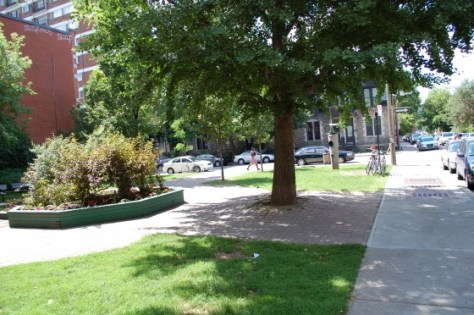
Yes, I know it sounds like a strange request, but Denys Arcand is getting up there in years – he just turned 71 years-old. I bring it up, because one of my favorite places in the city is Parc Claude-Jutra at the corner of Clark and Prince Arthur where there is a Charles Daudelin statue memorializing Claude Jutra, who died in 1986 at the age of 56.
Parc Claude-Jutra, Clark and Prince-Arthur
Both the park and the statue are stately and elegant, comfortable and very well planned and made.
Hommage à Claude Jutra, by Charles Daudelin at Parc Claude-Jutra, Clark and Prince-ArthurHommage à Claude Jutra, by Charles Daudelin at Parc Claude-Jutra, Clark and Prince-ArthurHommage à Claude Jutra, by Charles Daudelin at Parc Claude-Jutra, Clark and Prince-ArthurParc Claude-Jutra, Clark and Prince-ArthurParc Claude-Jutra, Clark and Prince-ArthurParc Claude-Jutra, Clark and Prince-ArthurParc Claude-Jutra, Clark and Prince-ArthurParc Claude-Jutra, Clark and Prince-Arthur
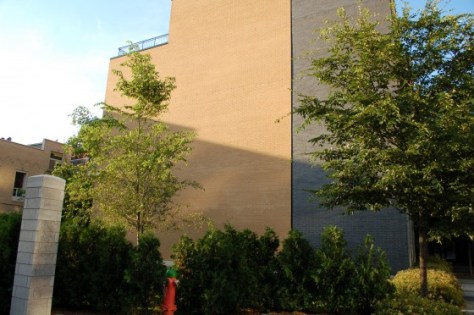
I bring up M. Arcand’s mortality, because I just discovered something called Place Gilles Carle. According to Google, a six minute walk from Parc Claude-Jutra. As you might have suspected M. Carle was also a noted Quebecois cineaste who died at the age of 81. M. Arcand is next in line as amazing, highly respected and extremely influential Quebecois directors. Well anyhows, Place Gilles Carle is a horrible little thing.
All bricks and no movement, nothing green six spindly and scrawny trees that don’t look like they will survive another winter, not a single living soul anywhere, it is obvious that whomever is designing public places to honor recently dead Quebecois filmmakers doesn’t have a clue as to what they are doing. So as a consequence I respectfully ask that M. Arcand stay alive a little bit longer (and so that no one gets the wrong idea, I don’t think he sick or anything, just getting up there in age) in order that someone else can design Square Denys Arcand and not whomever is responsible for the travesty that is Place Gilles Carle.
Place Gilles Carle, at the bottom of Henri Julien just off of Square Saint LouisPlace Gilles Carle, at the bottom of Henri Julien just off of Square Saint LouisPlace Gilles Carle, at the bottom of Henri Julien just off of Square Saint LouisPlace Gilles Carle, at the bottom of Henri Julien just off of Square Saint LouisPlace Gilles Carle, at the bottom of Henri Julien just off of Square Saint LouisPlace Gilles Carle, at the bottom of Henri Julien just off of Square Saint LouisPlace Gilles Carle, at the bottom of Henri Julien just off of Square Saint LouisPlace Gilles Carle, at the bottom of Henri Julien just off of Square Saint LouisPlace Gilles Carle, at the bottom of Henri Julien just off of Square Saint LouisPlace Gilles Carle, at the bottom of Henri Julien just off of Square Saint LouisPlace Gilles Carle, at the bottom of Henri Julien just off of Square Saint Louis
Vanity Fair has published an article, a photo essay and a video on some contemporary artists who have something of a presence in Marfa, TX. All in the name of modern journalism. Since they are about as close as I am ever likely to get to Marfa, I figured they were worth noting.
The film is called: Divine Horsemen: The Living Gods of Haiti, not The Voodoo Gods of Haiti (and after reading a little about Maya Deren, it looks like it could be a very interesting film). He then proceeds to spell David Michael Levin‘s name wrong, and finally he obviously hasn’t spent all that much time around street artists, because graffiti is anything but spontaneous. When was the last time you “just happened” to be carrying some cans of spray paint around “in case” you suddenly had the urge to be artistic in public?
But despite all the excess baggage and nonsense that he adds to the show, Ms. Zugler’s work is up to the task and came through with shining colors. (The show itself was on exhibit at the McClure Gallery from June 1 to 23, this year). If you ‘d like to see some of her work, she is currently exhibiting at the Eleanor London Côte Saint-Luc Public Library.
Installation view of Vrtlar by Mirana Zuger at the McClure Gallery, showing Fooling and Hibou.
Her name blipped on my radar when I was doing some research on Coriolis by Maskull Lasserre. She took some of the pictures to document the making of Coriolis, and something clicked when I saw her name come up as exhibiting at the McClure. Thankfully I was able to get over there slightly more than a week before the show closed. It consisted of ten paintings of various sizes and one small sculpture, the pieces had titles like Beet Root, Betty, and Hibou, or in simpler language, not exactly the most helpful in trying to decipher her paintings. There was one called The Tough Guy and the Texan which at least gave me a leg up on trying to figure out something.
The idea that Mr. Campbell would then go as far as to add another thick and very opaque layer between a viewer and the paintings just made me see something that resembled Zelena. I much preferred the piece written by Françoise Sullivan at the back of the catalogue. Simple, direct and to the point. It made it clear that Ms. Zuger is an abstract painter in the grand old tradition of the Automatistes. While she does guidelines and a framework for painting what she paints, it is at the opposite end of the scale when compared to someone like say, a Guido Molinari or a Claude Tousignant. Not quite spilling and brushing the paint any which way but loose, but close.
Precipitation by Mirana Zuger
There are some of her paintings that kind of remind me of something that Mark Rothko could have made, others remind me a little bit of the work of Leopold Plotek. There was one painting done on paper and another small bronze sculpture, Baseline and Wish respectively. Had I been asked, I would have suggested that they be left out of the exhibit in place of two other paintings. Back when I had Zeke’s Gallery, I would try to keep the shows as focused as possible. I would mention to the artists that when they were 80 years-old, it would be fine and dandy to have a retrospective that incorporated painting, sculpture, drawing, video any gosh darn thing that they pleased. But at the beginning of a career it is extremely helpful to present a fairly uniform body of work. I imagine it is part of the reason Paul McCartney and Elvis Costello did not compose classical music until they had already established themselves. Why Elvis Presley did not record Gospel music until his name (and voice) had been firmly established.
Baseline and Wish make it obvious that Ms. Zuger can and does work using lots of different materials, I can’t help but think that being able to see two other paintings would have helped enormously in furthering the understanding and comprehension of her work. And besides when you’re dealing with abstract paintings that large, things can get pretty hairy and fairly powerful – when they’re done up right, it kind of feels like how I would imagine being in the eye of a hurricane would feel. By exhibiting the sculpture and paper, it brings down the intensity to something more akin to a really strong thunderstorm.
Installation view of Vrtlar by Mirana Zuger at the McClure Gallery, showing Zelena and Baseline
One other nit picky point, some of the paintings are labelled as being on “rabbit skin sized canvas.” Being the hardheaded blowhard and duffer that I am, I was initially going to call her on what I thought was a large bluff. Not even if I skinned Harvey would I be able to get a canvas that was five feet by six feet. Besides while bunnies are delicious, I can’t quite believe that leather made from their skin would make for a great object to paint on. But thankfully I went to her website, and things became clearer. She uses something called “Rabbit Skin Glue” to do something similar to priming her canvases. Sizing being something you do to protect and glaze a piece of paper or textile.
Installation view of Vrtlar by Mirana Zuger at the McClure Gallery
I can only guess at why Ms. Zuger decided to call the show Gardener (in Serbo-Croat). There is obviously some sort of connection to her culture (if I remember correctly, her grandfather came to Canada from Yugoslavia, back when it was still called Yugoslavia) but whether she thinks that the painting Vrtlar was the best one in the exhibit and therefore worthy of naming the whole show, or it has something to do with the bright colors reminding Ms. Zuger of flowers, or the care and work she took in making the various paintings was similar to that which she would have done in creating a garden, or something completely different I have no idea. Nor does it really matter, because as Ms. Sullivan so eloquently writes Ms. Zuger’s “brushwork, her vigorous form and colour come with a sense of renewal, a feeling that it is right.”
RE: I’m-hungry-let’s-go-for-lunch-no-I-don’t-care-where-I-just-want-a-sandwich
maskull lasserre Sun, Jul 29, 2012 at 9:40 PM
To: zeke@zeke.com
Dear Chris,
I must admit that I am seldom moved to respond to the types of postings that appear on your blog, but when someone teeters, publicly, so perilously between being misinformed and ignorant, I can’t help but try to right the balance in the public interest, and in so doing give you the benefit of the doubt.
I came upon your piece about Coriolis when I was forwarded your post on Vrtlar, at the McClure Gallery, earlier this summer. I will not be as exhaustive in my redaction (and I apologize for the “fancy-ass” words, but you can look them up here and here) as you were of Mr. Campbell’s text – although you should really have a look to see that he was correct in his reference to the Divine Horsemen: The Voodoo Gods of Haiti, Chelsea House / Delta, 1970. I will, however, suggest the following links to, albeit after the fact, inform you that:
1) Coriolis is in a private collection, and does not belong to Quebecor,
2) the Coriolis effect does register on every falling mass, though measurable more easily on a planetary scale, and
Although these posts are probably more embarrassing to their author than they are to the people they exploit for their petty picking of criticism’s low-hanging fruit and the disingenuous slights that border on adolescent slander, maybe you should stick to writing about sandwiches.
Sincerely,
Maskull Lasserre
The comments about Coriolis are in response to an article I wrote about a month before this one on a piece of art that M. Lasserre made.
Apparently, in the fight for global domination of the beer galaxy, not only are there no Canadian brands in the top fifteen beers sold worldwide, but we aren’t even allowed to purchase 40% of them, with the most egregious being Snow, which is the most popular beer in the world and can’t be bought for love or money north of the 49th.
I almost missed it (Le Devoir is on my regular reading list, but somehow this one slipped through the cracks) but Isabelle Paré writes a lengthy (1,296 words in French, 1,164 in English) preview of the foreigners coming to the Circus Festival currently happening. From what little I’ve been able to gleanCirco Aereo and Cirkus Cirkör look pretty cool as well.
Sometime, somewhere, somehow these pieces of African art got stolen. Once again, it would be nice if the police released some details, and in this particular case, it would be even nicer if they got some of the descriptions right.
Northern Bamana Chi Wara Horizontal Headdressses, Mali
They called it a Cimier Bambara, whatever that is…
One of my favorite galleries is Wilder & Davis Luthiers. Mostly because its primary purpose is not to display art, but to fix and make violins, violas and cellos (and maybe the occasional double bass as well). It’s in a wonderful two story building just down the street from my place. I’m friends with Elizabeth Barbosa who is the director of the space. There’s something extremely comforting and nice about people who know bend and shape exotic wood so that it can sing also like not only having pretty pictures around, but also opening up their place of business so that other people can see them as well. All in my neighborhood as well, what more could you ask for?
Installation view of Judith Klugerman’s work in Présence at Wilder & Davis
In my mind, it’s pretty much a perfect example of how Quebec culture works. Not only making sure it is an integral part of life, but so completely integrated into the fabric of the community that to be without the art life would seem weird. While Wilder & Davis Luthiers aren’t a government run Maison de la Culture, they are the for-profit commercial equivalent, and in certain respects might actually be doing better than any of the Maison de la Culture as they are open 8½ hours/day 6 days/week, which is far more than any MdC.
Installation view of Nicole Doré-Brune’s work in the Violin room at Wilder and Davis.
This particular show is called Présence (it is up on their walls until July 20). Guest curated by Wah Wing Chan it features fourteen different artists all showing work on paper that somehow is an interpretation of the word presence. Kind of a stretch if you ask me, since it is an extremely vague and nebulous concept that could potentially be used on just about any piece of art.
None the less, tossing the title and concept out the window, it also was an opportunity to see some good work, some great work as well as some not so great work (as is the case in just about every group show I’ve ever seen or organized). On the positive side though by viewing art in a real-world situation, such as a working luthier, it enables the art that is not so strong (read as a polite way to say something not so good) to become background and not stick out so much.
Installation view of Jean Fitzgerald’s work in Présence in the Cello room of Wilder and Davis.
On the flip side, seeing good and great art in a real-world situation ends up making it somewhat more difficult to fully appreciate. With all the distractions, it can get a little bit dicey. But invariably great art will win out and win over its surroundings in kind of the same way that the sun always manages to be seen despite any temporary clouds.
There was nothing really earth shattering. As I mentioned, the art ran the gamut from not good to very good. The combination of the instruments and the art had a calming effect, not quite the same as being in a church, but similar. It gave a certain weight to the prints that I don’t think they would have had in say a cafe. A sense of comfort if you will.
Another reason why I’m not all that keen on the concept of the exhibit is that Présence (in French) and Presence (in English) have different meanings. The primary definition in both languages is fairly similar, but once you get below the surface – which, to my understanding is what art is supposed to do – the meanings diverge widely, with the French being much closer to the ideas of church and spirit, and the English sticking to the more concrete. But that all being said, it’s still a good collection of artists in an extremely nice setting that is not your standard issues white cube.