All posts by zeke

Sylvain Émard’s Fragments – Volume 1

Howdy!

Last Friday I finally got around to seeing Fragments – Volume 1 choreographed by Sylvain Emard and danced by Monique Miller, Laurence Ramsay, Manuel Roque and Catherine Viau. I’m kind of glad I did, not because the dance was mind blowingly phenomenal (it wasn’t, although there were parts that kicked-ass) but because it kind of gave me some insight (or what I think is some sort of insight) into the inner workings of quote; high Quebecois Culture, unquote.

But first things first, the dances. In short, it’s fragmented, as you might suspect. If you don’t know the dancers personally, you gotta take the press release at face value (always a dangerous proposition) that it was inspired by the personalities and concerns of the performers. Catherine Viau one of the dancers (and to quote from my notes: “she is very very good”) kept some of her own notes as to how things went during practices (one, two, three and four) with nary a word about how it connects to her personally, which is not to say that it doesn’t, ‘cuz I don’t know her at all, just traded emails a couple of years ago, but you figure… although now that I’m going down this tangent, it also could be that I don’t have the vocabulary or knowledge to recognize certain movements that are based on emotions or thoughts, and what I call a “cheerleading kind of move” or “marching band” is in fact coming directly from some history that I am completely unaware of. Continuing to quote from my notes “I could watch her all night.” But I digress.
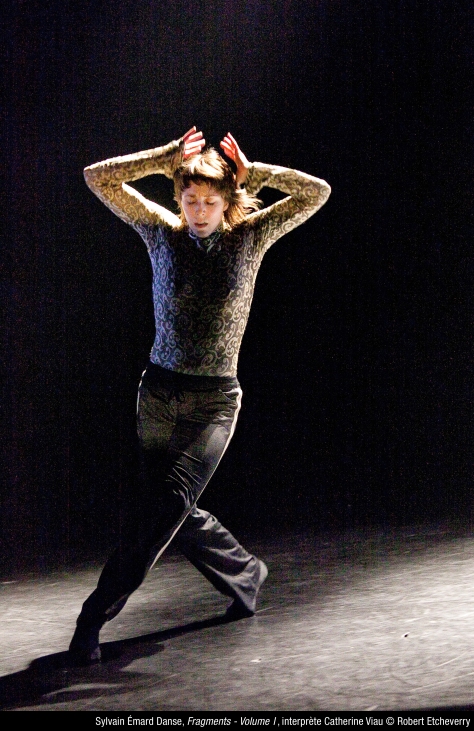
Catherine Viau dans Fragments - Volume 1 par Sylvain Émard. Photo: Robert Etcheverry. Source: Sylvain Émard Danse.

Ms. Viau’s piece was the second of the night, called Émoi, émoi, which according to my handy-dandy French/English dictionary could mean “emotion, emotion” or “stir, stir” or “commotion, commotion” or “agitation, agitation” or “flutter, flutter.” (Obviously, I’m not as bilingual as I thought) Personally, I’d go for stir x2 or flutter x2, but mostly because of the way the words can be repeated (it isn’t real common to write “agitation, agitation”) than for anything specific to the dance that she did. It began with her waving or possibly fanning herself and ended with some high stepping and spinning all to some sort of mechanical / industrial kind of soundtrack by Michel F. Côté.

And no matter how hard I try I can’t figure out any connection between Ms. Viau and the movements she made other than she and the moves she makes really really good.

But, instead of doing the whole in media res thing (I don’t know what’s up with this recent fascination with Latin, paenitet) I should just start from the beginning.

It got off on the wrong foot. The very first thing that we saw was this blinding strobe light. Which is all fine and dandy, if you’re 18 years-old and at some discotheque. But isn’t so hot if you’re middle-aged and sitting with someone who has epilepsy. Once the strobe stops you can see Manuel Roque sitting on a chair, upsidedown. Kind of like a you’d imagine a how it would look if you were choreographing a car crash. As all the car crashes I have been in made time seem to move incredibly slow, it only makes sense that Mr. Roque also moves in slow motion. How this car wreck relates to “his garden” I have no clue, but the piece is called “dans mon jardin…” although as far as I know it has nothing to do with the song by Manu Chao.

He returns to a normal speed with a bunch of jumping around and shaking. And then my notes mention that he has swallows and butterflies in his garden, but I have no recollection as to why I suddenly decided to note down the wildlife. Judging from the way it was written and its placement on the page, I would have guessed that it was some sort of lyric, but last I heard Michel F. Côté only writes instrumental music. So I am back at square one. Obviously I need to take much better notes next time.

Anyhows, after the jumping and the shaking, Mr. Roque returns to the chair, upsidedown, and then the piece ends.

The third piece is the one that’s been getting the most notice, mostly because M. Émard chose to use a septuagenarian non-dancer as a dancer. Monique Miller is an actress (now a dancer) who has been performing since the early 1950s.

She wore a kick-ass knit pant suit that had almost looked like a skirt (I think the technical term is elephant leg pants, but I am not certain, I have even less of a vocabulary in fashion than I do in dance) although from where I was sitting it also looked liked she was covered in Saran Wrap underneath the pant suit. Also from where I was sitting I never would have guessed that she was pushing 80 years-old. Forty, maybe fifty, just before I changed the prescription on my glasses, but never 78.

There was some sort of wind-chimey, dangly things suspended from the ceiling that was extremely annoying because of the reflections of the spotlights back into the audience that made it extrmely difficult to concentrate on what Mme. Miller was doing. What she was doing looked an awful lot like emoting and mime. Now, I’m not going to go and complain because a septuagenarian actress can’t dance. But I will question the necessity of putting a non-dance performance in the middle of a dance performance.

It’d be kind of like if I started singing right here, right now

Confusing, right? And then right in the middle of Mme. Miller’s performance someone starts plainchanting a personal ad, not exactly the New York Review of Books quality, but easily worthy of Craigslist. Initially this confused me, as Michel F. Côté only writes instrumental music. But then with a little bit of research, I discovered that M. Émard and M. Côté chose to insert some sort of excerpt from eL/Aficionado a very obscure opera by Robert Ashley. And no, I’d never heard of it either, prior to this. And I would hate to think that it was used as part of the soundtrack because Mme. Miller was looking for a date (remember way back at the top, how M. Émard said that the dances were inspired by the personalities and concerns of the performers… Things that make you go hmmmm.

The last piece, Bicéphale which was the duet of the evening, danced by Laurence Ramsay and Manuel Roque is about as cliched as it’s name. It starts off slow in front of a seam of light, again making it difficult to see. Their movements become quicker and seemed to me to be slightly like something Bob Fosse would have done.

Unfortunately the music by Jan Jelinek had way too much throbbing, buzzing and skreetching for my tastes. And even more unfortunately, it wasn’t anything like what Bob Fosse would have done.

I haven’t seen the other “latest and greatest” creation by M. Émard, The Continental line-dancing thing (it comes in various shapes, sizes and flavors). But, if it does come back this summer, I think I’m going to have to make a point to see it, just because it strikes me as being the complete opposite of Fragments – Volume 1. Either that or wait for Fragments – Volume 2 and see if things then fit together.

Gratte-ciel, cascades d’eau, rues, ruisseaux… by Melvin Charney at Place Émilie Gamelin 3/5

Howdy!

Built in 1992.

+This is the 29th in an occasional series of videos on the fountains of Montreal+

Outfits from a New Era at the Biosphere (Part One)

Howdy!

I’ve been meaning to write this one for a fairly long time, since August actually. But seeing as how I took 104 pictures, getting them all organized, uploaded and labelled seemed like a daunting task, so I did what anybody else would do, I put it off. Until today. If you click through to see all the pictures, it’s going to take a while to load, sorry in advance.

Bag Garment By Mélanie Casavant and Bullet Dress By Geneviève Dumas and Geneviève Flageol

In short, since the Biosphere is an “Environment Museum” it only makes sense that they mount exhibits designed to promote environmental awareness. And some bright wag decided to commission 16 clothing designers (I think all women) to create dresses using refuse material.

Now while I am an environmentally aware person and keep a fairly sustainable lifestyle, I’m not big on preaching about it. As a consequence what really struck me about this exhibit was not its Green-ness, but that while everyone was going gaga over the Jean Paul Gaultier exhibit at the Musée des beaux-arts de Montréal here was a truly original fashion exhibit that was not getting any press anywhere.

Light Switch Wall Plate autographed by David Suzuki

And while I might not proselytize about sustainability, like certain people, I do champion the underdog and Outfits from a New Era at the Biosphere is definitely underdog material if there ever was. The museum probably counts the number of daily visitors in the high two figures, has some breathtaking views of Montreal and is a charter member of the Cult of Bucky. What more do you need?

Anyhows, while I do not consider myself a fashionista, nor an authority on fabrics and style, instead of viewing these as liabilities I figured (like usual) that instead, if I approached this as a learning opportunity it shouldn’t be a hindrance to writing about it and taking some pictures. Right?

Mermaid Skin By Geneviève Bouchard

To me it was more of a compare and contrast situation. While it seemed like everyone and their mother was raving about how original and inventive M. Gaultier’s dresses were, here were some truly original and inventive dresses that weren’t getting any attention whatsoever. And while I’m certain that at some point M. Gaultier did in fact actually touch the dresses on exhibit that bore his name, I’m fairly convinced that he didn’t actually do much (if any) of the sewing, knitting, weaving, embroidery or any of the other tasks involved in making the dresses.

Whereas even without doing serious research, I’d bet my bottom dollar that each and everyone of the designers who made the “Outfits from a New Era” was significantly involved in the actual fabrication of their dresses. And while I am all for the artist-as-thinker-and-not-necessarily-creator concept (see Andy Warhol’s Red Self-Portraits One, Two, Three, Four, Five , Six, Seven and Eight for a fascinating insight into the attribution of artwork)

Detail from Dress the Part By Isabelle Bérubé

If I’m going to make one complaint (actually as I’m less than halfway through, I imagine that there will be other complaints, let’s just call this one the first. Which is not to say or suggest that the exhibit is bad, just that there is always room for improvement). This contemporary fad, or what I hope is a fad, for Dramatic Lighting! (with the capital “D,” capital “L” and an exclamation mark) drives me up a wall. In general when it comes to art/culture/things to look at or watch, you have two choices if you’re indoors; A white cube or a black box.

White Cubes tend toward being bright and Black Boxes (as you might expect) tend to be dark. Since they are dark, the Black Boxes use highly focused spotlights to draw your attention to stuff that the exhibition designers want you to look at. In contrast to the White Cube where, for the most part, your eye is free to roam where you wish. If you haven’t figured it out yet, I can’t stand exhibits that are housed in Black Boxes. And Outfits from a New Era is, unfortunately in a Black Box, pity.

I don’t know if it is because my eyes don’t react well to large contrasts in brightness, or if because I’m in darkness for the most part I don’t get the nuances of color as well as I would if it were brighter, or if it has something to do with my glasses. But whatever it is, Dramatic Lighting! (with the capital “D,” capital “L” and an exclamation mark) bugs the heck out of me.

Chapter Ten: Words & Wonder By Geneviève Oligny

Light Flow By Chloé B. Fortin

Light Flow By Chloé B. Fortin

I think you can see what I mean by a lot of nuance being missed because of the Dramatic Lighting! (with the capital “D,” capital “L” and an exclamation mark) in the picture above. Light Flow By Chloé B. Fortin is a light, wispy and diaphanous something or other that to my mind would be appropriate in a boudoir or a pornographic film shoot. Apparently made from 2,500 light bulbs and 66 meters of stripped copper wire.

Light Flow By Chloé B. Fortin

One of those garments that professes to show more than it hides, in French it is called “le grand courant lumineux” or in a hackneyed translation “the great current of light,” it was initially called “Le grand souffle” which has more to do with breath and wind than electricity. Which gives a much better idea of the “wispy and diaphanous something or other nature” of the garment.

Detail from Light Flow By Chloé B. Fortin

You can see better detail pictures here> I’m fairly certain that it doesn’t light up or get illuminated from within. But beyond the wispy nature of it, I’m not quite certain what to make of it. While the use of the light-bulbs is alright, there isn’t really anything in it beyond the use of non-traditional materials that pushes any boundaries. And given what has been already done with LEDs and clothing, I’m inclined to think that’s it’s kind of like the clothes your sister’s friend in high school wore. Something designed to make her look good, not making any real statements and not that different from what everyone else was wearing.

Bag Garment By Mélanie Casavant

Bag Garment By Mélanie Casavant

This little frock caught my eye, although I don’t know if it was because it’s black, and as you know, black is the new black. Or if it was because it was strapless and since I am not y-chromosome challenged, bare shoulders always make me shiver slightly, even during the summer, even on a faceless mannequin. Or what. I’ll leave it up to your imagination.

Detail from Bag Garment By Mélanie Casavant

Anyhows, this was the first one, where I thought to myself: “I’m not so certain that they actually used stuff from the garbage to make this…” Seeing as how it is made from those plastic bags you take with you when you’re walking your dog and you’re playing State Farm and being a good neighbor and picking up after your dog and everything.

None the less, I like how it incorporates the paw print motif from the bags, is over the knee and has some sort of petticoat action happening. Kind of like being post-modern and anti-nostalgic at the same time.

Detail from Bag Garment By Mélanie Casavant

Although I’m not certain I want to know what’s in the bag…

More tomorrow.

Gratte-ciel, cascades d’eau, rues, ruisseaux… by Melvin Charney at Place Émilie Gamelin 2/5

Howdy!

Built in 1992.

+This is the 28th in an occasional series of videos on the fountains of Montreal+

Gratte-ciel, cascades d’eau, rues, ruisseaux… by Melvin Charney at Place Émilie Gamelin 1/5

Howdy!

Built in 1992.

+This is the 27th in an occasional series of videos on the fountains of Montreal+

The International Orchid Show

Howdy!

I know diddly-squat about orchids, nonetheless I went to the International Orchid Show last weekend and took some pictures. They’re pretty…

Continue reading The International Orchid Show

La Grande Dégustation de Montréal & Bourbon Whiskey, Our Native Spirit by Bernie Lubbers

Howdy!

Yesterday I went to the La Grande Dégustation de Montréal. Unlike the 99% I was looking for bourbon. And of all the different things to taste, there was exactly one (1) bourbon. Woodford Reserve which was right next to the Jack Daniels stand, which makes sense as both are brands that are owned by Brown-Forman, unfortunately they decided not to bring Early Times or Early Times 354. The Woodford Reserve was as expected, extremely tasty.

However, we were able to think quickly on our feet, and sampled from very fine scotches. Our first stop was at the Edrington Group/Beam Global booths. While Maker’s Mark, Jim Beam, Knob Creek, Basil Hayden’s and Booker’s are all available from the SAQ, they weren’t at La Grande Dégustation de Montréal. I spent some time talking with the folk at the booth about making Baker’s, Old Grand-Dad and Old Crow available in Quebec.

They did have Highland Park and The Macallan both of which were extremely tasty in a bunch of different variations. If I remember correctly, we sampled Macallan 15 year-old and 18 year-old along with the 18 year-old Highland Park. Video to follow as soon as I have time to edit things down.

I was also able to taste a couple of varieties of Bowmore and Auchentoshan both of which were delicious.

All of which is a long winded way to get around to talking about Bourbon Whiskey, Our Native Spirit by Bernie Lubbers. Pretty much the first time in a long time I’ve picked up what I would call a textbook. If you didn’t realize, me and textbooks are not a terribly good mix, most of the time.

This time however, I’m probably going to go back and read it a second time. Voluntarily. While it just scratches the surface, it is a very nice entry into the world that is bourbon, and by extension whiskies and other distilled beverages.

Recently I’ve been doing some tastings of different types of bourbons (sadly, only ten) and for the most part end up concentrating on color, smell and taste. After reading Mr. Lubber’s book I was informed of a bunch of things about bourbon (and by extension American and Canadian whiskies) that enabled me to look like a superstar at La Grande Dégustation de Montréal.

Things like asking about how barrels were racked. Or the effects of different types of barrels on whiskies (because unlike bourbon which must be stored for at least four years in new oak barrels that have been charred, other types of whiskies don’t have such restrictions). I brought a checklist with me to the tasting in order to remember to discuss the recipe used, the number of distillations, how the grain is milled, the racking, the yeast and the barrels. All of which will affect the final product.

I only was able to think to ask those kind of questions, thanks to Mr. Lubber’s book, which goes into some detail about how those things affect bourbon.

The one fault I would point out with the book – which might not be a fault for you – is that there is a large chapter on places to visit in Kentucky when on the Bourbon Trail. And while Mr. Lubber is very good at explaining the various nuances about bourbon, he isn’t quite as compelling when writing about bars, restaurants and hotels in Kentucky. But that’s a minor point, given that he devotes two chapters to the history of bourbon, and another to various bourbon recipes.

I’m going to have to track down some more books on bourbon if I expect to become a better informed bourbon drinker.

La Grande Dégustation de Montréal continues today and tomorrow at the Palais de congres, and you can order Mr. Lubber’s book here.

More of the Fountain at Parc Lafontaine

Howdy!

While Parc Lafontaine has been around since 1874 or so, the town ponds connected by a waterfall were not introduced until 1900, and the fountain was built in 1929 because Léon Trépanier wanted one there, and was paid for by Westinghouse. I’m going to have to return next spring as at nighttime, it is illuminated.

+This is the 26th in an occasional series of videos on the fountains of Montreal+

The Fountain at Parc Lafontaine

Howdy!

While Parc Lafontaine has been around since 1874 or so, the town ponds connected by a waterfall were not introduced until 1900, and the fountain was built in 1929 because Léon Trépanier wanted one there, and was paid for by Westinghouse. I’m going to have to return next spring as at nighttime, it is illuminated.

+This is the 25th in an occasional series of videos on the fountains of Montreal+

More Waterfalls at the Hilton Bonaventure Hotel

Howdy!

Place Bonaventure was built in 1967 by Ray Affleck, and I would guess that while not exact, the waterfalls were part of the original plans.

+This is the 24th in an occasional series of videos on the fountains of Montreal+