Category Archives: Public Art

Outfits from a New Era at the Biosphere (Part Two)

Howdy!

Part One is here.

Bullet Dress By Geneviève Dumas and Geneviève Flageol

I’m not quite sure what to make of this one. First I never really thought of shotgun shells as refuse material. Off the top of my head, I can’t imagine that they take up an awful lot of space in landfills. On the other hand, due to the nature of their use I would also imagine that they aren’t brought to landfills and for the most part are left scattered on the ground. But then again I’m not a hunter, and the hunters that I know of are extremely conscientious stewards of nature. So it wouldn’t be a stretch to for them to pick up after themselves, either.

Then we get into the whole use of deadly arms as fashion statement morass. And while I’m certain that there are people out there who match their Smith and Wesson to their bracelet, or more simply, carry a gun around like my father wears a watch. I’m not one of them. Heck I don’t even carry around anything on me that tells the time.

I can see the allure of using brass tipped red plastic cylinders as the basic material for a dress, but the more I think about it, the less I like this particular dress. I don’t remember where or who, but I do remember somewhere learning that the designers were assigned their materials, and so if my memory is in fact correct, I can’t really blame Geneviève Dumas and Geneviève Flageol.

\

Signed gas mask used by Jean-François Lépine.

But this is where it veers off into the surreal. For reasons that are beyond my comprehension, the exhibit designers decided that dresses made from strange materials wasn’t enough of a draw, so they engaged some vedettes to sign objects that some how had significance to the dresses themselves. Someone decided that a gasmask used by Jean-François Lépine would be make for a good pairing with the Bullet Dress. As M. Lépine writes on the tag for the display “Pour moi, c’est devenu un objet fétiche qui me rappelle que, même dans l’adversité la plus opaque, l’espoir est toujours permis.” Or for the squareheads reading this: “It has become a symbolic object for me; it reminds me that even in the darkest hours of adversity, hope remains.” (As an aside, that is a kick-ass translation, I hope that the designers for the show got paid at least as much as the translators did – but somehow I have a sneaking suspicion that they didn’t.)

But, if you take the statement at face value, it is completely bizarre. I’m not certain what would give the sense of adversity, the bullets? Wearing the dress? Thinking about the use of the bullets? I dunno. But I do know that there are people out there who would pay good money to wear a sexy red Mexican inspired frock like that despite whatever implications it might have.

Rear view of Mermaid Skin By Geneviève Bouchard

If you’d like to see the front of the dress, click here, I used the photo yesterday, and don’t want to be duplicating things.

I think that this is my favorite dress out of the whole bunch. But more in theory than actual practice. Inspired and inventive. Sassy, smelly and insouciant!! (hey! maybe I could get a gig working for Elle Quebec!)

Detail of Mermaid Skin By Geneviève Bouchard

But someone should let Ms. Bouchard know that if she ever wants to make a second salmon skin dress that she should talk to Lottas Garfveri and/or get her books. Her dresses would be just as Inspired and inventive. Sassy and insouciant, but they would no longer be smelly.

I’m not entirely sold on her use of mussel shells as accessories. And given the exotic nature of the material used, I’m not certain that I really need to discuss the actual design. For the most part, when using skin (ie leather) as a dress material most, if not all the really impressive dresses I’ve seen tend to follow the form of the body fairly closely. As you can see with this one, it is much more florid. Not quite what I would call rococo, but approaching. I don’t know if that was caused by there still being some meat left on the skin when it was cut (and as a consequence why it needs to be refrigerated).

It appears to me that it was made more for one of those matronly mermaids, and not one of those nymph-like mermaids.
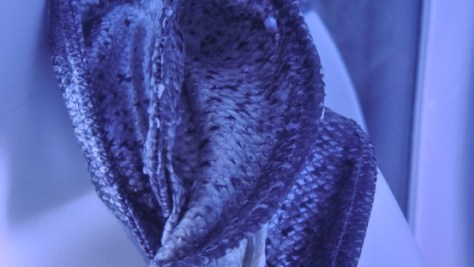
Detail of Mermaid Skin By Geneviève Bouchard

And the reason the photographs are so blue, is because of the fluorescent lights in the refrigerator where they have to keep the dress, since Ms. Bouchard made the executive decision not to tan the salmon skins.

Charlestea By Maude Lapierre

A flapper inspired dress made of old tin aluminum cans.

Rear view of Charlestea By Maude Lapierre

Next to each dress the exhibition designers wrote some sort of lagniappe next to each dress. In this case they decided that everyone should know that it Maude Lapierre made 4,376 16 gauge holes in the tin aluminum. Personally I would have preferred to know how heavy (or light) the dress was. While it might be aluminum, it still is metal, and before I were to wear it, I’d want to know how many kilos it was.

Detail of Charlestea By Maude Lapierre

Still more tomorrow.

Gratte-ciel, cascades d’eau, rues, ruisseaux… by Melvin Charney at Place Émilie Gamelin 3/5

Howdy!

Built in 1992.

+This is the 29th in an occasional series of videos on the fountains of Montreal+

Outfits from a New Era at the Biosphere (Part One)

Howdy!

I’ve been meaning to write this one for a fairly long time, since August actually. But seeing as how I took 104 pictures, getting them all organized, uploaded and labelled seemed like a daunting task, so I did what anybody else would do, I put it off. Until today. If you click through to see all the pictures, it’s going to take a while to load, sorry in advance.

Bag Garment By Mélanie Casavant and Bullet Dress By Geneviève Dumas and Geneviève Flageol

In short, since the Biosphere is an “Environment Museum” it only makes sense that they mount exhibits designed to promote environmental awareness. And some bright wag decided to commission 16 clothing designers (I think all women) to create dresses using refuse material.

Now while I am an environmentally aware person and keep a fairly sustainable lifestyle, I’m not big on preaching about it. As a consequence what really struck me about this exhibit was not its Green-ness, but that while everyone was going gaga over the Jean Paul Gaultier exhibit at the Musée des beaux-arts de Montréal here was a truly original fashion exhibit that was not getting any press anywhere.

Light Switch Wall Plate autographed by David Suzuki

And while I might not proselytize about sustainability, like certain people, I do champion the underdog and Outfits from a New Era at the Biosphere is definitely underdog material if there ever was. The museum probably counts the number of daily visitors in the high two figures, has some breathtaking views of Montreal and is a charter member of the Cult of Bucky. What more do you need?

Anyhows, while I do not consider myself a fashionista, nor an authority on fabrics and style, instead of viewing these as liabilities I figured (like usual) that instead, if I approached this as a learning opportunity it shouldn’t be a hindrance to writing about it and taking some pictures. Right?

Mermaid Skin By Geneviève Bouchard

To me it was more of a compare and contrast situation. While it seemed like everyone and their mother was raving about how original and inventive M. Gaultier’s dresses were, here were some truly original and inventive dresses that weren’t getting any attention whatsoever. And while I’m certain that at some point M. Gaultier did in fact actually touch the dresses on exhibit that bore his name, I’m fairly convinced that he didn’t actually do much (if any) of the sewing, knitting, weaving, embroidery or any of the other tasks involved in making the dresses.

Whereas even without doing serious research, I’d bet my bottom dollar that each and everyone of the designers who made the “Outfits from a New Era” was significantly involved in the actual fabrication of their dresses. And while I am all for the artist-as-thinker-and-not-necessarily-creator concept (see Andy Warhol’s Red Self-Portraits One, Two, Three, Four, Five , Six, Seven and Eight for a fascinating insight into the attribution of artwork)

Detail from Dress the Part By Isabelle Bérubé

If I’m going to make one complaint (actually as I’m less than halfway through, I imagine that there will be other complaints, let’s just call this one the first. Which is not to say or suggest that the exhibit is bad, just that there is always room for improvement). This contemporary fad, or what I hope is a fad, for Dramatic Lighting! (with the capital “D,” capital “L” and an exclamation mark) drives me up a wall. In general when it comes to art/culture/things to look at or watch, you have two choices if you’re indoors; A white cube or a black box.

White Cubes tend toward being bright and Black Boxes (as you might expect) tend to be dark. Since they are dark, the Black Boxes use highly focused spotlights to draw your attention to stuff that the exhibition designers want you to look at. In contrast to the White Cube where, for the most part, your eye is free to roam where you wish. If you haven’t figured it out yet, I can’t stand exhibits that are housed in Black Boxes. And Outfits from a New Era is, unfortunately in a Black Box, pity.

I don’t know if it is because my eyes don’t react well to large contrasts in brightness, or if because I’m in darkness for the most part I don’t get the nuances of color as well as I would if it were brighter, or if it has something to do with my glasses. But whatever it is, Dramatic Lighting! (with the capital “D,” capital “L” and an exclamation mark) bugs the heck out of me.

Chapter Ten: Words & Wonder By Geneviève Oligny

Light Flow By Chloé B. Fortin

Light Flow By Chloé B. Fortin

I think you can see what I mean by a lot of nuance being missed because of the Dramatic Lighting! (with the capital “D,” capital “L” and an exclamation mark) in the picture above. Light Flow By Chloé B. Fortin is a light, wispy and diaphanous something or other that to my mind would be appropriate in a boudoir or a pornographic film shoot. Apparently made from 2,500 light bulbs and 66 meters of stripped copper wire.

Light Flow By Chloé B. Fortin

One of those garments that professes to show more than it hides, in French it is called “le grand courant lumineux” or in a hackneyed translation “the great current of light,” it was initially called “Le grand souffle” which has more to do with breath and wind than electricity. Which gives a much better idea of the “wispy and diaphanous something or other nature” of the garment.

Detail from Light Flow By Chloé B. Fortin

You can see better detail pictures here> I’m fairly certain that it doesn’t light up or get illuminated from within. But beyond the wispy nature of it, I’m not quite certain what to make of it. While the use of the light-bulbs is alright, there isn’t really anything in it beyond the use of non-traditional materials that pushes any boundaries. And given what has been already done with LEDs and clothing, I’m inclined to think that’s it’s kind of like the clothes your sister’s friend in high school wore. Something designed to make her look good, not making any real statements and not that different from what everyone else was wearing.

Bag Garment By Mélanie Casavant

Bag Garment By Mélanie Casavant

This little frock caught my eye, although I don’t know if it was because it’s black, and as you know, black is the new black. Or if it was because it was strapless and since I am not y-chromosome challenged, bare shoulders always make me shiver slightly, even during the summer, even on a faceless mannequin. Or what. I’ll leave it up to your imagination.

Detail from Bag Garment By Mélanie Casavant

Anyhows, this was the first one, where I thought to myself: “I’m not so certain that they actually used stuff from the garbage to make this…” Seeing as how it is made from those plastic bags you take with you when you’re walking your dog and you’re playing State Farm and being a good neighbor and picking up after your dog and everything.

None the less, I like how it incorporates the paw print motif from the bags, is over the knee and has some sort of petticoat action happening. Kind of like being post-modern and anti-nostalgic at the same time.

Detail from Bag Garment By Mélanie Casavant

Although I’m not certain I want to know what’s in the bag…

More tomorrow.

Gratte-ciel, cascades d’eau, rues, ruisseaux… by Melvin Charney at Place Émilie Gamelin 2/5

Howdy!

Built in 1992.

+This is the 28th in an occasional series of videos on the fountains of Montreal+

Gratte-ciel, cascades d’eau, rues, ruisseaux… by Melvin Charney at Place Émilie Gamelin 1/5

Howdy!

Built in 1992.

+This is the 27th in an occasional series of videos on the fountains of Montreal+

More of the Fountain at Parc Lafontaine

Howdy!

While Parc Lafontaine has been around since 1874 or so, the town ponds connected by a waterfall were not introduced until 1900, and the fountain was built in 1929 because Léon Trépanier wanted one there, and was paid for by Westinghouse. I’m going to have to return next spring as at nighttime, it is illuminated.

+This is the 26th in an occasional series of videos on the fountains of Montreal+

The Fountain at Parc Lafontaine

Howdy!

While Parc Lafontaine has been around since 1874 or so, the town ponds connected by a waterfall were not introduced until 1900, and the fountain was built in 1929 because Léon Trépanier wanted one there, and was paid for by Westinghouse. I’m going to have to return next spring as at nighttime, it is illuminated.

+This is the 25th in an occasional series of videos on the fountains of Montreal+

On the side of the Centre Culturel Calixa-Lavallée

Howdy!

I find these utterly charming…

Baseball player bas-relief above an entrance to the Centre Culturel Calixa-Lavallée
A sportsman bas-relief above an entrance to the Centre Culturel Calixa-Lavallée
Canoer bas-relief above an entrance to the Centre Culturel Calixa-Lavallée
Tennis player bas-relief above an entrance to the Centre Culturel Calixa-Lavallée
Skiier bas-relief above an entrance to the Centre Culturel Calixa-Lavallée
Football player bas-relief above an entrance to the Centre Culturel Calixa-Lavallée
Hockey player bas-relief above an entrance to the Centre Culturel Calixa-Lavallée

Talking about Quebec and Canadian Art in the Claire and Marc Bourgie Pavilion of the Musée des beaux-arts de Montréal

Howdy!

Earlier this month I was a guest on the CBC Montreal radio show Cinq à Six with Pierre Landry. We discussed the opening of the Claire and Marc Bourgie Pavilion of the Musée des beaux-arts de Montréal and their new hanging of Quebec and Canadian Art.

If you’d like to hear it,

Or if you’d like to download it, click here.

The Fountains at the Hilton Bonaventure

Howdy!

While the building itself was built in 1967 by Ray Affleck, I strongly doubt he had a hand in either fountain, and I would also doubt that the one at the entrance was part of the original plans.

+This is the 22nd in an occasional series of videos on the fountains of Montreal+