Category Archives: Ramble

Valérie Blass, Ghada Amer and Wangechi Mutu at the Musée d’art contemporain de Montréal

Howdy!

I’m not quite certain what to think. Nor how to think. Do I approach each show separately? Or do I group Valérie Blass, Ghada Amer and Wangechi Mutu all together and do just one review? If I was good, I think I would have preferred to have done separate reviews for each one. But since I’m not, I’m going to group them all together, just like the museum did.

First order of business; did you know that in between January 8, 2006 and November 5, 2008, 1,032 days, or about two months short of three years, the Musée d’art contemporain de Montréal did not have a single solo exhibition by a woman? I can’t help but thinking that this set of three solo shows by women was somehow organized to make up for that. But then again it has been over three years, maybe it just worked out that they happened to schedule three solo shows by women all at the same time by coincidence.

Second order of business; juxtaposing a Quebecois artist with limited international exposure up against two internationally known artists can and does have a way of biting you in the ass.

Third order of business; I don’t know if it is due to insecurity, incompetence or insomething else. But I would bet dollars to doughnuts with anyone who is interested, that I am the only person writing about art exhibits at the Musée d’art contemporain de Montréal who is also a member of the Musée d’art contemporain de Montréal’s foundation. As a consequence I was quite surprised to find out that I was not invited to neither the press conference nor the vernissage for the latest exhibit they mounted, La Question de l’abstraction. Insecurity, because I get the distinct impression that my series of humorous rhymes about the Triennale went over like a lead balloon. Incompetence, because if you can’t manage to invite the people who give you money without being asked there is something seriously wrong. I will wait with baited breath to see what happens at the end of May for the Zoo exhibit.

But all of that is neither here, nor there when it comes to talking about the art of Valérie Blass, Ghada Amer and Wangechi Mutu. More along the lines of background material, so that you know where my thoughts are coming from as I type this. To get the easy stuff out of the way first. I’ve never been much of a fan of Valérie Blass’ work and I had never heard of Ghada Amer and Wangechi Mutu before seeing their work at the museum. After seeing the shows I still wasn’t much of a fan of Valérie Blass’ work but I now was familiar with the work of Ghada Amer and Wangechi Mutu.

If I were to try and sum up each artist’s work in a line. I’d say that Ghada Amer sews images on to canvas. Wangechi Mutu scares the living bejeezus out of me. And Valérie Blass make three dimensional collages. For what it is worth, it is actually fairly easy to see the common line that links the work of all three artists. It’s spelled C-O-L-L-A-G-E. But you’d figure that the Musée d’art contemporain de Montréal wouldn’t be as simplistic to group three artists just because they were women who combined things that they found into new assemblages, would you?

But anytime you juxtapose art, there’s bound to be some joker who tries to link everything, no matter how tenuous that link is. I guess I’m that joker, today. One way to avoid things like that in the future would be to have three separate openings for the three separate shows. Something like one every week or month probably would be sufficient to make each of the shows by the artists separate in the mind of the public. But then again, I could be wrong, and be the only person in the entire universe who was unable to think of the exhibits as being unlinked. Oh well.

So now I think it’s time to get down to brass tacks. So that no one gets their nose out of joint, I’m going to approach each artist’s section of the show separately, before trying to link them together in a more formal and structured manner (if I can) and I’m going to do them in alphabetical order by their first name. Everyone knows that a last name is a social residue left over from when society was not only patriarchal and patrilinear, but also run by jerks and assholes. I’m also not going to give any background on the artists. If you are at all interested in that, there are some mighty fine catalogues that the Musée d’art contemporain de Montréal has published which in and around the multisyllabic words give you a good idea of where each of the artists came from. Or you can use Google.

Ghada Amer. The first time I saw Ms. Amer’s work, it looked extremely delicate, not quite lace-like, not quite like cotton candy on canvas, not quite like teased hair. But like the middle section of a Venn diagram of the three. From a distance, it wasn’t easy to tell what materials she was using and for the most part everything seemed pretty abstract.

The second time I saw Ms. Amer’s work, I realized that the first time I had been very wrong and must have obviously been smoking some crack that was stronger than I was used to, in order to have thought her work was delicate. There’s a quote going around the internet that’s being attributed to Betty White, but probably wasn’t said by her, nonetheless it makes a point. “Why do people say “grow some balls”? Balls are weak and sensitive. If you wanna be tough, grow a vagina. Those things can take a pounding” Ms. Amer’s work is like that vagina, it’s been pounded. Pounded in order to be created, pounded in order to be looked at, and pounded in order to be understood.

Betty White on balls and vaginas.

Let’s start with the easiest first. In order to make her work, I believe that Ms. Amer has either got to be using some kind of super industrial sewing machine, or an awl that could also double as an ice pick. While the holes she punches in the canvases aren’t necessarily large in and of themselves, they are all over the place and way more than it would take to fill the Albert Hall. She then threads some thread (duh!) through the holes.

The reason you need to pound in order to look at her work – and in case you hadn’t figured it out I’m using the word “pound” as a synonym for “work hard” – is that there is an awful lot of threading going on in each individual piece.

Installation shot of Ghada Amer exhibit at the Musée d'art contemporain de Montréal.

And you have to work hard when looking at her work, because behind just about every bit of thread is a second set of images, mostly copied from mainstream culture. Giving all sorts of fodder for the Phd’s in the house to go wild over layering and contrast provided by the two very separate images, ideas and thoughts.

There’s also a large egg shaped object made out of some type of plastic called 100 words of love

Ghada Amer, 100 Words of Love, picture courtesy Art Hag

Which basically takes this idea translates it into Arabic and makes it three dimensional. When I saw it for the second time I spent way too long going over it looking for a seam or a seal or something to indicate how it was joined together, but couldn’t find one. Personally, I think that while it’s a pretty enough object and a nice enough sentiment, something got lost in translation (sorry, I couldn’t help myself there).

Wangechi Mutu is apparently known mostly for her collages. But I would never have known it in a million years if I based it on my impressions on what she’s got up at the museum. And while I’m certain that there were some collages on the walls of the museum, somewhere, they got completely wiped from whatever little memory I had of the exhibit because there are five (or six, depending on what you call art) pieces there, that just completely and utterly blow anything and everything else out of the water, blow them out of the way, and blow my mind.

Unfortunately, I have no idea what the heck they are called, because I was left so slack jawed at them, that I completely forgot to take notes and incorrectly presumed that the museum would be responsible enough to make some reference to them in the catalogue. But nope, no such luck there. If all you were to do was to read the catalogue for Ms. Mutu’s show you’d get the idea that there was some completely different type of exhibit that happened. While I recognize that it is a document of and about the exhibit, it’s like an entirely separate universe.

The catalogue is all brightness and light, big on the feminist theories and post colonialism, using two-bit words like they’re going out of style. Whereas the exhibit itself is darkness and brooding, somewhat threatening (I told you it scared the living bejeezus out of me) very spooky and completely (sorry about the two-bit word) visceral. Kind of like having someone throw a bag over your head and then start beating you with a bag of oranges. Not quite, but close enough.

Most of the space for Ms. Mutu’s work has walls that are covered in brown felt, which makes for a very somber environment. Then after walking around I came across what I’m calling The Thrones.

Installation shot from Wangechi Mutu's exhibit at the Musée d'art contemporain de Montréal.

Now that I’m looking at the picture closer, they don’t look half as intimidating as they do in real life. The feet are really pointy, and someone could easily lose an eye if they were careless. They towered over me not like a Goliath, but more like a very angry sasquatch, or Dr Honorious, or Dr. Maximus from the original Planet of the Apes films. I have no idea if they were supposed to make me feel weak, insignificant and beholden, but they did. And even weirder, was the fact that I found it really hard to look at them straight on.

Once I had those kind of emotions running around inside me, there really wasn’t any holding back. Over on the other side of the gallery were a bunch of wine bottles suspended upside down from string over some white plates. But the bottles themselves were full had some sort of contraption over their mouth that if I squinted slightly and used some free associative techniques could be considered to be like a miniature Hannibal Lecter mask.

They hid just enough, and enabled the wine to drip out very slowly. Slowly enough that I have made a note in my agenda to go back to see the show a third time just before it closes so that I can see just how much wine has been spilled.

Now it’s not like each bottle was lined up precisely over each plate, and in case you hadn’t realized it already, the wine was red. So without too too much of a stretch, if I’m already feeling weak, insignificant and beholden due to what I’m calling The Thrones, it wasn’t hard for what I’m calling The Bottles to get me feeling all vulnerable and guilty. What with the wine looking like blood, and the bottles being a replacement for some kind of lynching scene. I’m kind of annoyed with myself that I wasn’t able to get back to the museum before the show closed to see how much wine/blood was on the plates and the floor.

Then again, I could be very wrong and it all could be just some kind of elaborate physics experiment to measure the effects of gravity on colored water and openings a various diameters.

In between what I’m calling The Thrones and what I’m calling The Bottles was what I’m calling The Tinsel. And while it probably would be fairly easy to succumb to some kind of dark thoughts while experiencing it, it left me in wonder and awe, instead. Basically it’s a large cube like space that stretches down from the ceiling that has golden tinsel streamers as it’s walls. As a consequence, it is extremely easy to walk through the streamers and get inside the cube. Kind of like finding a place to stand behind the waterfall, or the latch to the hidden chamber.

On the flip side, it’s also real easy to assume that The Tinsel itself was some kind of wall or barrier. Especially since a lot of the other walls of the museum were covered in felt. And as a consequence not even think to wander into the inner sanctum – probably because of the lack of a creaking door.

There also was some awesome and amazing structure in front of the Moth Girls – the piece that the museum bought that probably was influential in enabling them to get the exhibit – that looked for the life of me like some sort of 150 year-old gnarled tree or something.

I’m not quite what to make of Moth Girls. It definitely is not half as terrifying or scary as what I’m calling The Bottles and what I’m calling The Thrones. Obviously requiring more contemplation than I was willing to give them (it’s tough to bring your pulse down when it’s going like a pneumatic drill) it also didn’t give off that “I found something!” sensation that what I’m calling The Tinsel did. And so while I’m certain that something significant can and will be made of it, I quite like the idea that it was made because Ms. Mutu’s apartment was infested with moths.

There were other pieces by Ms. Mutu in the show, and I’m kind of annoyed with myself that I can’t remember more about (or took a picture of) the piece with the naturalized animal, but the only memories I have of her collages are from the catalogue, and as I said that is a whole ‘nother thing.

Which brings us to Valérie Blass. I wish I could write something really witty cool and nice about her work. Sadly I can’t. And while I could write something witty, sarcastic and mean – which if done well would make for some entertaining reading – I really don’t have that in me either. Ms. Blass’ work not only leaves me “blah” it also makes me sad.

Installation shot of Valerie Blass' exhibit. Image courtesy of Valerie Blass and Facebook.

For the most part I believe down to the marrow of my bones that there are an awful lot of really amazing and super-duper artists here in Quebec (and by extension Canada). But recently the Google Art Project went global. And when it did, there was not a single Canadian Museum included (for comparison there were six in Australia, two in New Zealand, one in South Africa, and, and, and. Since the global launch the AGO has signed on – but still no Quebecois institution.

I can’t help but thinking that it has something to do with the fact that institutions like the Musée d’art contemporain de Montréal are promoting and hyping artists like Ms. Blass. The contemporary equivalent of whomever did the copy of the Mona Lisa at the Prado. Significant and important, but only to a point, and not really doing anything original.

Gluing found objects together and then casting them in porcelain is all fine and dandy, and makes for some pretty shiny objects that you can look at while holding your chin and nodding your head slowly (I said I wasn’t going to write something witty, sarcastic and mean, sorry). Pretty and shiny objects, do not, by virtue of being pretty and shiny deserve to be exhibited in a museum.
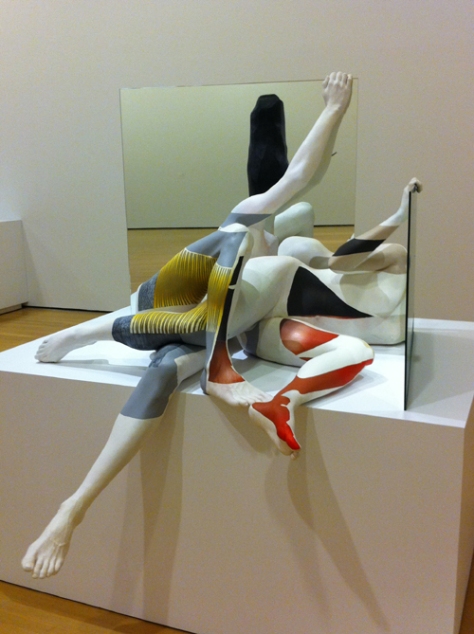
Dans la pose très singulière qui est la mienne, by Valérie Blass. Image courtesy http://cuisineetc.wordpress.com/

I am 100% convinced that Ms. Blass’ technique is superlative. That her instincts are true, and that she makes really nice things. But if anyone out there can explain to me how Ms. Blass’ work affects them as emotionally as Ms. Amer’s or Ms. Mutu’s work did me, I’m all ears. While Ms. Blass’ pieces didn’t repulse me, they just left me feeling like I was walking through some high-end home furnishing store looking for something that would be perfect in the nook. (OK, I apologize, I obviously wanted to get mean and sarcastic – Ms. Blass, when you read this, it is not intended as a personal attack, it is intended as a way to keep any readers who are left at this point, entertained.)

Déjà donné, by Valérie Blass. Image courtesy http://cuisineetc.wordpress.com/

When I see what I think are the equivalent of home furnishings in a major Canadian museum, I can kind of understand why Canadian (and by extension Quebecois) art doesn’t get the respect it deserves on an international level. Frustrating, yes. Annoying, yeah. But, if they don’t invite me to the press conferences after I write about the art they exhibit and the openings after I give them money to be a member, it’s obvious as the nose on my face that they and I don’t see things the same way. So what am I going to do?

This is almost up at 3,000 words now, I kind of get the impression that if there is still anyone reading this far in, they are a blood relation. So in order to tie everything up (I said I was going to try) and enable my family to get on with other things more important than reading what I write… It’s obvious that there is an extremely limited public who is interested in Quebecois art, and I betcha dollars to doughnuts, unfortunately, that it isn’t likely to change in the near future.

Pity.

Kolik, by Rainald Goetz, directed by Hubert Colas, acted by Thierry Raynaud

Howdy!

By my count there were approximately 120 (one hundred and twenty) shots. More than 4½ bottles of vodka. More than enough to kill someone. Back at the end of March I got to see Thierry Raynaud in a play called Kolik by Rainald Goetz, which was directed by Hubert Colas at Usine C. (That’s a mouthful!) That’s where the shots were. It’s a fairly sparse play, in short, M. Raynaud is sitting on stage in front of a table with a bunch of glasses on it. During the course of 70 minutes (an average if 1.7 shots/minute) he rants on and about a variety of subjects and in general portrays a very ugly drunk. But that’s not the half of it. That’s kind of like saying there are a couple of books at the library.

But before I go on, I probably should give some background, since in poking around on the internet, there isn’t too too much about Kolik, Mr. Goetz, Mr. Colas and Mr. Raynaud in English. As far as I can tell, Mr. Goetz is some kind of avant-garde, experimental German playwright. Mr. Colas appears to be a very influential and important director of plays in France and Mr. Raynaud a kick-ass French actor who has worked with Mr. Colas since 1994.

Back in the eighties he wrote a trilogy called “Kreig,” (War in English). In the first part, I think it’s about how society deals with war, in the second part, family and war, and the third part – Kolik (colic in English) brings war down to the personal level. I have no idea if the first two parts played at Usine C and I just missed them, or if this was a oneshot deal.

But no, never mind, Kolik stands up on its own, and it was only in reading the press kit and other stuff that I could find on line, after the fact that I discovered it was part of a larger whole. As far as I could tell while it might have been cool and/or interesting to see the first two parts of the trilogy, it was not necessary.

Kolik, by Rainald Goetz. Photo courtesy of Dipthing.com

Anyhows, now that we got the background out of the way, we can proceed to the foreground. 120 shots. 1.7 shots/minute for the entire duration of the play. But despite the overdosing on alcohol, one of the first things that occurred to me was, did the Automatistes ever do any spoken word performances? The way the shole things was done, if I didn’t know any better, it would have been extremely simple to think that Mr. Raynaud was just doing some sort of stream of consciousness rant – and in fact I might have believed he was, had Mr. Goetz not been given credit for the text.

Thanks to Rue89.com and Google Translate, this is how it would start if someone did a half-assed translation into English:

Brain
grime
man
Come on
dark
(go) faster
quickly
out
human
man
Go on
recumbent
Tip-shit
Brain dog dirt
grime
grime
Grime fucking dog fucking
Laying there-
Brain-shit
God fucking damn dirt
Outside of dog shit

Each word being barked out, as if Mr. Raynaud was himself the Tip-shit Brain dog dirt in the grime. Just a little bit aggressive, although to be honest I wasn’t thinking that it was going to be a nice relaxing night at the theatre.

At various points, I was thinking that maybe they were trying to make some connection to Tourette’s Syndrome. But then given the amount of drinking involved, there was also the one time, when I kind of wished I had seen Broue. Not that I honestly thought that the two plays shared anything in common, beyond the drinking, but so that I would be better able to see the extremes. But despite Broue having been performed since Methuselah was knee high to a grasshopper, somehow I haven’t been able to get my act together to go and dee it. Pity.

And then there were the two pages of notes that I took that consisted of the word “drink,” repeated about two dozen times on each page. Given the nature of the performance (it being in French, me being a bloke and a a squarehead, along with me writing my notes in English) there were sometimes where it just seemed appropriate to let the words cascade over me. Not quite like music, nor like a shower, but more like dirt. You know the sensation when you’re digging a tunnel and suddenly part of it caves in on you? And you end up with dirt in your eyes, ears, mouth and every other place you can think of? Like that.

Kolik by Rainald Goetz with Thierry Raynaud. Photo coutrtesy dipthong.com

He drinks
I
yet
but why
Question why Word
Answer strict order
Question why strict order of words
Response in exercise maximum rigor of the test material
Question why resistance test word
reply Hate
Word-response shut up
Word hush ai ai
Discipline-word response
I hate repeat
I do not ask why
I say I say this material is
Hate-word response
I say hate
hate hate
He drinks

Again from rue89.com and Google Translate. And did I mention the approximately 120 shots that are consumed during the course of the performance? Easily the equivalent of three 40 pounders.

Mr. Raynaud’s character is angry and pissed off, and as far as I can tell probably dies. While I was watching him perform, I was not quite as conscious of any specific war-like parallels or analogies. But now safely ensconced in the library, where they have some of Mr. Goetz’s work if some teacher asked me to knock together some sort of paper outlining how Kolik was about the war, I wouldn’t balk too too much. Just from my Psych 101 knowledge of Post-traumatic stress disorder it would be fairly easy. Using just a little brain power, it would become a slam dunk. But since I don’t have much of the script to quote from, and seeing how it’s really early in the morning and I don’t quite have access to all the brain power I would like, you’re just going to have to take me at my word.

Kolik by Rainald Goetz with Thierry Raynauld. Photo courtesy 23h32.com

During the course of the performance I only heard two people leave, so obviously, it isn’t for everyone. But now in retrospect, I kind of get a feeling that some people would walk out on a play by Eugène Ionesco or Samuel Beckett. And while I don’t want anyone to infer that I think Kolik is theatre of the absurd, going to see it in the same frame of mind as you would The Bald Soprano or Waiting for Godot. Although now that I am doing cursory research, I’d venture a guess that there are some striking similarities to the plays of David Mamet. I should also mention the almost ghost-like video that is projected on the back wall of the theatre that kept me engaged for far longer than it should have, given that I was barely able to make out what was on it.

In the middle of the play things get very dark and Mr. Raynaud’s speech comes out of a bunch of speakers in different places in the theatre. But despite these bits of high-tech gadgetry the play really remains and belongs entirely to Mr. Goetz and Mr. Raynaud. The power of the words, and the the power of their presentation is such, that even if you were to watch the play with your eyes closed you’d understand it completely.

Métro Charlevoix

Howdy!

Continuing the photo-essays on obscure Métro stations, today it’s Métro Charlevoix. It was my home station for about a year in the mid-eighties and at the time I hated it, because it was so deep, and being forced to take the green line one stop from Lionel-Groulx was a pain in the neck. Since then it has kind of grown on me, because I don’t have to use it two times every day. It was inaugurated on September 3, 1978. From a cursory search I can’t find any other buildings that the architects Ayotte and Bergeron built. More information about the station can be found at the STM’s website, Wikipedia and Metro de Montreal.

Some spooky ventilation duct at the Métro Charlevoix
The ornamental brick work on the platform at the Métro Charlevoix
The benches on the platform at the Métro Charlevoix
The exit from the platform at the Métro Charlevoix

Looking down at the entrance to the platform at the Métro Charlevoix
Looking up at the exit to the platform at the Métro Charlevoix
Another spooky ventilation duct at the Métro Charlevoix
Another view of the other spooky ventilation duct at the Métro Charlevoix
Some fancy grill work at the Métro Charlevoix
Looking up one of the escalators at the Métro Charlevoix
Looking down one of the escalators at the Métro Charlevoix
The stained glass at the Métro Charlevoix

The stained glass was done by Mario Merola and Pierre Osterrath.

The stained glass at the Métro Charlevoix

Continue reading Métro Charlevoix

Kidd Pivot, The You Show

Howdy!

Color me embarrassed! Last month I went to go see The You Show by Kidd Pivot Frankfurt RM, and it wasn’t until long after I had seen the show that I discovered that instead of it being one dance performance in four acts, that it was in fact four separate dances combined together to make an evening’s program. Oooops. (And it’s obvious that my habit of going into a performance attempting to be a tabula rasa works). Then on top of that, my notes, which get scrawled in the dark, and sometimes are extremely difficult to decipher after the fact, somehow got mixed up and taken out of order. So I wasn’t certain that lines that I had written, such as “repetition of voice / with new moves / switch to her” were referring to something that happened before or after “moving together / all others leave / and we’re back to two.”

But I think I have everything sorted out as best as I can, and can attempt to make some sense out of what I saw (apologies, again for my lack of timeliness, but as per normal, things here have been busy). I find life is so much easier when I don’t really have to force some sort of narrative on something that doesn’t have one. Plus in this case, there are a whack of other reviews and articles to draw from and react to.

(Dance Magazine, The New York Times, The Globe and Mail, World Arts Today, Solomons Says, Seeing Things, Vancouver Courier, Dfdanse, Ottawa Citizen and Rover)

In this particular case I find it fascinating that without too much trouble I was able to find over a dozen reviews from a variety of places (at first I was concerned that they were all from North America, but then looking at Kidd Pivot Frankfurt RM’s website it appears that it has only been performed outside of North America in three places. It’s also a little weird that it has been performed 22 different times in eight different cities in the rest of the world versus nine times in two cities here in Quebec. I wonder if there are any other international touring companies that spend 30% of their time here in Quebec? But I digress).

The reviews, as you might expect, were all over the place. Most took advantage of the fact that there were four different pieces to say that three of the four were great and one was not. But there was no consensus on which one sucked. I particularly enjoyed Wendy Perron’s take over at Dance Magazine, where she wrote “I’m skipping the third duet because it didn’t add much…” Imagine skipping the third side of Tommy, because it didn’t add much. Or skipping the lobster omelette in your review of the Pied de Cochon’s sugar shack? If you’re reviewing it, review the whole thing. Not just the good bits.

Anne Plamondon in A Picture of You Falling, picture by Micheal Slobodian

As for my take? Overall I thought it was quite good. The dancers (Eric Beauchesne, Peter Chu, Ariel Freedman, Sandra Marín Garcia, Yannick Matthon, Anne Plamondon, Ji?í Pokorný, Cindy Salgado and Jermaine Maurice Spivey) were all amazing to varying degrees – great amazing, really good amazing, very good amazing and just plain amazing.

In my notes the only dancer that I singled out happened to be Ms. Plamondon. I wrote “she quite accomplished dancer (sic).” But at the time I didn’t know that in fact she was who she was. Personally I think that her background (or what I know of her background, I’m no walking dance encyclopedia) in both Les Grands Ballets Canadiens and Rubberbandance Group serves her well in dancing to Ms. Pite’s work. Where Rubberbandance does a very obvious and direct combination of hip-hop and classical dance techniques. From what I have seen of Kidd Pivot, their work appears to me to be more variations and modifications on hip-hop while leaning heavily on the rigorousness of both classical dance techniques and training.

Eric Beauchesne and Jiri Pokorny in The Other You, photo by Michale Slobodian

The variations and modifications, for the most part work way more often than they don’t. Again, I think when it works, it has more to do with the caliber of the of the dancers in Kidd Pivot and when it doesn’t more to do with the caliber of the choreography. Or in blunter terms and plainer English, Ms. Pite is obviously trying to combine old moves (for the lack of a better term) in new ways while at the same time develop new moves. Because the dancers in her company are so good, most of the choreography shines really well. But occasionally, Ms. Pite stretches too far, tries too hard and no matter how good the dancers are, the moves aren’t as bright. Unlike Ms. Perron, I thought that the parts that didn’t work, were exactly that, small parts within the larger piece, not entire pieces.

If I were to get specific, one of the parts that didn’t work for me was when everybody else turns Ms. Garcia and Mr. Spivey into Transformers in A Picture of You Flying

Transformers
Transformers

I must’ve spent over an hour searching through my files trying to find the other time I’ve seen dancers become Transformers, however my searching skills are obviously not up to snuff, because for the life of me, I can’t. But I am completely convinced (unless I made it up) that I’ve seen something similar before. But whether or not I have almost becomes secondary, because beyond being derivative I thought there were other reasons why it didn’t work.

While it was obvious that Ms. Pite wanted something cinematographic, it ended up turning the piece into something more cartoony. During the piece Mr. Spivey recites what I was calling simplistic pop psychology. Things like “It’s about thinking about later, later / And know your own limits / And know what makes us vulnerable.” Or “It has nothing to do with the glory / You do it because you love it.” Which had the effect of making the piece comedic in nature – the audience laughed at some of the jokes in the text. However, I presume that Ms. Pite wanted the subject matter and the dancing to be taken somewhat seriously. In the parts when there weren’t any jokes, it was possible to take the subject seriously. But once they turn into the Transformers it makes it extremely difficult to take the dance very seriously, which then also ends up making the subject matter silly as well. And I am not convinced that that is a good thing. But as I mentioned, it’s a small part of a larger whole, and not a profound fault. More like a scab the day before it’s going to fall off. Something that you’re aware of, and is mildly annoying, but not major.

I guess at this point I should mention The Other You, and Das Glashaus, the other two pieces in the evening’s performance.

I’m not sure why Ms. Pite decided to use the Moonlight Sonata as part of the score to The Other You other than the fact that it is a very pretty piece of music. The dancing is also very pretty. Ms. Pite steals the idea from numerous other dance performances in that she has Mr. Beauchesne and Mr. Pokorny mirror each other and/or control each other like marionettes, but with invisible strings. But in this case, the moves that they do, again modified hip-hop, in my notes I called them “funky chicken” “kung-fu fighting” and “robot,” are pretty good. In performances like that the dancers need to be perfectly synchronized and Mr. Beauchesne and Mr. Pokorny were.

There’s not an awful lot I remember about Das Glashaus, and it also is the piece where my notes got all out of order. There was some crashing sounds (which other people called breaking glass, probably due to knowing the title in advance) there’s some wrestling or aggressive cuddling, and modified yoga according to my notes, but overall it mainly draws a blank. Which is not necessarily a bad thing, just how it happens to be.

I think that trying to combine the four pieces thematically is a little bit of a stretch – especially if you’re viewing them with no prior knowledge. Instead of “The You Show” it just as easily could have been called the “You Two Show,” or “Four Duets.” But that does not take away from the fact that the dancing was pretty gosh darn good. For the most part when I go to see contemporary dance, I’m not expecting a story. I’m hoping to see some spectacular moving. It seems to me that dance has become so technically sophisticated that for the most part trying to combine it with some other art form (like theatre) ends up making a mess. Either because the dancers aren’t as accomplished in the other art form as they are in dance, or that the choreographer isn’t as accomplished or quite frequently both. In this case, while I recognize that there was an attempt to combine things thematically, because I went in not knowing that, it was mighty tough to figure out on the fly. Which does not take away from the dancing or the choreography, in fact to me, makes them even that much better.

Kate Puxley & Chris ‘Zeke’ Hand talking about Copy / Paste at the Stewart Hall Art Gallery (part 4)

Howdy!

This is the fourth part of a video of the talk I gave (with Kate Puxley) at the Stewart Hall Art Gallery on, about and around the Copy / Paste exhibition.

Parts one, two and three are here.

Kate Puxley & Chris ‘Zeke’ Hand talking about Copy / Paste at the Stewart Hall Art Gallery (part 3)

Howdy!

This is the third part of a video of the talk I gave (with Kate Puxley) at the Stewart Hall Art Gallery on, about and around the Copy / Paste exhibition.

One more to follow tomorrow. Parts one and two are here.

Kate Puxley & Chris ‘Zeke’ Hand talking about Copy / Paste at the Stewart Hall Art Gallery (part 2)

Howdy!

This is the second part of a video of the talk I gave (with Kate Puxley) at the Stewart Hall Art Gallery on, about and around the Copy / Paste exhibition.

Two more to follow in the coming days. Part one is here.

Kate Puxley & Chris ‘Zeke’ Hand talking about Copy / Paste at the Stewart Hall Art Gallery (part 1)

Howdy!

This is the first part of a video of the talk I gave (with Kate Puxley) at the Stewart Hall Art Gallery on, about and around the Copy / Paste exhibition.

Three more to follow in the coming days.

Sliding and Acéphales presented by Tangente

Howdy!

Merely a month late… Apologies, better late than never. Back in March, I got to see Sliding by Lise Vachon with Marielle Morales and Acéphales by Catherine Lavoie-Marcus with Kelly Keenan and Magali Stoll by Tangente. Two short pieces that Dena Davida said in her introduction were “idea based dance.”

I wasn’t quite sure what to make of that statement, as I find it hard to wrap my head around the concept of dance that is not based on an idea. As far as I can tell all dance is “idea based.” It’s the differences in the ideas (some obviously being better than others) that make individual dances, unique.

In the program Sliding was also referred to as a being perceived as a “series of postcards.” A postcard being a “condensed idea of the history of a particular moment in time” Ms. Vachon said. Given that nobody sends postcards anymore, I’m not quite sure what to make of that statement either. But it’s a good thing that the performance itself was made up of different types of statements. Statements that didn’t involve words, because I was fairly confident I knew what to make of that.

As the proverbial curtain lifted (because there wasn’t any curtain) there was some sort of screen above a low riser that was center stage but towards the back. At the front of the stage in either corner was an overhead projector (now that I think about it some, maybe Ms. Vachon just likes things that have become obsolete due to newer technology).

Ms. Vachon and Ms. Morales kind of peek their heads out from the bottom of the screen, not in a cute or coy way like Betty Boop. More in an experimental way of testing what’s out there, kind of how a new born (and blind) animal checks out the world. Eventually the rest of their bodies flop on stage and it becomes a proper dance performance.

Both Ms. Vachon and Ms. Morales were wearing what I at first thought were black unitards and black stockings, but as I was able to get a better look at things, I changed my mind and noted that they were wearing black socks but then realized it was in fact just the shadows, and what I had thought was a unitard was shorts and a top. So while Patricia Eggerickx costume design might not have been the most original, Marc Lhommel’s lighting design was particularly intriguing if it caused me to get confused about the costumes.

There’s nothing particularly striking about the movements both dancers did. But at the same time they weren’t banal either. More like they were movements well done, without any flash or glitz. At one point I wrote down that it looked like it was done in a “Concordia University” style. But I quickly wrote down after that “what is Concordia University style?” As if I would be able to identify and then explain how the dancers and choreographers trained at Concordia moved differently than those at say UQAM or elsewhere. That’s just me being pretentious while hte lights are down.

Although if I were to now make a calculated guess, instead of Concordia University I’d venture a guess that in fact Ms. Vachon’s style is closely related to that of Anne Teresa De Keersmaeker, seeing as how she studied with and worked for Ms. De Keersmaeker. But then again, that’s just me trying to be pretentious again, because I wouldn’t recognize a piece by ms. De Keersmaeker if it smacked me in the head.

Also, while doing research I discovered that Sliding had been originally performed by Lisbeth Gruwez and Lise Vachon and somewhere along the way lost 15 minutes. I don’t know if Ms. Gruwez was taken by Ms. Morales or if Ms. Vachon switched parts. But after having seen Ms Gruwez perform I am intrigued that she did it and wonder how different it would been and what it would have been like. Tant pis.

Also In the program (and elsewhere) it was written that Sliding was inspired by (or from) Edward Hopper. Now I’m no Hopper specialist, but like the rest of you I know what Nighthawks looks like,

Nighthawks by Edward Hopper, 1942 ; Oil on canvas, 30 x 60 in; The Art Institute of Chicago

And I’m also familiar with some other of his paintings, and the closest I can think of is his Rooms by the Sea and the second use of the overhead projector where there are some lines that transform the scene into a bare room and then a yellow gel is placed on to form the ceiling. But Rooms by the Sea has a yellowish floor. But then again, I haven’t seen all of his paintings, so I might be missing something as obvious as the nose on my face.

Rooms by the Sea by Edward Hopper, 1951; Oil on canvas, 29 x 40 inches; Yale University Art Gallery, New Haven, Connecticut

However before you get the impression that I spent the entire performance scratching my head and questioning things that didn’t make sense to me and as a consequence didn’t like it. I should start to write some positive stuff as well. At the time I quite liked it (well, actually everything but the music, but you can’t win ’em all). The dancing was quite accomplished and well done, there were a bunch of different place in my notes where I wrote things like “really good,” “double checkmark” and “very nicely done.” It’s just that without the benefit of a script, I can’t tell you where. In certain parts they seemed to be moving like six year-old girls pretending to be models, and in other places I noted that they looked like “post-modern cheerleaders” with their arms out spinning and kicking. Then towards the end there’s a nice bit where their shadows kiss.

Although it sounded to me like it received tepid applause at the performance I attended, I thought it was quite accomplished, despite my difficulties making the same connections as Ms. Vachon would have wanted me to.

As you would expect, I had the same sort of opposing reaction to Acéphales. According to my notes, the applause it got was “much warmer.” I have no idea why. (Actually, I do, the dancers, Kelly Keenan and Magali Stoll, along with the choreographer Catherine Marcus-Lavoie are locals who are probably recent graduates from university, and as a consequence the audience was packed with their friends who would be naturally inclined to clap louder). But it still makes no sense to me.

[Edit January 11, 2013: Apparently I am much older than I thought, or dancing makes you look much younger than you are. I just met with Catherine Marcus-Lavoie, and neither she nor Kelly Keenan, nor Magali Stoll have been anywhere near a university in a long time. And Ms. Marcus-Lavoie also informed me that the show I saw didn’t have an awful lot of her friends in the audience.]

Acéphales somehow translates into “without a head” in English, although it isn’t half as poetic sounding. In retrospect it’s kind of easy to see how that idea made its way through the performance. But the performance – I hesitate to use the term “dance” – could have equally been called “Head,”

or “heady,” or “head’s up.” As most of the moving was based around and on the head. Plastic bubble wrap covering a head.

Acéphales by Catherine Lavoie-Marcus with Kelly Keenan, photo by Frédéric Chais courtesy http://dancenews-mtl.weebly.com

Or facepainting, but not like what you see during the Jazz Festival but more like what you would expect children to do if they did the facepainting themselves.

[Edit January 11, 2013: Ms. Lavoie-Marcus also asked me to remove a picture that was taken for a different performance and not Acéphales.]

The stage itself looked vaguely like a minimalist Thomas Hirschhorn installation (if that’s actually possible). A lot of bubble wrap and other plastic, some blenders, paint, you get the idea. Ms. Keenan and Ms. Stoll were both dressed in what could be called plastic smocks. Despite the precautions, everyone did get dirty.

[Edit January 11, 2013: Apparently I also need a stronger prescription for my glasses Ms. Lavoie-Marcus informed me in no uncertain terms that they were wearing regular street clothes street-like clothes.]

There was no real rhyme or reason to the action that I could see, but if I was going to get all technical on you, it looked to me like the two women were possibly in opposition. Why? I don’t know, it was never quite stated.

When the promo video for a performance concentrates on a microphone as much or more so than it does on the performers, and when a significant portion of it is deliberately out of focus, you can understand that the actual movement on stage isn’t exactly of the highest priority. And in this case it didn’t strike me that it was.

Whether it was intended as some sort of commentary on the practice of female mud-wrestling, or was intended as some sort of PoMo female mud-wrestling, or was intended just as a means to muck about with paint on stage, I have no clue. But whatever the intention was, it really didn’t come across as anything more than mucking around.

And if you’re going to muck around, it helps to be two years-old, blonde and outdoors instead of an adult in a block box theatre…

[Edit January 11, 2013: As you might guess Ms. Lavoie-Marcus did not like what I wrote about her piece. She has a view that there are certain things that a reviewer should always do. In conversation with her, I got a sense she wants critics try to keep some sense of objectivity, reporting facts of what happened, and then explaining whether these things that happened were done well or not. I’m probably not doing her point of view any justice for any number of reasons. But it was quite obvious that she really doesn’t like my attempts at new journalism reviews. As a consequence I have offered her a carte blanche to respond as she sees fit. As soon as I have it, I will post it.]

Chapelle Notre-Dame-de-Lourdes de Montréal

Howdy!

I’m a big fan of the Chapelle Notre-Dame-de-Lourdes. Used by (what I presume) are locals it kind of gives me a sense of what life in Montreal must’ve been like back in the 1940s and 50s. Back when everybody, and I do mean everybody, went to church. I have never seen the place empty, and they hold at least six different services every day.

Chapelle Notre-Dame-de-Lourdes de Montréal viewed from the east.
Chapelle Notre-Dame-de-Lourdes de Montréal viewed from the west.
Chapelle Notre-Dame-de-Lourdes de Montréal viewed head on.
Plaque on the Chapelle Notre-Dame-de-Lourdes de Montréal

For the squareheads, blokes and Protestants in the house, the inscription reads:

Those of you who pass by / high society or street people / people who contemplate God / or those who have forgotten / enter into this House of the Father / prostrate yourself in front of him / adore the incarnation of his son / and remember supreme being / is the Father, the Son and the Holy Ghost / And before you leave / gaze upon Mother Mary.

La Vierge dorée by Joseph Lefèvre on Chapelle Notre-Dame-de-Lourdes.
Something in Latin on the Chapelle Notre-Dame-de-Lourdes.

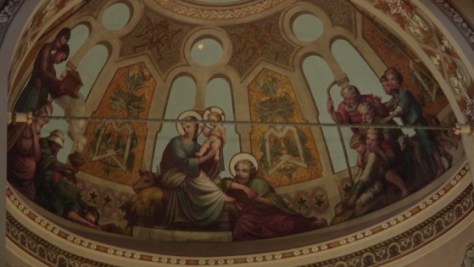
Built by Napoléon Bourassa in between 1873 and 1882. Louis-Philippe Hébert did a bunch of the sculptures, while Toussaint-Xénophon Renaud and François-Édouard Meloche did some of the painting. It has the first organ built by Casavant Frères and La Vierge dorée was added in commemoration of its 50th anniversary.

Interior of the Chapelle Notre-Dame-de-Lourdes.