Category Archives: Ramble

Edward Burtynsky : OIL at the McCord Museum

Howdy!

Once again I’m late to the party. The exhibit was up from October 6, 2011 to January 8, 2012. I’m just realizing now, how backlogged those rhymes about the Triennale Québécoise and other things made me. Like Marie Chouinard’s The Golden Mean (Live) I saw it at the end of November, 2011. Jeez! It’s a good thing that there is a history of reviewing shows that you can no longer see, otherwise y’all would think that I am one of the most irresponsible people in the known universe. But before I go find a whip so I can flagellate myself, we gotta get to the verse:

Ed Burtynsky takes really big photographs.
For the most part I don’t think he does anything by halfs.
Big political statements
I hear they cost many many cents.

Mostly on concerns about the environment
Places with natural resources and the changes they underwent.
I really liked the images of the refineries,
Sometimes you gotta think duodecimally and not in binaries.

His pictures of highways were also very impressive,
The Golden State Freeway, like La Joconde is something I won’t outlive.
But condemning Talladega and Sturgis
Is where, from my beliefs, he diverges.

They’re images designed to make you pause and reflect,
I think it is the earth that he wants you to protect.
But it is possible to be too politically correct.

Yes, big photographs are good. I still get weak in the knees thinking about the Andreas Gursky show I saw back in 2002 in Chicago. Big (for the most part) is synonymous with good, especially when talking about photographs.

But this one raised more questions than it answered. The first one being, that it was sponsored by Scotiabank. The very same Scotiabank that has a mutual fund of $170 million dollars invested in “equity securities of Canadian resource based companies, including companies that operate in the oil and gas, gold and precious metals, metals and minerals, and forest products industries.” – The One Sheet (pdf). Does this mean that Mr. Burtynsky is allowing himself to be used for greenwashing purposes? Or is he just willing to take money from whomever without thinking about their ethics? Or something else? I dunno, as I said his show raises more questions than it answers.

The second question that came to my mind as I was looking at it, was how much oil did Mr. Burtynsky use in order to get his pictures? There are shots that could have only been taken from a helicopter. There are other ones where he went to rather obscure places (Sturgis, South Dakota, Walcott, Iowa, Baku, Azerbaijan, Chittagong, Bangladesh) which would have either required some serious long distance driving or flying. And while I’m fairly certain that in order to take his pictures he doesn’t travel alone, I gotta think that he has a rather large carbon footprint.

The reason I ask questions like these, is because according to the press release the images in the show “deliver a social and environmental message that is both disturbing and thought-provoking.” So I can’t be accused of being the only person linking the concern for the environment and the images. What’s that line about glass houses and stones?

But enough about the theoretical questions, what are the pictures like? ‘Cuz isn’t it possible to appreciate them aesthetically without giving one good gosh darn hoot about any political message that Mr. Burtynsky is trying to make? Short answer: For the most part they are very good. As I mentioned up above “Big (for the most part) is synonymous with good, especially when talking about photographs.

The longer, nuanced and more detailed answer is as follows: Spread over two floors, it presents something like four or five dozen images that vary in size from 68″ x 78″ to 29½” x 36½”, with most of them being 51″ x 63″. Organized thematically, they span three of the four sections that he lists on his website; Extraction & Refinement, Transportation & Motor Culture and The End Of Oil (somehow Detroit Motor City section didn’t make the cut at the McCord, I can’t understand why).

Now while I don’t know too much about photography, there was the aforementioned Gursky show I saw in Chicago and if my memory serves his teachers at art school were Bernd and Hilla Becher. Don’t quote me on this, but if they weren’t the first people to take large pictures of industrial things, they definitely were the folks who made it hip. Mr. Burtynsky definitely owes them something. What I’m not sure. Because he doesn’t copy them (at least as far as I can tell) but at least as far as recognizing that he is mining a field that they were instrumental in making.

Mr. Burtynsky, does them one better, his are larger and in color. Have I mentioned that big is good, when it comes to photographs?

For the most part his images are very formally set up. If I were to make a gross generalization about Mr. Burtynsky’s landscape photographs, I’d say that the picture would be taken from a high vantage point, if not a helicopter, some sort of scaffolding was used, there would be an immense foreground, taking up something like ¾ of the image. There would be mountains in the background, or something mountain-like taking up the other ¼ of the image. The sky (and this is where my knowledge of photography is woefully lacking) is completely washed out, to the extent that I would make a pinky bet that Mr. Burtynsky’s skies are very familiar with Photoshop (or Gimp).

AMARC #3 Tucson, Arizona, USA, 2006 Courtesy edwardburtynsky.com

The foreground is some kind of large collection of something industrial. Endless repetition of form with minor variations since each object is distinct. And since they are so large and there are so many objects in the picture it’s quite easy to literally get lost in it. On one side that’s the fun part. On the other, once you realize that there is a formula it kind of makes me think that while Mr. Burtynsky is making some sort of commentary on 20th century industrialization, he is at the same time being very mechanical in how he makes his pictures.

Oil Fields #10 McKittrick, California, USA, 2002 Courtesy edwardburtynsky.com

You get the picture.

One other thought that occurred to me as I was looking at the pictures. Not a single one was signed, and there was no information on how many prints had been made. Not that that would detract from the image itself, but it’s just that if I want to buy into the concept that the images Mr. Burtynsky makes are art and not just some mass produced industrial object that happens to look pretty, it would be nice to have his John Hancock on it and know that there were only XXX copies made. But I would guess I’m in the minority here. Or maybe he signed and numbered them on the back.

As I wrote in my notes, there really is no movement in the pictures. There was also a distinct lack of people in the pictures. While I didn’t keep count, there couldn’t have been more than half-a-dozen people. I wonder if Mr. Burtynsky has ever done portraits, and if he has, I’d love to see them. I’d guess that he would ask his subjects to dress in tuxedos. (ba-da-boom!) His images are that formal.

I always find it a tad awkward when I come across an exhibit that has an agenda, like this one does. Even if it is an agenda that I agree with. I find that trying to force an idea on someone by using an art exhibit extremely difficult. In order to do so, the the exhibit, for the most part, has to be incredibly simplistic. It tends to be repetitive as well, and I find that in order to make their point they end up being dumbed down to the point where the idea that they are trying to promote becomes more suitable for five year-olds than adults. As you might have guessed, I’m not five years-old.

But enough of that, and lets concentrate on the pictures. As I mentioned in the ditty, his pictures of highway interchanges are quite cool.

Highway #5 Los Angeles, California, USA, 2009 courtesy edwardburtynsky.com

I think part of the allure comes from the fact that he is using something like a helicopter to take the pictures. The pictures he gets are not the type of pictures that are available to M. & Mme. Tout le monde. And that I think is something incredibly significant. That sense of discovery, seeing something for the first time, is a sensation that shouldn’t be ignored. If he took similar pictures, as formal in their composition but from the perspective of a driver, they would not be one tenth as powerful.

Beyond that, if you are in London, England, I think that’s where the show is now, and it is probably going to continue touring and making more people aware of Mr. Burtynsky’s name. The catalogue for the show won some kind of award, but I’m not clear on how it is awarded, so I guess I should assume that it is legit, and not something where you toss the organizers some cash and you get a medal.

Being aware of Ed’s name is a good thing. It makes people aware of Canadian art just a little bit more. I just hope wish that he would push the envelope a little more, instead of playing it safe. He knows how to handle a camera, I’d like to see some images from him that prove that.

Les moments magiques by Michel Goulet at the Royal Victoria Hospital

Howdy!

About two years ago, I had a sudden flash of insight as to who I thought had created this art. But then I failed to write the name down, and now all I’m left with is the memory of remembering. But not remembering who.

Les moments magiques by Michel Goulet.

Which is kind of appropriate seeing as how they (it) aren’t that far from the Allan Memorial. But then I had another flash, “how about I write to someone at the Royal Victoria Hospital and ask?” Veronique Scott was extremely gracious and prompt. And if my memory serves, the “flash” I had about the artist wasn’t Michel Goulet. So I still have a ways to go.

Les moments magiques by Michel Goulet at the Royal Victoria Hospital in Montreal.

Done five years after Les leçons singulières (although the city’s database says that Les leçons singulières were done in 1992, M. Goulet’s website says 1990). They are similar in that they use copper and seem to tell some sort story.

Les moments magiques by Michel Goulet at the Royal Victoria Hospital in Montreal.

Although it is very very similar in concept to the CCA Garden which was designed by Melvin Charney, who is definitely not Michel Goulet. It’d be nice to talk to both of them and get their thoughts.

Les moments magiques by Michel Goulet at the Royal Victoria Hospital in Montreal.

Continue reading Les moments magiques by Michel Goulet at the Royal Victoria Hospital

Marie Chouinard, The Golden Mean (Live)

Howdy!

I‘ve been feeling guilty. Last year, back in November, I saw THE GOLDEN MEAN (LIVE) (yeah, I don’t like things that are all in capital letters either… But that’s how she spells it) one of the newer creations by Marie Chouinard. I wanted to write about it, but then got hung up in the humorous verse cycle I wrote about the Quebec Triennial. By the time I had finished that, it was the beginning of January 2012, and the absolute need to write about a performance I had seen almost three months prior was more like a theoretical and potential concept than a valid reality.

But then on Friday I had a Marie Chouinard day. I first saw her at the DHC Art Foundation’s exhibit Chronicles of a Disappearance (more on that in a separate article, in short go hang out on the fourth floor for at least 30 minutes, Ms. Chouinard didn’t) in the afternoon. And then saw her at the performance of Je” by Dominique Porte (also more on that in a separate article) that night. But this time, Ms. Chouinard had to stick around for the entire performance because Dena Davida sat down right next to her and it would have been kind of awkward to leave in the middle of the performance – this is not to imply that the only reason Ms. Chouinard stuck around was because of Ms. Davida, because Je is pretty gosh darn good, but every other time that I have been in a black box with Ms. Chouinard watching something artistic, she has bolted long before the performance was over, unless it was one of her’s. But I digress.

Then I kept thinking about her participation in The Big Bang at the Montreal Museum of Fine Arts and figure now is as good of a time as any to spill what’s been inside of me on and about The Golden Mean (Live).
So before I forget how, first a bit of humorous verse about

Marie Chouinard’s The Golden Mean (Live)


Marie Chouinard’s The Golden Mean (Live)
Might have been better if done as a shuck and jive.
Real Pixar lamps, some video screens and masked dancers
Lead to more questions than answers.

Zombies stretching” is how I described the dancers movements
There are numerous things that I can think of that would make for improvements.
The only thing I really liked was the woman with the four sided mask
It was almost as good as the art of Karen Trask.

I‘ll have more to say, not in rhyme, but in prose
Somehow rhyming is difficult when holding your nose.

It actually wasn’t that horrible. It’s just that when writing in rhyming couplets I tend to make everything black or white. No shades of gray, whatsoever. It isn’t like I walked out in the middle of the performance or anything.

But getting to the meat of the matter, I imagine that somewhere Ms. Chouinard believes in her heart that The Golden Mean (Live) is truly saying something. Unfortunately it is in a language that I have an extremely hard time understanding.

In French the title is Le nombre d’or (Live) which really translates into English as The Golden Ratio (Live), not the Golden Mean. The Golden Mean has more to do with Nicomachean Ethics, whereas The Golden Ratio is 1.6180339887… referred to in most of the literature in the press kit (yes, Virginia, I do occasionally get press kits).

Also in perusing the press kit, while the piece itself may be named after a mathematical principle (A+B is to A, as A is to B) the piece itself doesn’t seem to be as rigorous. I read reviews where it was danced by 10 dancers in one place and 11 dancers in another and in Montreal there were a total of 14 dancers on stage. And as long as I’m going on about the press kit, there were nine photocopied articles in Spanish, Italian, German and Dutch. I’m not entirely certain what the point was. While I’d like to think of myself as a polyglot, in fact I am really just an old and fat opinionated American, commonly referred to as a Tête carrée here in Quebec. The idea that I can really understand four other languages, when I have a hard enough time wrapping my tongue around la langue de Moliere is just kind of silly and a waste of paper.

As long as I am nitpicking, according to Ms. Chouinard the dancers put on masks of the head of state of whatever country they are performing in. But it seems that when they were in Amsterdam last summer someone forgot to tell them that Jan Peter Balkenende had been defeated and resigned, and while technically still Prime Minister, was not the man in charge. It also might account for why it wasn’t performed in Brussels.

And while the catwalk is integral to the performance, in order to, as she told Catherine Lalonde of Le Devoir, get the dancers as close as possible to the audience, to literally penetrate the theatre. [J’avais envie de voir les danseurs au plus pres du public, de faire pénétrer dans l’espace de la salle.] But when it was preformed in Venice there was no catwalk, and it is because of that performance that Tanz magazine named Carole Prieur dancer of the year.

So obviously when you (or I) go to see The Golden Mean (Live), what you see and what I see are not going to be the same thing. I’m still trying to figure out if that’s a good or a bad thing.

If you’d like to see a 13 minute video of Ms. Chouinard describing how The Golden Mean (Live) was made and what’s it about, click on this (unfortunately, I wasn’t able to embed it).

But enough about the background and the nitpicking over details gleaned from the press kit. What about the dance itself? And the even more importantly the dancers? I’d love to be able to tell you what Mark Eden-Towle, Eve Garnier, Benjamin Kamino, Leon Kuperschmid, Lucy M. May, Lucie Mongrain, Mariusz Ostrowski, Carol Prieur, Gérard Reyes, Dorotea Saykaly and James Viveiros did and how they moved. But unfortunately since they were all masked, I have no freaking clue as to who did what. Although after the fact I did realize that it was Carol Prieur who did the unmasked solo.

Depending on where we are in the performance, the dancers are either all wearing some moth-eaten blonde wig with a kind of plastic face shield, occasionally with some hipster glass frames. Or they are wearing photographs of people that have been glued to something like foamcore to keep it rigid. There’s one set that was all Stephen Harper, another set that was a bunch of “old people,” and a third that was all of infants.

It was the infants that I particularly didn’t like, as when the dancers were wearing those masks, they were completely naked. My first thought was did Ms. Chouinard get permission from the parents of the infants before slapping their faces on masks? My second thought was what’s the point? When they had the masks of the infants on, nobody did much of anything. If it was for shock value, it didn’t work at the performance I was at. If it was to make the audience uncomfortable, I’m fairly certain that there were some people in the audience who were made uncomfortable, but it wasn’t a majority, and most people were very polite about it.

Then much later, I went to see The Big Bang at the Musée des beaux-arts de Montréal (I told you that I’d get around to it) in which Ms. Chouinard had some work. That work was four photographs of her dancers with the infant masks on. Apparently she was influenced by an incense burner which she likened to developing genitalia of fetuses. One of the many problems with it was that the crotches of the dancers were very much obscured. Using the lingo of the day, it was a #totalfail. It was made even curiouser because there is a dancer in The Golden Mean (Live) who imitates Marc Quinn’s sculpture Sphinx (Road to Enlightenment) which is at the Musée des beaux-arts de Montréal.

Marc Quinn's Sphinx (Road to Enlightenment)

Then at another point, some of them suck in their stomachs just like the statue by Mr. Quinn, and it isn’t pretty. So while the museum asked her to be influenced by a piece that they have (I think it’s a loan, and not part of the permanent collection) she just got confused or something. Another thing that struck me about the masks that were pictures of faces, was that for whatever reason, she had not chosen the picture of anyone who wasn’t Caucasian.

As I mentioned in the verse, an awful lot of the dancing was what I would liken to zombie stretching. Sometimes there was some undulating and Carole Prieur’s solo was what I called “tribal” or “voodoo.” There were a couple of times when two dancers would do something that suggested sex, but was more violent than erotic.

No matter how hard I tried, I really couldn’t put a finger on anything that would unify the whole piece. It didn’t come across as movement for movement’s sake. It sure as shooting didn’t have a plot. There weren’t any incredibly breathtakingly beautiful moments (or movements). In writing this, I am struck how it seems to me as a disparate collection of things that Ms. Chouinard wanted to copy. From the Pixar lamps, to the Quinn statue, I can easily see how each scene could have been copped from some image that she had taken, and then most fruit these days, grafted on to the performance.

It would be an interesting exercise to go through Ms. Chouinard’s sketch book (or the equivalent) while watching The Golden Mean (Live), it would kind of like this:

So there you have it. The Golden Mean (Live) isn’t a bad piece, it’s more of a blah piece. Nothing remarkable, good or bad. it sort of sits in my memory taking up space, and with a little luck that memory will inform future stuff better and worse.

Vertical Road by the Akram Khan Company

Howdy!

Who would’ve thunk? I kind of like it… OK, let me back track slightly. On January 27th, I went to see Vertical Road by the Akram Khan Company at Theatre Maisonneuve. The company was brought into town as part of the Danse Danse series (who also somehow forgot to give me a press kit, but I digress). In short they were pretty gosh darn amazing. In my notes I wrote “very cool,” “wicked cool!” “I’m riveted,” “Wow!!” and “She’s Amazing!” You get the idea.

In mulling things over, I wasn’t quite certain how or what I was going to write. It’s always easier to write something sarcastic and negative than it is to write something that praises. But then I started to do some cursory research, and one thing that stuck out like a sore thumb to me was how the whole shebang was sponsored by Colas. In the program they had even gone so far as to give some guy named Hervé Le Bouc a full page to explain how his company ended up being partnered with the Akram Khan Company.

I only had one small question. Who, or what was Colas? As it turns out, they are a French company that builds roads (or as they write in the program: Roads). As I wrote up above, “I kind of like it.” It being the idea that some industrial engineering company is paying some kind of coin (and I would imagine and hope that it is some serious coin if they are getting a full page in the program) so that contemporary British dance can be seen.

So it now becomes self-evident here the name of the dance comes from. Unfortunately I wasn’t invited to the dinner with M. Le Bouc and Mr. Khan so I can’t comment on whether M. Le Bouc had any other input into how the dance was created, or if he participated in any other way. Personally, I’d like to think that M. Le Bouc was a big dance fan going way back, and that over dinner he and Mr. Khan hit it off like a house on fire, brainstorming ideas ’till the cows came home. Then after they had become BFF, Akram (after all they gotta be on a first name basis by now) blurts out to Hervé “I know I’ll make a dance for your company!”

I also think it would be great if some of our local engineering firms that built roads (or other things) started sponsoring local dance companies. But somehow, I don’t see that happening for a while. Pity.

Despite not getting a press kit (me, obsessive? nah.) I was able to suss out that Vertical Road is supposed to be some kind of spiritual dance. Mr. Khan is quoted in the program as saying it is “the journey from gravity to grace.” But I’m not entirely clear on what that means, exactly. Is he referring to the force of attraction? Heaviness or weight? Seriousness or importance? Or something else. And grace has equally many definitions, none of which are exactly antonyms of gravity. In fact, riffing off of the seriousness definition you could almost make a point that gravity and grace were synonymous. Almost.

But back to the point at hand, the performance. In reading about it (after the fact) just about everyone seems to talk about Vertical Road as a journey by one person. That did not come across as strongly as you would think during the performance. Salah El Brogy definitely was the “lead.” But there was enough other stuff happening that the idea of a journey really only occurred to me after I read about it and then kinda nodded my head and said to myself (quietly) “yeah, I can see that…”

To me it was much more of a group piece done in about eight separate scenes, beginning and ending quite dramatically with a scrim. At the beginning, I couldn’t quite tell if there was one or two people behind it, and then I figured out that it was only one person, Mr. El Brogy – who I referred to as “the hairy dude” in my notes – because he placed various body bits on it in a kind of shadow play. But what was most impressive to me was how he banged it, like a gong or something, with his hand and it rippled like a vertical lake. At the end he goes back to the shadow play and when the scrim drops the show is over.

For the six other scenes, there is lots of running, jumping, spinning and the like. While I was watching I thought there were some similarities to various martial arts like kung-fu. But while doing some cursory research I came across this article from The Guardian that informed me that

Khan’s dance roots are in kathak – and it shows. It’s a style characterised by mathematically complex rhythmic footwork, spins, fluid arm and hand gestures, as well as dynamic contrasts between speed and stillness.

I also saw some similarities to the Dhikr performed by the Mevlevi Order (as I wrote that I was sticking out my chest proudly, showing off my madd wikipedia skillz!). In plainer language there were some bits that reminded me of Whirling Dervishes.

And if I remember correctly, I read someplace that Mr. Khan is a Sufi, and the whirling dervishes are also Sufi.

But then my theory starts to fall apart when I also noted that certain bits of the show reminded me of Loie Fuuller.

And no matter how hard I try I can’t make any connections between a 19th century American vaudeville performer and Mr. Khan. Other strange visions that jumped onto my head during the performance were of American football referees.

Touchdown!!
Touchdown!!

And Chinese terracotta warriors (mainly due to the incredible amount of talcum powder that was on their costumes and how solidly they stood at in the second and third scenes). In what I’m calling the third scene there’s a wicked cool back and forth that I would call a duet except that all eight dancers are on stage doing stuff. Where the shortest woman in the company (sorry but my memory is not good to begin with and since I didn’t get a press kit, trying to figure out if it was Eulalia Ayguade Farro, Konstandina Efthymiadou or Yen-Ching Lin is beyond my abilities – suffice it to say that they all are pretty gosh darn amazing dancers) does a kind of puppet and puppet master dance with Mr. El Brogy (aka the Hairy Dude) made even more spectacular because at various points they trade positions and that who was the puppet becomes the puppet master and vice versa.

It because of things like that, where Mr. Khan plays fast and loose with whatever plot there is, in order to wow and impress the audience with movement that caused me to that there wasn’t much of a path happening.

Some other brief thoughts I had were that while I have never been to Burning Man, the performance was very Burning Man-esque. Sort of like a 21st century version of transcendental meditation done while throwing bodies through space. And while looking up the dancers on the internet I discovered that Ms. Ayguade Farro also danced in the Hofesh Schecter company and immediately recognized the similarities in style between the two.

I should also mention Ahmed Khemis, Yen-Ching Lin, Andrej Petrovic and Elias Lazaridis. Just because they didn’t get anything that I would call a solo does not in anyway mean that they were anything less than kick-ass and amazing dancers. They were and are, and I can only hope that when I grow up that I can dance half as well as they can.

Dancers explaining

At which point I’ve gone way over any reasonable word count and should probably attempt to wrap this up somehow. An easy way? Next time the Akram Khan company shows up in your town, go buy tickets.

Weird Stuff at the Bay

Howdy!

Back on December 14th I was wandering around downtown (don’t ask me why I was hanging with the Christmas shoppers) and realized I had not been to the Hudson’s Bay Gallery before. It’s on the 5th floor of The Bay. And it was weird and wonderful.

The entrance to the Hudson's Bay Gallery.
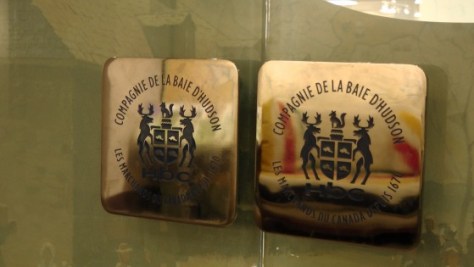
Cool Door Handles.
Cool Door Handles.
A wooden pig.
A wooden pig.

Yup, that’s right, a wooden pig, with the various cuts of meat clearly marked.

The other side of the pig.
Front of the pig.
Front of the pig.
Two pigs.
Two pigs.

At some point I need to find out where Hutton’s was. And why their models are in the Bay now. Then after I’ve solved that mystery, I’m going to have to make myself one (or maybe, two) just because I don’t already have enough useless stuff gathering dust in my apartment.

A hat.
A hat.
The hat in context.
The hat in context.

And you thought fashion only got funky in the 70s? The mock up of the store is supposed to recreate what Morgan’s looked like in 1894.

A bear.
A bear.
A scale (and it still works!)
Graphic representation of how the British plundered the world.

If you’re interested the Hudson Bay Company’s website does a way better job of actually explaining its history, but it’s way more fun to go down there in person. Promise.

Cool model of the S.S. Nascopie.

More details about the S.S. (now referred to as RMS) Nascopie.

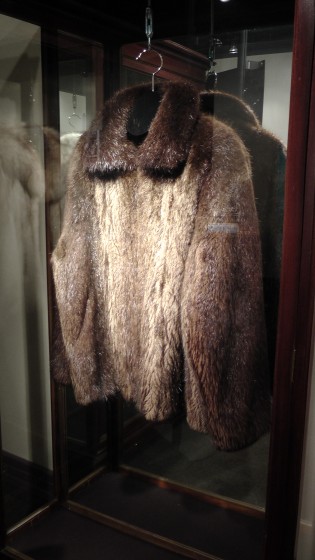
A beaver coat.
A beaver coat.
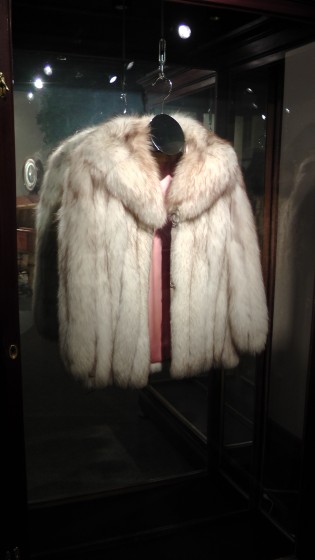
Not a beaver coat. (Maybe fox?)
Different types of animal skins.
Teaching how to pack a canoe.
How I packed the model canoe.
How the canoe was supposed to be packed.

You see? In person it can be interactive!

If you have an extra 15 to 20 minutes to spare the next time you’re at The Bay, go check out their gallery. It definitely could use the love.

Festival TransAmériques Press Conference

Howdy!

On Monday I was invited to the press conference for the Festival TransAmériques. It took place in the studios for ARTV at Places des Arts, a weird little room that was a far cry from where they used to do it (l’Agora des Sciences at UQAM). I don’t know if their budget had been cut or if they had spontaneously decided to shake things up. But either way the room was jam packed.

The view from my seat at the Festival TransAmériques press conference.

I’m torn between loving press conferences and hating them. I love them because they make you feel special. Press kits have all sorts of information that you otherwise wouldn’t know. In Montreal the press conferences tend to offer free food and drink. I hate press conferences because there are more significant and better ways to feel special. Once you’ve been to a bunch of press conferences on the same subject you tend to find mistakes and holes in the press kit. And the free food and drink isn’t always the best.

Anyhows, this one was notable because (as I’ve mentioned) it was in a new venue. They also couldn’t give me a press kit, and the food and drink consisted of bottled orange juice and cupcakes (they also were serving coffee, tea, bottled water and bottled apple juice).

The cupcakes (and tea and bottled water) at the press conference for Festival TransAmériques.

Despite my love/hate relationship with press conferences one thing that you always get at a press conference is a lot of “blah, blah, blah.

Sorry about the camera shake. I really wish people would learn that reading from a script is incredibly bad and completely stultifying. It gets worse when they don’t really have much to say.

Since I don’t really follow Francophone Quebecois Theatre, I had no idea (and since I didn’t get a press kit, still don’t know) who Olivier Choinière is or what he has done. But apparently it’s a big deal that the Festival TransAmériques is re-staging his Chante avec moi. If I caught it correctly, it’s a play with 50 performers. For whatever reason M. Choinière decided to recite all of their names during the press conference. It only occurred to me about halfway through the list how bizarre that was, so I only caught about the last third on camera. Sorry.

But then, every now and again you get something that makes it all worthwhile to be at the press conference.

Getting to hear a choreographer explain the stuff behind something they are making, five months in advance of when you’re going to get to see it, is kind of cool. Thankfully I had my wits about me enough that I was able to film her whole speech (again, sorry for the camera shake, you’d be amazed at how heavy a 20 oz. camera can get when you’re holding it away from you body for 4 minutes and 19 seconds).

But this one got even better.

They decided that they’d get Bernard Martin and Karina Champoux to perform. I’m looking forward to trying to memorize this little bit and then see if it actually makes it into the performance.

Also, if Danièle Desnoyers happens to come across this. (If you didn’t watch the video or can’t understand French – basically her dance is about nightlife in Montreal in the 40s and 50s. She’s much more nuanced than that, which is why I filmed her doing the talking. The title translates as Beneath the Skin, The Night) Besides Montreal Confidential by Al Palmer there is also Montreal by Gaslight by Anonymous which covers much of the same material but from a perspective sixty years earlier.

Then because press conferences are held for very specific purposes, I think that the information they wanted to get out to the public was this (remember, I didn’t get a press kit): This year’s festival starts on the 24th of May. It ends on June 9, 2012. Five shows have been announced. Two different ones by Anne Teresa De Keersmaeker’s company Rosas (pity that they couldn’t have coordinated the festival with Beyoncé’s performance in town, that would have been awesome!) Cesena and En Atendant, On the Concept of the Face, regarding the Son of God, by someone I have never heard of and the previously mentioned performances by Olivier Choinière and Danièle Desnoyers.

Tickets are on sale for the five shows as of January 30th. The Anne Teresa De Keersmaeker show at Place des Arts (the only show for which I asked about prices) tops out at $61 plus taxes plus service charges. But when I asked to see what seats were available it looked like most of the kick-ass seats had been held back for subscribers who will be getting their crack at the end of March. Apparently there is a 10% discount if you buy your tickets now. But I also imagine that there is some sort of discount if you subscribe, and I would guess that it might be even larger than 10%.

And in conclusion, if you’d like to read/see/hear what the other media outlets had to say about the press conference click on the links.

Montreal Gazette, La Presse, Le Devoir,

Les Angèles ces derniers bleus by the Collectif C’est Juste Lundi

Howdy!

Since my last attempt at a poetic review for a dance performance was a trainwreck (if you haven’t read Ken Monteith‘s comment, I urge you to drop everything right now, and do so, and while you’re at it you should read his blog as well.) I figured I can revert back to something a little easier this time…

I’m not certain I’m any closer to understanding Les Angèles ces derniers bleus (loosely translated to The Angels’ Latest Blues) but it somehow makes me smile and think that everything is linked. I went in thinking it was going to be some sort of dance performance. I came out realizing it was something much more than that. Basically, a collection of things “Angel.” With a heavy emphasis on a certain American television show from the 1970s.

I wasn’t keeping track of how many angel references they actually used, but the ones that I did catch were Bobby Helms‘ (the voice behind Jingle Bell Rock) You are My Precious Angel.

Doreen Virtue’s Angel Therapy [no video, click on the link to hear her radio show] and most obviously (although, believe it or not, it took me about 20 minutes into the performance to realize it) Charlie’s Angels

.

I’m not much into angels, but some that they missed were AngeNeige, the angel store run by my friend Franceen, up the street from La Chapelle (the theater where they performed it). The Blue Angels, the United States’ Navy’s flying aerobatic team. And The Blue Angel, the Marlene Dietrich film, directed by Josef von Sternberg.

I’m certain I missed scads upon scads. Both in the performance and not in the performance. Feel free to let me know what I’ve missed (and bonus points for doing it in rhyme). But you get the idea.

Initially and for a good half to three-quarters of the performance I was trying really really hard to figure out (or perhaps impose) a plot on it. I’m not entirely certain why. Possibly due to some outdated belief that if there are characters, there must be some sort of narrative. Kind of like still arguing for the Ptolemaic system, old habits die hard. It was only when I realized that there wasn’t any real plot, that I was able to realize that it was a pretty gosh darn good performance.

To get the easy stuff out of the way first, it was a minimalist set. Two table lamps (one with what looked like goldfish embedded in the base), three manequin heads, a TV and a phone. There might have been some other things as well, but the action started and I got distracted while I was writing things down, so I don’t know if my list is a complete or incomplete inventory.

Pierre-Marc Ouellette came on stage first in a red suit and started doing some kind of disco dancing that veered towards Elvis

then towards a more freer hippy style, before going all YMCA, but spelling A-N-G-E-L-E-S instead.

The three other members of the C’est Juste Lundi collective come on stage, Hinda Essadiqi, Karina Champoux and Emmanuelle Bourassa Beaudoin. They shake, they emote and then they start doing some rather complicated and fast moves. Up and down, kind of dog-like but I was very impressed with how tight they were, Anne Thériault their rehearsal director did a mighty fine job. Their timing was impeccable and incredible.

They do some more emoting, use some finger guns, run around and then bring out a TV which shows an edited version of the opening sequence from Charlie’s Angels (and at the same time allows everyone to catch their breath and change costume). Then M. Oulette and Ms. Champoux do a duet that involves some blue clothes. Ms. Bourassa Beaudoin comes on stage and uses one of the mannequin heads as some sort of appendage to her body. Ms. Essadiqi then gets a solo that has something to do with an address book and a pen, and then Ms. Bourassa Beaudoin brings a cassette player out and sticks her head above a fan so her hair can billow. Everyone starts go-go dancing and finally Ms. Champoux starts playing a ukelele and whistling while the others are doing bird calls and the lights fades.

You see? No real plot to speak of. But to repeat myself that is not a bad thing.

While I generally prefer not to single out specific dancers, Ms. Essadiqi definitely got the lion’s share of my notes and attention. In retrospect I found it a tad strange, because as an adolescent I definitely preferred Sabrina Duncan and Jill Munroe to Kelly Garrett. And Ms. Essadiqi was playing the Jaclyn Smith character.

I should also make mention of Denis Lemieux who helped with the costumes (I’m not sure exactly how or what he did to help, but that’s what it says in the program) and the costumes were pretty darn good as well.

In the program and the press kit and the website, they emphasize the word ludique, which because I’m a bloke with a bad vocabulary, thought had some connection to being a Luddite, and not the notion of playing. After looking it up in numerous dictionaries (just to be certain) it made perfect sense.

I’ve said this before (and I’ll probably repeat myself again) but I absolutely love the fact that Montreal, and by extension Quebec, is a place where artists are allowed to play and experiment with form and content. Les Angèles ces derniers bleus effectively is just that. But unlike an awful lot of other performances I have seen, it also manages to be entertaining for the audience (or at least this audience member) at the same time. It bodes well for future projects by the C’est Juste Lundi folk.

Yes, there are things that didn’t quite work, or could have worked better – but unless you’re Robert Lepage or Marie Chouinard you’re never going to get absolutely everything right all the time. And that’s my point exactly. Having the ability to try out things in a trusting and comfortable environment is a good thing.

I was somewhat at odds over, or maybe just confused by, the choice of angels as the overriding theme. I’ve never been religious, and have actually been accused of being an anti-spritualist (whatever that is). I’m certain if I sat down with Ms. Bourassa Beaudoin (who gets credit as the artistic director of C’est Juste Lundi) she would be able to explain in plain language how and why angels were chosen. But it was not immediately self-evident. Nor did it make itself known in the 72 hours following.

Playfulness is not normally something that is immediately associated with a strong sense of spirituality, although there are some paintings I can think of where the cherubim aren’t exactly moping around. Towards the end with the ukelele and the bird sounds, someone probably could point out some sense of spirituality, but it still would be a stretch.

However, since Les Angèles ces derniers bleus is definitely absurdist (in the best sense of the word) choosing to use angels as the main characters could be considered an absolutely brilliant choice just because of its oppositional quality. The performance is not something that is easily digested and sometimes in situations like that it’s best just to swallow it whole without chewing.

I wouldn’t (ok, maybe I would) try to figure out where Les Angèles ces derniers bleus and C’est Juste Lundi fit in in the grand scheme of things performance in Quebec. But they (and it) definitely belong. I haven’t looked all that hard, but I didn’t see them on the cover of Voir, nor did I hear anything about them on Radio-Canada, which is kind of a pity, because many other less deserving projects have gotten both.

And then finally (‘cuz I definitely have rambled on for far too long) after some reflection; Les Angèles ces derniers bleus by the Collectif C’est Juste Lundi, is trying to incarnate some kind of mythical childhood. None of the performers is old enough to have even been thought of by their parents when Charlie’s Angel’s first aired, and as it was most definitely an American (as opposed to Quebecois) television show, they all are starting out with two strikes against them. So the entire production must be based on some sort of concept that never existed in anything except their minds. And I like that.

Big Bang at the Montreal Museum of Fine Arts

Howdy!

Like everyone, a museum gets the winter doldrums
Organizing an exhibit is better than twiddling one’s thumbs.
I can hear them now, “we’ve got two and a half months to fill.”
“Something local and cross-disciplinary would fit the bill!”

Let’s get some local vedettes, get them to choose something from our collection
Have them respond in kind with their art, kind of like making a connection.”
In theory and on paper the idea looked good if not great,
The sad truth of the matter, unfortunately was a bunch of art that was second rate.

The first pairing was Rodin with Michel Rabagliati
The cartoon and the sculpture were fine, but the incessant noise drove me batty.

Pierre Soulages and Roland Poulin
Brush strokes on canvas, brushed metal, sounds like a plan.

Jean Verville and Pierre Lapointe used Patrick Join’s C2 chair
Stacked plastic chairs and a ditty on a piano was what we were supposed to compare.
There was no info on the song, and I bet their stock came from Home Depot.
I can’t quite decide if they mailed it in, or if they just had a budget that was cheap-o.

Adad Hannah and Denys Arcand wanted to use Archizoom’s Safari Sofa
So they made a multi-channel video about a bunch of cocaine snorting loafers.
The sound track should have been disco but was more world beat
And there were other details that, for me, made it incomplete.

Renata Morales likes George Segal’s Woman Sitting on a Bed
She made something to represent everything in the woman’s head.
Birds and dolls made from cloth, a tad simplistic,
But from a clothing designer quite artistic.

Jennifer Alleyn and Nancy Huston used some drawings from Jennifer’s dad.
The technology failed and as a consequence this installation was both sad and bad.

Gilles Saucier used Composition 11 by Borduas
One shiny white wall, one shiny black wall, kind of blah.

Riopelle’s The Circus was used by Jeannot Painchaud
She took it kind of literally and her videos of circus performers fairly glowed.
Next time, I’d suggest instead of the title that she focus on the content
Making something that combines with the original, to augment.

Marie Chouinard was the most egregious
The pictures of her dancers were atrocious.
Looking at them, you couldn’t see the piece from the museum
Perfect definition of the word hokum.

Melissa Auf de Maur liked Hodler’s Halberdier,
Taking pictures of herself naked with old army gear.
How a panoramic camera becomes a weapon
I something that I can’t reckon.

En Masse used Penck’s Start of the Lion Hunt
As an excuse to paint a large room, left, right, back and front
Completely with cartoon like drawings in white and black
Their work is not a tough nut to crack.

Wadji Mouwad used a photograph by Catherine Opie
As a means to talk about childhood very aggressively.
But beyond the quote, I think all the art was made by Raymond Marius Boucher
He gets credit for “Art Direction” and probably can better make what Wadji wanted to convey.

Genvieve Cadieux compared her work to Tom Thomson’s Northern Lights
Marfa, Texas is not Northern Ontario, unless it’s history she rewrites.

Claude Cormier used a piece of 12th century religious art
And a wall of stuffed animals, probably thought he was being smart.

Jean Derome wasn’t content with just one.
27 paintings, and 72 pieces of music is just a little overdone.
It would have been nicer if he hadn’t relied so much on chance.
And if there was more light, viewing the paintings would have been enhanced.

Rita redid a Lawren Harris painting as couches
Stéphane Halmaï-Voisard and Karine Corbeil are no slouches.
Nice to end the exhibit on a high note.
Leaving with a smile is always good; quote, unquote.

Metro Georges-Vanier

Howdy!

More pictures of obscure metro stations. Pierre W Major was the architect and the only other thing that he built that I can find online is the Saint-Justin Church.

A tile circle
A tile circle
A tile circle
A tile circle
A tile circle
A tile circle

My best guess would be that he kind of liked (or maybe was one of) Les Plasticiens even though it was built in the 70s.

A tile circle and a tile quadrilateral
A tile quadrilateral
Horizontal brick stripes
Diagonal brick stripes

Continue reading Metro Georges-Vanier

Namasya by Shantala Shivalingappa

Howdy!

So I went to see the second of Shantala Shivalingappa’s performances last Friday. This one was all-contemporary all-the-time and as a consequence was not as mystifying to me as her kuchipudi performance a week earlier. This one was a little shorter, about an hour in length, and was made of only four different dances. All with extremely evocative names; Ibuki (breath of life), Solo, Shift and Samarana. Also instead of highly elaborate and fancy saris, Ms. Shivalingappa wore very plain monochromatic costumes that seemed to be made more for comfort than for anything else. Although she was using the same pink toenail polish as she had for the kuchipudi. I presume that she, like Gene Kelly, is a firm believer in the idea of high contrast on and around the feet so as to better direct your eye.

httpv://www.youtube.com/watch?v=tciT9bmCMq8

Despite it’s name, Ibuki (breath of life) the first dance had nothing to do with the character from the Street Fighter III video game series.

Ibuki from Street Fighter III by Stan Lau

And from my seat (actually the second one of the eve, we had accidentally sat in the wrong seats to start) I couldn’t make the connection to anything related to a set of lungs either, despite the fact that in Japanese, the word ibuki, translates into breath.

But neither point really matters, the title of an abstract dance piece isn’t quite exactly the most significant thing. The more I see them, the more I become convinced that whomever names them, for the most part might actually be in a bubble of their own creation, and have no real concept of the possible broader connotations. Ibuki (breath of life) starts and ends with Ms. Shivalingappa lounging on the stage, in something that looks like a sleeveless white pantsuit, almost as if she was posing for some sort clothing ad. In between those two fashion advertisements she does a lot of slow moving and some fast moving which initially I found very jarring. The music is something flutish by Yoichiro Yoshikawa. Not to belittle the music, but it’s fairly straightforward and typical world fusion. A day later I have some vague memories of something that would be played if I was in a movie and approaching a Buddhist temple. But then later in my notes I wrote “Generic World Fusion Music” which would make me believe that somewhere in the middle some other instruments and rhythms might have appeared. For what it’s worth I don’t remember, but I wasn’t there to hear the music.

I was there to see the dance. Or more precisely, how Ms. Shivalingappa moved. As I expected, she moved exquisitely. There were some points where it looked like she was swimming upstream, others where she imitated a rotating cell phone tower, and at some point I noted how she ran around the stage coquettishly. But all of those paled in comparison to what I duly noted on my pad as “THE HANDS!!!

It was the same exact movement (or pretty gosh darn close) that she had done with her hands in the kuchipudi performance, last week. Since I’m not going to use as much video, let me see if I can describe it in writing: Take one part butterfly, a large dose of Archimedes’ screw, the perception of air blowing, one of those time lapse photography videos of a flower blooming and apply liberally to your imagine in order to visualize a movement involving both hands together, touching at the wrists and spinning that starts at about waist level and finishes above her head.

At one point my insides turned to jelly as Ms. Shivalingappa looked directly at me. Thankfully it was dark, so I think, despite the start that it caused me she was just looking out into the audience, without really focusing on me. She did this just before doing “THE HANDS!!!” a second time. If I were a 15 year-old boy, I would definitely swear up and down that there was a connection.

It’s a good thing, I’m not a 15 year-old boy.

After she returned to the fashion model pose for the second time, the lights went dark, she scurried offstage and this large blurry video of her in blue and orange sari doing what I presume was some kuchipudi dance was shown while she changed. If there would be anything negative about the performance I would say it was the video interludes (there were two others, of which I won’t write an awful lot). There’s gotta be some better way to pass the time while doing costume changes than making Ms. Shivalingappa’s movements the equivalent of moving wallpaper. Something like an animated graphical presentation of where the dances originated that used pretty colors, or whatever the Indian equivalent of the drive-in interstitial is, or in other words something that is instantaneously recognized as the wallpaper and time killer it is.

http://wwwv.youtube.com/watch?v=q8BHqQamnNM

As long as I’m embedding video, watch this

httpv://www.youtube.com/watch?v=HSYCSxRvT0I

It was the second piece of the program. Called “Solo” and possibly choreographed with or by or under the supervision of Pina Bausch (the program reads “Choreography made during a residency at Tanztheater Wuppertal-Pina Bausch.” So it isn’t exactly clear, and if you read it fast, you definitely get the idea that some really influential but dead choreographer had a hand in it. (And now after seeing it for the third time, I finally read the title on the video to see that it was Ms. Shivalingappa who in fact did the choreography.)

Now if you watched really closely, you can skip over the next 500 or so words, because now that you’ve seen it, you don’t need to read my description of it. Or if you prefer to skip over the video, thanks tons and continue reading.

First off, the music is by Ferran Savall. If I hadn’t read it in the program I would have guessed José Feliciano. I should also mention that Mr. Savall’s mom died two days before the performance.

Second off, Ms. Shivalingappa kind of dances like the hippy older sister of a friend of mine. I’m certain there are a bunch of allusions in the dance to things that I am unaware of since I haven’t seen all that much dance. Her arm moving like a sweeping second hand and with her body following, the way that she holds her head from teh top while following her hand strike me as being just incongruous enough to the rest of her movements that I would think that they were placed there for slightly stronger reasons than “they flowed.”

At the risk of sounding clichéd “Solo” is dance for dance’s sake. Basic form making beauty, as done by Ms. Shivalingappa. No more, no less. Somehow it makes me think of a painting by Mark Rothko.

The third piece “Shift” was also choreographed by Ms. Shivalingappa – I gotta hand it to her, in this day and age when everything dance seems to be centered around the choreographer, Ms. Shivalingappa is successfully bucking the tide and bringing the focus back to the dancer – and this one says so in the program.

Shift” starts with Ms. Shivalingappa in a classic ninja pose, you know the one, where they are jumping through the air, their trailing arm raised above their head, one foot fully extended, as if they just finished some humongous kick. Just like that, except she’s not flying through the air, she’s crouched on the ground. From that position she kind of walks/creep across the stage.

The main feature of “Shift” is the A-OK sign she makes with her fingers, her index finger and thumb are slightly pinched together instead of being in a circle.

A OK
A OK

She uses it a bunch of times during the dance. Unfortunately, I have no idea if it has the same cultural meaning in India as it has here. But I do know that in France it is used to signify zero, instead of everything being alright. And what in means in the context of her dance, I have no clue. It kept my attention focused on her hands for the most part of the performance, and while she did not make “THE HANDS!!!” her fingers wiggled a bunch and she made it obvious that she had mastered how to move each digit on its own (and I won’t get into the anatomy of the hand here, suffice it to say that it is complicated). I don’t know who composed or played the music, but for the most part it is just a bunch of hand drumming, although after a very intense period where she continues to move while there is no musical accompaniment towards the end the music starts up again and some steel pans get involved as well. In contrast to the rapid rhythm of the drum, her movements are slow and deliberate, during the show I wrote “zen moves,” “stylized martial arts.”

I think “Smarana,” the fourth and final dance, is a Sanskrit word meaning “the act of remembering.” Sadly, I have no idea if that is the idea that Ms. Shivalingappa is trying to give. My knowledge of Indian languages (besides Sanskrit there’s also Punjabi, Hindi, Tamil, Urdu and dozens of others). It was choreographed by Savitry Nair who also is Ms. Shivalingappa’s mother.

Most of it takes place while Ms. Shivalingappa is sitting (or kneeling) on the stage. There is a spotlight directly above her that causes some pretty cool shadows to be cast. During the performance I tried to write just her moves, almost like a play-by-play announcer during some sporting match. This is what appeared on my pad:

Sitting middle stage, back to us leaning over, she rises on her knees and wiggles back and forth, One foot extended, and slowly turning, while holding ankle, cross over and turn, spin, fetal position, Roll over, Extend and cross feet, sit up startled, calm, turn around, sweep hand back and around, Upright fetal position, get up on toes, spin around 360, crouched over all still slow, Notice shadow, Back kneeling, arms doing a balancing scale side to side, Faster, then stop wiggle fingers, Raise hand, Kneel forward and reach around, arms akimbo, slowly raise her hand, Slow and fast, A-OK again, looking like a flower, and it slowly fades out

It was an experiment, trust me the dance was much better and more interesting than my description.

At this point, I’m getting to the limit of even what I can concentrate on. I wanted to explain the choreography of Ushio Amagatsu, Pina Bausch, Savitry Nair, and explain how they are all fairly important, which would lead into a couple of paragraphs on the the similarities between kuchipudi, butoh, and some other dance styles. But I’m going to have to save that for another day.

In closing I can only express my disappointment that it took her so long to get to Montreal and that we got such old shows (both Namasya and Gamaka are more than four years old). She’s been touring internationally since 2005 and has many other performances that could be presented. it kind of makes me feel that Montreal has become some kind of dance backwater, instead of being the leader that it used to be.