Howdy!
Submitted without comment, for the most part.


Howdy!
Submitted without comment, for the most part.
Howdy!
Back on Monday (who schedules dance performances on a Monday?!?) I got to see the opening night festivities for Quartiers Danses. Now as an aside the current scuttlebutt is that dance is the poor bastard child of the arts and gets absolutely no respect, no press and no one cares about it. Well I think that Quartiers Danses is the poor bastard child of dance festivals.
This was the first time in my life that I had seen an opening night where the theatre wasn’t even half full. and they had even taken up a bunch of space with tables replacing chairs, so to begin with there weren’t an awful lot of seats to fill.
Anyhows, since it is quite likely that you’ve never heard of it, Quartiers Danses is a festival that has its mandate to bring dance to the people. Instead of Mohammed going to the mountain, the mountain comes to Mohammed. Unfortunately given the crowd, it was more like a hill or a mound than a mountain.
All of this is a long-winded way of saying “pity.” Because for the most part it was quite good. There were four short pieces performed; L’Absense by Marie Brassard, danced by Sarah Williams. Sente by Lucie Grégoire. Dédale by Françoise Sullivan, danced by Ginette Boutin. And an excerpt from Out of White by Jane Mappin, danced by Francine Liboiron.
I gotta hand it to whomever programed the evening (I presume it was Rafik Hubert Sabbagh) they kind of knew what they were doing. For the first time in my life I thought that the evenings programming went as well together as a well done set by a DJ or a well curated exhibit at a museum. You know the sensation you get when you suddenly sit up and say “Hey! Those things not only only go well together, but they compliment each other and actually make more sense together than apart”? Kind of like that.
I hear y’all asking “why?” (Or my preferred question: “How come?”) Well, they are all variations on the same idea. Basically one woman swaying in space with a focus (more or less) on one part of the body. In Sente it’s the hips, Dédale the arms, and in the excerpt from Out of White it’s the legs.
There were also a couple of cool moments in L’Absense due to the backdrop sort of looking vaguely floor-like and Sarah Williams’ ability to contort herself so despite lying on the floor, it appears as if the audience is hanging from the ceiling – just like one of those photographs by Alain Paiement.
It all really kicked in with Dédale (Daedalus for the people in the house who only read one language, yes that Daedalus). In my lifetime I must’ve seen a 63 year-old dance, but for the life of me I can’t remember one. And I’m fairly certain I’ve never seen a 63 year-old dance done in the presence of its creator. Because yes, Françoise Sullivan was in the house (and yes, I was too chicken to go up and talk to her).
The backstory: Françoise Sullivan first performed Dédale on April 3, 1948, the same day that Harry Truman signed the Marshall Plan and the very same day that Arlette Cousture was born. For reasons that I won’t go into here (you can find the details elsewhere) it’s a fairly significant piece of of work within the context of Quebecois culture.
I don’t know if it has ever been performed since then (my guess would be yes) but either way, it’s still pretty gosh darn cool to see a dance that was made way back then. For the most part dance eats its young and not an awful lot of it survives to adolescence, let alone old age.
Nine minutes long, it starts with Ms. Boutin tapping on her hip and then expanding on that movement ever so slightly over time until she is rolling about on stage. Even if you don’t know the story of Daedalus it works. And as a connecting piece between Sente and Out of White it works even better.
Sente is basically a woman swaying to some fado, while a woman recites something over it (apologies, but I wasn’t really paying attention to the monologue. I’m certain it was important and would have aided me greatly in gaining a deeper and more meaningful understanding of the performance, but I was kind of getting a kick out of watching Lucie Grégoire move. Sometimes a superficial and simplistic appreciation is all that is needed).
And then in the excerpt from Out of White you get Francine Liboiron lying on her back making her legs act like hand puppets. It’ll be interesting to see how that little bit fits into the larger piece which I am going to see on Thursday, I think.
None of the dances have any elaborate costumes or fancy lighting. The soundtracks (when there were any) were either completely ignorable, as was the case with Sente or completely forgettable, as was the case with the others. So basically what you got was dance. Movement in a fairly controlled and focused state. And when it’s done well, it definitely deserves to have more than a half empty house watching.
One suggestion that I would make to the fine folk who organize the Quartiers Danses, is to switch the time of year when they present it. Trying to compete with all the other season opening events is not working. I’ve followed it now for about three years, and each year (this one included) I’ve always thought “how can I squeeze it in?” Most other dance organizations kick in with big-budget press and marketing at the beginning of September (how many of those Rodin/Claudel ads have you seen?) and trying to compete is obviously not working.
Moving it to March or April would seem to me to be a no-brainer. While most marketing budgets will have been spent by then, the buds on the trees and the weather getting warmer and better make everyone more inclined to do things, get out of the house if you will. It worked for the Festival International de Musique Actuelle de Victoriaville, I’m certain it would work for Quartiers Danses.
Howdy!
Lets get this out of the way first and foremost: For the past two weeks I have been living and breathing Jocelyne Montpetit almost 24/7. Back in August I interviewed her, and if you’ve been watching this website regularly, you already know that there is a six-part interview with her available for your viewing pleasure. Well, in order to get that six-part interview here, I needed to do some editing. And in order to do the editing, I had to watch the film, again, and again, and again, and again, you get the picture.
All that being a kind of long winded way of saying that I’m not objective in the least. But then again, I rarely am objective about anything. But I digress.
The short version of my review of Avril est le mois le plus cruel by Jocelyne Montpetit at the Agora de la Danse could be summed up as “It’s great! Go see it.” But if you want the longer more detailed version, keep scrolling.
As you might have guessed, it was inspired by the first four lines of T.S. Eliot’s poem from 1922, The Wasteland. But, not the English version (obviously), the French. I transcribed the version that were in the program notes, but then noticed that they seemed a little bit different from what I was used to.
The English
April is the cruellest month, breeding
Lilacs out of the dead land, mixing
Memory and desire, stirring
Dull roots with spring rain.
The version in the program notes
Avril est le mois le plus cruel
Il engendre des lilas qui jaillissent de la terre morte
Il mêle souvenance et désir
Il réveille par ses pluies de printemps les racines inertes
And then a version I found online
Avril est le mois le plus cruel, qui fait surgir
Des lilas de la terre morte, mêle
Mémoire et désir, réveille
D’inertes racines avec la pluie de printemps
I’ll leave it up to you to decide which one you prefer and if the differences are significant or not.
I very deliberately did not re-read The Wasteland, not even the beginning before going to see the performance because a) I thought that it was inspired by the first four verses of the poem (my mistake; vers in French doesn’t mean verses, it means lines) and b) I did not want to make the mistake of wanting, or expecting, the performance to be a literal representation of the poem (I’ve already seen one of those).
And I’m glad I didn’t reread it until after the performance, because, knowing myself I would have gone looking for direct connections between both, and there really aren’t any. The performance is all about sadness. It just as easily could have been named after Anna Karenina, Madame Bovary, Fauré’s Requiem in D minor or anything else imbued with an overwhelming sense of sadness.
Anyhows, now that I got that out of the way we can get on with everything else. Before anything begins there’s a humongous block of ice (about four feet high, two feet wide and eight inches thick) front stage left and a bed with some glasses underneath it back stage right. I don’t know if it was intentional (and somehow I think it wasn’t) but on the night I was there (opening night, September 14) it looked like there was an image of a really really big tulip that hadn’t quite gotten around to blooming, yet. There also seemed to be something like pollen squirting out of the top.
I mention this, because if you use your imagination a tulip that’s just about to bloom with some pollen squirting from the top can, and does look like something else, and neither of them look like lilacs. I also mistakenly thought that the glasses under the bed were bubble wrap. I think I might have to go see my optometrist to make sure my prescription is correct.
Dressed in a white nightgown to start, Ms. Montpetit comes out on stage from the rear and starts wandering around the stage. Although I should be horsewhipped for using the word wandering. Unfortunately words fail me when I try to describe how Ms. Montpetit moves and I end up sounding like a blathering idiot. After thumbing through my thesaurus, I guess it could be called a combination of slow, in control of every muscle in her body, deliberately ungraceful, beautiful, and emotionally moving. But that’s 121 letters, the word wandering is nine letters.
As is mentioned in the program notes, Avril est le mois le plus cruel is the first in a trilogy of Elegies (or if you prefer, Élégies) that Ms. Montpetit is creating. Dedicated to Tomiko Takai, who died in May, I do not know if it was directly inspired by her death, but as I have already mentioned, her performance is very emotionally charged almost completely permeated with anguish, despondency, disconsolateness, dolefulness, dolor, dysphoria, forlornness, grief, heartache, melancholy, mournfulness, mourning, poignancy, sorrow, sorrowfulness, and woe (man I adore thesauruses!)
To quote another famous and sad piece of English literature, “there’s the rub,” expressing a difficult and deep emotion without saying a single word. But Ms. Montpetit makes it look as easy as falling off a log.
At this point, I gotta remember to mention Sonoyo Nishikawa who did the lighting, he (she? Are Japanese names like Italian names and the boys get the “O” and the girls the “A”?) did a phenomenal job. Not only did I think a bunch of glasses were bubble wrap, but about two thirds of the way through the performance, they made the bed disappear. Solely through judicious use of spotlights. I can’t say I was as enthralled by the soundtrack, some Arvo Pärt, Louis Dufort and Alessandro Scarlatti (at least I presume it is Alessandro Scarlatti, since the other two Scarlatti’s weren’t known for their vocal compositions and his first name is not noted in the program notes).
Beyond that, there’s not much more I can say. If you’re interested Ms. Montpetit not only “wandered” around the stage, sometimes she lay down on the bed, or next to the bed. There were a couple of times she writhed around on stage or crawled from place to place. She changed costumes three times, and by my count there were six parts (although other people who probably know far more than me say there were only three). And it all takes about an hour.
But basically, Ms. Montpetit is a living and breathing testament to the concept that somethings truly can’t be spoken or written down. They need to be experienced. Avril est le mois le plus cruel is one of them.
Avril est le mois le plus cruel continues at the Agora de la danse, tonight, tomorrow and Friday the 23rd at 8 pm. Tickets are $26. And I’ll bet you dollars to doughnuts that it has a couple of more engagements both here in Montreal and elsewhere.
Howdy!
As I said yesterday, I was on Île Sainte-Hélène earlier this week, and the haut-gamme, fancy-ass, upscale and real expensive restaurant Hélène de Champlain closed and they are doing some sort of renovations on it. But what I didn’t know and fascinated me was the rose garden in front of it. Next year I’m going to have to go back earlier in the season. because it was kind of slim pickings in mid-September.


Howdy!
I’m getting backlogged. In case you’re interested, these are the various articles and videos that I am working on. If I’m good they will all show up here in the not to distant future.
Art Reviews:
Berlinde De Bruyckere, John Currin, O.N.E.
Book Reviews:
Roadworth, Montreal en paysages, Marcel Brisebois et le Musee d’Art Contemporain de Montreal, Blowing up the Brand.
Videos:
Nouveau Palais, Gourmet Burger, Griffintown Cafe, Family Ties at Stewart Hall, Margaritas, The Montreal Burger Tour.
If I’m not so good they all will show up in the very distant future…
Howdy!
Earlier in the week I went to Île Sainte-Hélène (more on that later) but while I was there I became a picture snapping fool! Besides these, of Alexander Calder’s Man, Three Disks (L’Homme), I also got pictures of most of the other public art and a whole bunch of roses (who would’ve thunk?!?).


Anyhows, Man, Three Disks (L’Homme), by Mr. Calder has got to be one of the more iconic statues, monuments pieces of public art in Montreal. But until earlier this week, I had never seen it, due to its location and the fact that I am not a real big fan of contemporary disco music (actually come to think of it, I’ve never been a fan of contemporary disco music even in the 1970s, 80s, 90s and 00s – I think it takes me about 15 to 20 years or so before I like any dance music. If I remember correctly I didn’t get a copy of Amii Stewart’s Knock on Wood until the late 90s, but I digress).


But as I was saying, Man, Three Disks (L’Homme), by Mr. Calder is a pretty gosh darn impressive piece of work. I’ll leave it to you to do the reading up on it that can be found on the internet (one, two, three). One thing I did not know is that it was moved from its original location in 1991. At some point I’m going to have to go back to Île Sainte-Hélène (for other reasons) and see if I can find where it was originally.

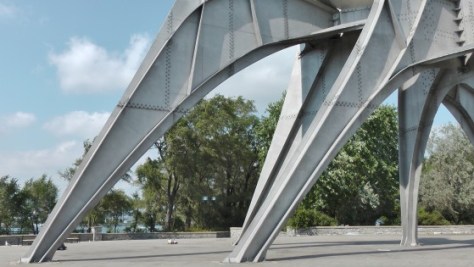

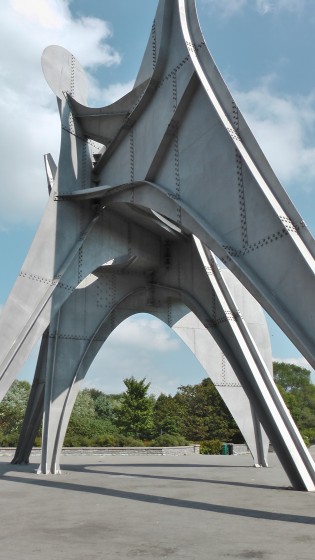
And finally, if you want to see other pictures of it (both in its original location and the new one) try these.


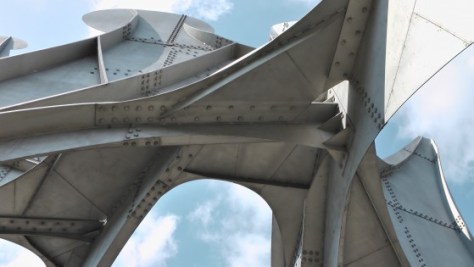


Turn up the volume and boogie!

Howdy!
When I first read this review in the New York Times last year, I said to myself, “Maybe, just perhaps I should go to London, it sounds like a pretty kick-ass exhibit.” But then life got in the way, I put the idea on the back burner and almost forgot about it.
But everything works, if you let it. And it wasn’t but a couple of months later that I discovered that the exhibit, Diaghilev and the Golden Age of the Ballets Russes 1900-1929 was going to be in Quebec City this summer. Sweet! While it is only a five hour plane ride from Montreal to London, it is only a three hour car ride from Montreal to Quebec City. Or in other words 40% shorter, and there’s room to stretch, and the food is better.
One problem, while I don’t know how to fly, buying a plane ticket isn’t too complicated. But as I also don’t know how to drive, trying to find a sucker someone extremely kind, nice and generous who would drive me and my sorry ass down river so I could see a bunch of ballet costumes that were almost a hundred years old did almost prove to be an insurmountable obstacle.
In the interim this review came out in Le Devoir (unfortunately behind a paywall) where Catherine Lalonde wrote « Demeure donc une impression de rendez-vous manqué. » Or if you prefer, “One gets a sense of missed opportunity.” Which almost put a kibosh on my desires. But thankfully I am pigheaded, persistent, and kinda realize that my cultural connections are much more aligned with the New York Times than they are with Le Devoir. So on August 29, I got chauffeured down the 20, and boy am I glad I got so lucky.
But lets back up here for an instant. First, if you need to know who Sergei Diaghilev is start with this book by Sjeng Scheijen. Don’t come looking for me to explain anything. Second, if you need to know what Les Ballets Russes were get this book by Lynn Garafola.
That’s one of the things I didn’t like about the Le Devoir review, given that a hard copy review has serious space limitations to use more than 30% of the word count explaining the historical background is a decision I’m not quite sure I understand.
Now that we’re all on the same page, what made it across the ocean is a slightly smaller and modified of the exhibit from the Victoria and Albert Museum called Diaghilev and the Golden Age of the Ballets Russes 1900-1929. Basically there was a whack of stuff added from the Bibliolthèque de la danse Vincent Warren and they cut some of the antecedents and maybe (my memory is a tad sketchy on this) some of the stuff that happened after he died. In Quebec there were nine sections in three galleries, in England there were (I think) two more sections, and I don’t know how many more galleries.
To cut to the chase, what got me were the costumes

Now a) I’m used to seeing my ballet from the cheap seats and b) most of the dance performances that I see these days are not ballet. So being able to get this close to them and see them from all sides was surprisingly quite a thrill. The pictures don’t do them justice.

I was also fascinated by this piece of psychedelia, made more than 30 years before the invention of the word psychedelic.

Unfortunately, as I was initially planning on just enjoying the exhibit, and not writing about it, I didn’t take a single note, and as you can see am having to rely on pictures from other sources. However after going through the entire show I did ask a couple of questions of Jean-Pierre Labiau, curator of the exhibition, and he was quite gracious and generous with his time. I was also able to score one of the visitor’s booklets that they gave everyone, so I don’t quite sound so foolish.
They also gave everyone an audio guide, which only contained music. As M. Labiau pointed out there isn’t an awful lot of classical ballet in Quebec City and I guess that they wanted everyone to be able to hear the music that would have accompanied the performances. I was able to avoid the difficulties Ms. Lalonde had, by just saying “thanks, but no thanks,” and walking around the exhibit without headphones.

Also, I’m not sure if I was the one setting up the exhibit, that I would have done it thematically. Given how didactic it was (sorry about my consistent overuse and repetition of the word didactic, but I’m going through a phase. Not in this article specifically, but in life and in general I’m using it way too much).

I think, arranging it chronologically might have helped a bit, but no one thought to ask me. And then another thought that occurred to me on the ride back was that while being able to see the Picasso, Matisse and Braque designed costumes was pretty cool, artists today, or make that contemporary Quebecois artists who paint, don’t do work in textile.
I don’t know if this is a good thing – keeping your artistic output focused always helps in getting recognition – but it was kind of cool. It would be interesting to see someone like Adad Hannah, Rafael Lozano-Hemmer, Shary Boyle or Isabelle Hayeur design ballet (or theatre) costumes or more generally work with fabric.
And being able to see the sketches by Picasso, Matisse and Braque (and lots of others as well – heck I don’t think I have ever been that close to anything Coco Channel touched ever before (or will be ever again) in my life.

And this too was interesting, virtual reality before they invented computers, or make believe you were Diaghilev in your very own home.
And as this was my first visit to the Musée national des beaux-arts du Québec, it struck me as being much smaller than I imagined, at some point I’m going to have to try to sucker convince or bribe someone to go back.
And then finally if you want to read someone else who is much more eloquent than I am on the exhibit, you should take a gander at Andrew O’Hagan’s review from the Guardian.
Howdy!
One of my favorite Montreal sculptures is Comme si le temps… de la rue by Pierre Granche. Unfortunately, in the most recent set of renovations to what used to be the Hall des Pas perdus of Place des Arts, but that they now call Espace culturel Georges-Émile-Lapalme they have just about killed it.

A little background; back in the early 90’s the Musée d’art contemporain de Montréal was planning on moving from Cité du Havre to downtown and getting themselves a brand spanking new building in the process. As the law stipulated, 1% of the project had to be dedicated to creating art. Even if it was a museum they still had to make more art specifically for the place (that’s one of the things I like most in theory about the 1% for art law, is that it ends up creating site specific work).
Anyhows, Pierre Granche [pdf alert] a sculptor and a teacher (he was one of the people responsible for the Universite de Montreal‘s visual arts department – and now that he’s dead, they no longer have one. Make of that what you will…) submitted a proposal and won. (I’m still going to have to try and find out who was one the jury.) And in 1992, what ended up getting built was Comme si le temps… de la rue.

Basically it was a bunch of aluminum cutouts in a semi circle with a waterfall. It was open to the sky and viewable from the esplanade of Place des Arts, which gave a viewer the chance to have a complete overview of the entire piece (which is not a small piece by any stretch of the imagination). And there is a skylight looking down into the Musée d’art contemporain de Montréal’s restoration workshops.
[Old pictures here, here, here, and here]
I never gave it much thought, always figuring that at some time in the future I would hunker down and give it the time, energy and thought that it required.
Well that time is now (actually, Sunday night, as I try to write these posts in advance of posting them). Because I was passing by over the weekend and from where I sit the powers that be (in reality Consortium Menkès, Schooner, Dagenais, Le Tourneux/Provencher, Roy Jean-Pierre Le Tourneux, concepteur Claude Bourbeau, chargé de projet) have completely and thoroughly killed, destroyed, ruined and entirely screwed up Comme si le temps… de la rue [pdf alert] by Pierre Granche.
In short, by placing a roof over it and turning off the waterfall, they have stripped the sculpture of all meaning, significance and comprehensibility. it is now no more than the equivalent of a fancy-ass and extremely expensive indoor lawn ornament for the Deschamps bar at Place des Arts.

From the seats at the the Deschamps bar, it is completely and thoroughly impossible to get any perspective on the piece. By being so close to it, you literally can’t see the forest for the trees.

The roof of the bar prevents you from seeing the tops of the sculptures. And by being so close you can no longer gain any perspective on the base. And perspective was what Comme si le temps… de la rue was all about. There are two extremely large and two merely large aluminum sculptures that depending on which way you swing could represent either the ancient Egyptian god Sobek, or the ancient Egyptian god Set. There are also a couple of construction cranes, and seven things, that again (depending on which way you swing) could either be some sort of vaguely sphinx-like objects, or if you squint really heard could be viewed as some kind of deer or reindeer-like domesticated animal.

My quick and dirty translation of the plaque for the blokes in the house
Pierre Granche’s installation offers a mythical vision of Montreal. Inspired from Greek Theatre and Egyptian iconography, it works a representation of the urban fabric between Mount Royal and the St. Lawrence River through the use of a waterfall. Sculptured female figures used as a columns in an Egyptian style with bird’s heads refer to the history of art and architecture in a totem pole fashion. The sphinxes with deer antlers make their presence known on the outskirts of a city in action. And finally, the bird’s eye view of the work was from the esplanade of Place des Arts Preview, reflects the city as the top of Mont Royal.
OK, how many mistakes can you spot? If I were a tourist wandering through Espace culturel Georges-Émile-Lapalme I’d be scratching my head in wonder, trying to figure out what the heck they were talking about. Waterfall? Bird’s eye view? There ain’t none, no more.
And while I’m at it, there isn’t any Greekness (theatre or iconography or anything else) in the piece. When they are writing in French they use the word cariatides or in squarehead speak: caryatid, or in plain English “a sculpted female figure serving as an architectural support taking the place of a column or a pillar supporting moldings and bands on her head.” (Thanks Wikipedia!) And they speak of it as the parts that are Greek. One problem though, a column by definition supports something. And these objects don’t support a darn thing. Comme si le temps… de la rue is 100% Egyptian in its influences.

And as long as I am disputing the “official” wall plaque. Those aren’t deer antlers on the sphinxes either. I don’t think that there ever was a 37 point buck that ever lived… anywhere.

However, if you go with the idea that the two extremely large and the two merely large sculptures are representations of the Egyptian god Set, the god of chaos and foreign lands. Then I think we’re getting someplace. The early 1990s in Quebec were a volatile place. Quebec was on the cusp of a referendum to separate, the Bloc Quebecois were founded in 1991. In between 1990 and 1993 there were 46 major buildings built in Montreal. The Montreal Expos were sold in 1991 and subsequently became one of the best teams in major league baseball in the early 1990s. 1992 was also the 375th anniversary of the founding of Montreal. There were a ton of things happening in Montreal at the time and there was most definitely a sense of chaos in the air (if you don’t trust me, ask someone else who lived here then).

Also if you look closely, on each of the Sets, there is a cityscape, with some sort of root structure. I’m not quite certain what to make of the root structures. But if you flip them upside down, they become the deer antlers on the sphinxes. And there are no known instances of deer appearing in ancient Egypt. But maybe, kind of, perhaps it has something to do with some sort of family tree-like structure? I dunno.
But we’re getting off the point here. Comme si le temps… de la rue is all about Montreal. There’s a representation of the mountain on the largest Set, and the waterfall was a direct reference to the river.


And while we’re showing lots of pictures, here are some of it from above.


And then in consideration of the unilingual people in the house, Comme si le temps… de la rue translates as “As if time… from the street.” You can fill in the blank yourself, but by referring back to ancient Egyptian times Granche endows Montreal with a similar sense of history. Despite it being made when Montreal was only 350 years-old, if you squint hard enough (or maybe click your heels three times or go to the Neighborhood of Make-Believe) you can pretend that Montreal has been around for more than 5,000 years, just like Egypt.
Then my last question is, if it was made for the construction of the Musée d’art contemporain de Montréal and is directly on top of their restoration workshops, why does it belong to the Place des Arts collection? Shouldn’t it belong to the Musée d’art contemporain de Montréal?
Howdy!
What is it about Montreal and place temporary sculpture exhibits in parks where junkies hang out? Last month I wrote about Robert Lorrain at the Parc des Faubourgs, and at about the same time as I was writing that, I discovered the Glen Le Mesurier exhibit called Arcane de Mer at Cabot Square.
Cabot Square, for those who don’t frequent it all that often, is across the street from the Pepsi Forum and is notorious for being a hangout for junkies, hookers, hustlers and other assorted members of the not-quite-ready-for-the-nine-to-five lifestyle. I, myself, can remember selling oregano cigarettes, 3 for $5 there before a Gentle Giant show there in the 1970s.

Yeah, I know it’s not a great photo, but if you squint you can make out what it says. For the francophobes reading this, it roughly translates as
Glen Le Mesurier is a prolific artist know for making environmental sculptures. For 25 years he has show his work in Europe and the United States. In Montreal his work is on display at Sunset Garden [Ed note: it sounds WAY better in French as Le Jardin du Crépuscule] a permanent exhibit in the hipster neighborhood, Mile End. There are over 100 of his sculptures all over the world, Montreal and even in some private homes and stores. This exhibit of 10 sculptures made out of steel recycled from trains and ships took over two years to make. In memory of the voyages that Cabot made. These sculptures form an allegorical triptych combining movement, shipbuilding and spirit of adventure.
Overall it’s a nice enough exhibit. I didn’t get (or see) and of the kineticism of the sculptures, nor did any of them remind me of shipbuilding or Giovanni Cabot. But maybe whomever wrote the offending paragraph on the sign didn’t actually have a chance to see the sculptures before writing what they wrote.

As none of the sculptures had titles (or had titles that I was able to ascertain) it’s tough to figure out what M. Le Mesurier had in mind. If you squint hard, this one can look like a ships wheel. But to my eye it looks way more like an eye or perhaps a compass. Then again, it also could be some sort of monument to a sun god or any number of other things depending on which way you look at it.

This one, I’m not certain what to make of it, a bunch of circles, and semicircles, arranged in a vaguely totemic fashion. It doesn’t make me think much about the sea or ships unless I squint hard and then perhaps, maybe it reminds me of something kind of like a lighthouse. But if M. Le Mesurier had decided to name the exhibit Arcane de Haida then the connection to totem poles would be much more evident. And what’s with the use of the word “Arcane” in the title? On one hand, if he wanted to keep things mysterious, secret and obscure, I would have suggested picking a title that didn’t attract attention to the mysterious, the secret and the obscure. But on the other hand, I can’t help but think that the title has something to do with Tarot cards, but there are only 10 sculptures, whereas there are 22 arcana major cards and 56 arcana minor cards so the numerology is not quite there.

I don’t quite know what to make of this one, especially since it has a hat on. The gears inside kind of confuse me as well. Up close it reminds me of a film projector. But I have a sinking suspicion, that I’m missing something.


This sculpture, appeared to me, to be placed in the wrong direction. It’s on the northwest side of Cabot Square, facing Lambert Closse. Which is all fine and dandy if you want the buses to be able to see what it looks like from the front. Because they are the only things on Lambert Closse. If whomever had installed it, had twisted it 180 degrees, then the denizens of the square would have been able to see it from the front.

No matter how hard I try the only thing I can think of when I see this sculpture, is Fozzie Bear. I think it has to do with what I would call “the mouth.”

However the only thing I can find about Fozzie Bear being at sea is from the 220th episode of the Muppet Show, with Petula Clark as the guest, where they did this sketch called “Sea Chantey.”

Which still leaves us stretching for meanings.

At which point it probably would be better to start talking about form. If you notice, three of the five sculptures so far are columns with a circular piece on top, frequently the circular piece on top has some sort of mass inside. For those that aren’t made to look like magnifying glasses, M. Le Mesurier still manages to work a lot of circular parts in and on to the sculptures.
Now other than Cabot being fairly instrumental in proving that the world was round, I don’t see any other connections between the sculptures themselves and “Arcane de Mer.” And the world being round isn’t exactly the most obscure fact around.

What’s not to like about really big rusted chains?


Front and back views of what I think is my favorite sculpture in the exhibit. I don’t know if it is because there is text on the metal, or because he is using an I-beam for a pedestal, or if it is due to the reproduction of the Roman aqueducts being stuck on the front, or something entirely different.
In a nutshell, with this piece M. Le Mesurier has exploded his normal methodology. Instead of having a circular piece with something insde it on top of a column, he has taken the guts (the stuff that would normally be inside the circle) and placed multiple circles around it (and also depending on your perspective, in it and on it). In effect exploding his typical style.
As a consequence, where the sculptures that look like a magnifying glass kind of focus your view on one spot, your eye ends up roaming all over the place on this one.

The only thing that comes to mind upon seeing this one, is Etta James’ song Tell Mama.
“…and I’ll make everything alright.” Granted there are no legs, and the sculpture isn’t quite as voluptuous as Etta James is, but those arms look extremely inviting and comforting. It might have something to do with the lack of detail in the face, and as a result you end up imposing your own ideas on it, and mine say “Etta James.”


The last two sculptures at Cabot Square. I find them kind of “meh” but you may think differently.
Overall, it’s nice to see that the city takes the initiative to install temporary sculpture exhibits in disadvantaged neighborhoods during the summer. And Glen Le Mesurier’s work is a far sight better than that by Robert Lorrain at the Parc des Faubourgs, but M. Le Mesurier still has a long ways to go if these works are examples of his latest work. These sculptures are far too similar, bordering on clichéd, the only thing that they have going for them is their massive nature, but after a while, even extremely large gets mundane.
Other than making the presumption that M. Le Mesurier used old bits of ships to create the works, I can see no connection to the sea (even an obscure one) and with a lack of titles trying to find a quote, deeper, unquote meaning is going to take just a little bit more time than I have to invest in M. Le Mesurier’s work.
Ultimately I just wish that the city would be able to install a better caliber of work in both Cabot Square and Parc des Faubourgs.
Howdy!
3484 Hutchison is one of my favorite places in the city.


And then if you enter the lobby there’s THIS!


