Category Archives: Art

Sylvain Émard’s Fragments – Volume 1

Howdy!

Last Friday I finally got around to seeing Fragments – Volume 1 choreographed by Sylvain Emard and danced by Monique Miller, Laurence Ramsay, Manuel Roque and Catherine Viau. I’m kind of glad I did, not because the dance was mind blowingly phenomenal (it wasn’t, although there were parts that kicked-ass) but because it kind of gave me some insight (or what I think is some sort of insight) into the inner workings of quote; high Quebecois Culture, unquote.

But first things first, the dances. In short, it’s fragmented, as you might suspect. If you don’t know the dancers personally, you gotta take the press release at face value (always a dangerous proposition) that it was inspired by the personalities and concerns of the performers. Catherine Viau one of the dancers (and to quote from my notes: “she is very very good”) kept some of her own notes as to how things went during practices (one, two, three and four) with nary a word about how it connects to her personally, which is not to say that it doesn’t, ‘cuz I don’t know her at all, just traded emails a couple of years ago, but you figure… although now that I’m going down this tangent, it also could be that I don’t have the vocabulary or knowledge to recognize certain movements that are based on emotions or thoughts, and what I call a “cheerleading kind of move” or “marching band” is in fact coming directly from some history that I am completely unaware of. Continuing to quote from my notes “I could watch her all night.” But I digress.
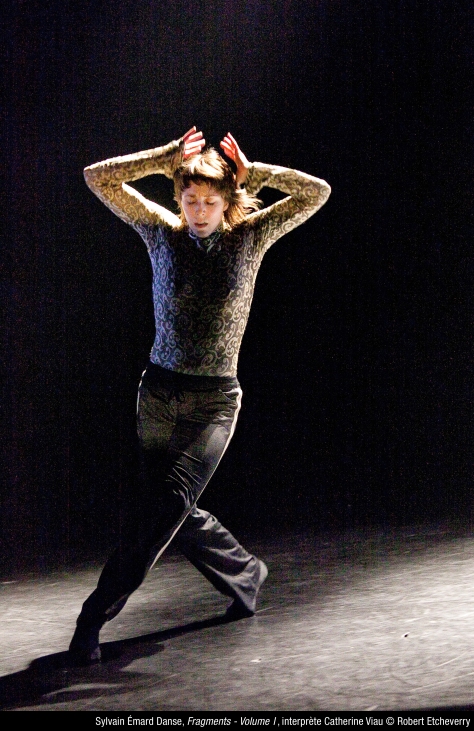
Catherine Viau dans Fragments - Volume 1 par Sylvain Émard. Photo: Robert Etcheverry. Source: Sylvain Émard Danse.

Ms. Viau’s piece was the second of the night, called Émoi, émoi, which according to my handy-dandy French/English dictionary could mean “emotion, emotion” or “stir, stir” or “commotion, commotion” or “agitation, agitation” or “flutter, flutter.” (Obviously, I’m not as bilingual as I thought) Personally, I’d go for stir x2 or flutter x2, but mostly because of the way the words can be repeated (it isn’t real common to write “agitation, agitation”) than for anything specific to the dance that she did. It began with her waving or possibly fanning herself and ended with some high stepping and spinning all to some sort of mechanical / industrial kind of soundtrack by Michel F. Côté.

And no matter how hard I try I can’t figure out any connection between Ms. Viau and the movements she made other than she and the moves she makes really really good.

But, instead of doing the whole in media res thing (I don’t know what’s up with this recent fascination with Latin, paenitet) I should just start from the beginning.

It got off on the wrong foot. The very first thing that we saw was this blinding strobe light. Which is all fine and dandy, if you’re 18 years-old and at some discotheque. But isn’t so hot if you’re middle-aged and sitting with someone who has epilepsy. Once the strobe stops you can see Manuel Roque sitting on a chair, upsidedown. Kind of like a you’d imagine a how it would look if you were choreographing a car crash. As all the car crashes I have been in made time seem to move incredibly slow, it only makes sense that Mr. Roque also moves in slow motion. How this car wreck relates to “his garden” I have no clue, but the piece is called “dans mon jardin…” although as far as I know it has nothing to do with the song by Manu Chao.

He returns to a normal speed with a bunch of jumping around and shaking. And then my notes mention that he has swallows and butterflies in his garden, but I have no recollection as to why I suddenly decided to note down the wildlife. Judging from the way it was written and its placement on the page, I would have guessed that it was some sort of lyric, but last I heard Michel F. Côté only writes instrumental music. So I am back at square one. Obviously I need to take much better notes next time.

Anyhows, after the jumping and the shaking, Mr. Roque returns to the chair, upsidedown, and then the piece ends.

The third piece is the one that’s been getting the most notice, mostly because M. Émard chose to use a septuagenarian non-dancer as a dancer. Monique Miller is an actress (now a dancer) who has been performing since the early 1950s.

She wore a kick-ass knit pant suit that had almost looked like a skirt (I think the technical term is elephant leg pants, but I am not certain, I have even less of a vocabulary in fashion than I do in dance) although from where I was sitting it also looked liked she was covered in Saran Wrap underneath the pant suit. Also from where I was sitting I never would have guessed that she was pushing 80 years-old. Forty, maybe fifty, just before I changed the prescription on my glasses, but never 78.

There was some sort of wind-chimey, dangly things suspended from the ceiling that was extremely annoying because of the reflections of the spotlights back into the audience that made it extrmely difficult to concentrate on what Mme. Miller was doing. What she was doing looked an awful lot like emoting and mime. Now, I’m not going to go and complain because a septuagenarian actress can’t dance. But I will question the necessity of putting a non-dance performance in the middle of a dance performance.

It’d be kind of like if I started singing right here, right now

Confusing, right? And then right in the middle of Mme. Miller’s performance someone starts plainchanting a personal ad, not exactly the New York Review of Books quality, but easily worthy of Craigslist. Initially this confused me, as Michel F. Côté only writes instrumental music. But then with a little bit of research, I discovered that M. Émard and M. Côté chose to insert some sort of excerpt from eL/Aficionado a very obscure opera by Robert Ashley. And no, I’d never heard of it either, prior to this. And I would hate to think that it was used as part of the soundtrack because Mme. Miller was looking for a date (remember way back at the top, how M. Émard said that the dances were inspired by the personalities and concerns of the performers… Things that make you go hmmmm.

The last piece, Bicéphale which was the duet of the evening, danced by Laurence Ramsay and Manuel Roque is about as cliched as it’s name. It starts off slow in front of a seam of light, again making it difficult to see. Their movements become quicker and seemed to me to be slightly like something Bob Fosse would have done.

Unfortunately the music by Jan Jelinek had way too much throbbing, buzzing and skreetching for my tastes. And even more unfortunately, it wasn’t anything like what Bob Fosse would have done.

I haven’t seen the other “latest and greatest” creation by M. Émard, The Continental line-dancing thing (it comes in various shapes, sizes and flavors). But, if it does come back this summer, I think I’m going to have to make a point to see it, just because it strikes me as being the complete opposite of Fragments – Volume 1. Either that or wait for Fragments – Volume 2 and see if things then fit together.

Gratte-ciel, cascades d’eau, rues, ruisseaux… by Melvin Charney at Place Émilie Gamelin 3/5

Howdy!

Built in 1992.

+This is the 29th in an occasional series of videos on the fountains of Montreal+

Outfits from a New Era at the Biosphere (Part One)

Howdy!

I’ve been meaning to write this one for a fairly long time, since August actually. But seeing as how I took 104 pictures, getting them all organized, uploaded and labelled seemed like a daunting task, so I did what anybody else would do, I put it off. Until today. If you click through to see all the pictures, it’s going to take a while to load, sorry in advance.

Bag Garment By Mélanie Casavant and Bullet Dress By Geneviève Dumas and Geneviève Flageol

In short, since the Biosphere is an “Environment Museum” it only makes sense that they mount exhibits designed to promote environmental awareness. And some bright wag decided to commission 16 clothing designers (I think all women) to create dresses using refuse material.

Now while I am an environmentally aware person and keep a fairly sustainable lifestyle, I’m not big on preaching about it. As a consequence what really struck me about this exhibit was not its Green-ness, but that while everyone was going gaga over the Jean Paul Gaultier exhibit at the Musée des beaux-arts de Montréal here was a truly original fashion exhibit that was not getting any press anywhere.

Light Switch Wall Plate autographed by David Suzuki

And while I might not proselytize about sustainability, like certain people, I do champion the underdog and Outfits from a New Era at the Biosphere is definitely underdog material if there ever was. The museum probably counts the number of daily visitors in the high two figures, has some breathtaking views of Montreal and is a charter member of the Cult of Bucky. What more do you need?

Anyhows, while I do not consider myself a fashionista, nor an authority on fabrics and style, instead of viewing these as liabilities I figured (like usual) that instead, if I approached this as a learning opportunity it shouldn’t be a hindrance to writing about it and taking some pictures. Right?

Mermaid Skin By Geneviève Bouchard

To me it was more of a compare and contrast situation. While it seemed like everyone and their mother was raving about how original and inventive M. Gaultier’s dresses were, here were some truly original and inventive dresses that weren’t getting any attention whatsoever. And while I’m certain that at some point M. Gaultier did in fact actually touch the dresses on exhibit that bore his name, I’m fairly convinced that he didn’t actually do much (if any) of the sewing, knitting, weaving, embroidery or any of the other tasks involved in making the dresses.

Whereas even without doing serious research, I’d bet my bottom dollar that each and everyone of the designers who made the “Outfits from a New Era” was significantly involved in the actual fabrication of their dresses. And while I am all for the artist-as-thinker-and-not-necessarily-creator concept (see Andy Warhol’s Red Self-Portraits One, Two, Three, Four, Five , Six, Seven and Eight for a fascinating insight into the attribution of artwork)

Detail from Dress the Part By Isabelle Bérubé

If I’m going to make one complaint (actually as I’m less than halfway through, I imagine that there will be other complaints, let’s just call this one the first. Which is not to say or suggest that the exhibit is bad, just that there is always room for improvement). This contemporary fad, or what I hope is a fad, for Dramatic Lighting! (with the capital “D,” capital “L” and an exclamation mark) drives me up a wall. In general when it comes to art/culture/things to look at or watch, you have two choices if you’re indoors; A white cube or a black box.

White Cubes tend toward being bright and Black Boxes (as you might expect) tend to be dark. Since they are dark, the Black Boxes use highly focused spotlights to draw your attention to stuff that the exhibition designers want you to look at. In contrast to the White Cube where, for the most part, your eye is free to roam where you wish. If you haven’t figured it out yet, I can’t stand exhibits that are housed in Black Boxes. And Outfits from a New Era is, unfortunately in a Black Box, pity.

I don’t know if it is because my eyes don’t react well to large contrasts in brightness, or if because I’m in darkness for the most part I don’t get the nuances of color as well as I would if it were brighter, or if it has something to do with my glasses. But whatever it is, Dramatic Lighting! (with the capital “D,” capital “L” and an exclamation mark) bugs the heck out of me.

Chapter Ten: Words & Wonder By Geneviève Oligny

Light Flow By Chloé B. Fortin

Light Flow By Chloé B. Fortin

I think you can see what I mean by a lot of nuance being missed because of the Dramatic Lighting! (with the capital “D,” capital “L” and an exclamation mark) in the picture above. Light Flow By Chloé B. Fortin is a light, wispy and diaphanous something or other that to my mind would be appropriate in a boudoir or a pornographic film shoot. Apparently made from 2,500 light bulbs and 66 meters of stripped copper wire.

Light Flow By Chloé B. Fortin

One of those garments that professes to show more than it hides, in French it is called “le grand courant lumineux” or in a hackneyed translation “the great current of light,” it was initially called “Le grand souffle” which has more to do with breath and wind than electricity. Which gives a much better idea of the “wispy and diaphanous something or other nature” of the garment.

Detail from Light Flow By Chloé B. Fortin

You can see better detail pictures here> I’m fairly certain that it doesn’t light up or get illuminated from within. But beyond the wispy nature of it, I’m not quite certain what to make of it. While the use of the light-bulbs is alright, there isn’t really anything in it beyond the use of non-traditional materials that pushes any boundaries. And given what has been already done with LEDs and clothing, I’m inclined to think that’s it’s kind of like the clothes your sister’s friend in high school wore. Something designed to make her look good, not making any real statements and not that different from what everyone else was wearing.

Bag Garment By Mélanie Casavant

Bag Garment By Mélanie Casavant

This little frock caught my eye, although I don’t know if it was because it’s black, and as you know, black is the new black. Or if it was because it was strapless and since I am not y-chromosome challenged, bare shoulders always make me shiver slightly, even during the summer, even on a faceless mannequin. Or what. I’ll leave it up to your imagination.

Detail from Bag Garment By Mélanie Casavant

Anyhows, this was the first one, where I thought to myself: “I’m not so certain that they actually used stuff from the garbage to make this…” Seeing as how it is made from those plastic bags you take with you when you’re walking your dog and you’re playing State Farm and being a good neighbor and picking up after your dog and everything.

None the less, I like how it incorporates the paw print motif from the bags, is over the knee and has some sort of petticoat action happening. Kind of like being post-modern and anti-nostalgic at the same time.

Detail from Bag Garment By Mélanie Casavant

Although I’m not certain I want to know what’s in the bag…

More tomorrow.

Gratte-ciel, cascades d’eau, rues, ruisseaux… by Melvin Charney at Place Émilie Gamelin 2/5

Howdy!

Built in 1992.

+This is the 28th in an occasional series of videos on the fountains of Montreal+

Gratte-ciel, cascades d’eau, rues, ruisseaux… by Melvin Charney at Place Émilie Gamelin 1/5

Howdy!

Built in 1992.

+This is the 27th in an occasional series of videos on the fountains of Montreal+

On the side of the Centre Culturel Calixa-Lavallée

Howdy!

I find these utterly charming…

Baseball player bas-relief above an entrance to the Centre Culturel Calixa-Lavallée
A sportsman bas-relief above an entrance to the Centre Culturel Calixa-Lavallée
Canoer bas-relief above an entrance to the Centre Culturel Calixa-Lavallée
Tennis player bas-relief above an entrance to the Centre Culturel Calixa-Lavallée
Skiier bas-relief above an entrance to the Centre Culturel Calixa-Lavallée
Football player bas-relief above an entrance to the Centre Culturel Calixa-Lavallée
Hockey player bas-relief above an entrance to the Centre Culturel Calixa-Lavallée

The Tiger Lillies at Usine C

Howdy!

I’ve definitely been out of touch with the music industry for the better part of a decade. On Thursday I went to see a band that I had never previously hear of, that I initially thought were derivative because they were just starting out, and then after doing a little bit of digging discover that I need to eat my shorts as they have been around since the mid 1990s and have recorded and released 24 CDs (according to Wikipedia 31). Ooops!

But let me backtrack slightly. I’ve always had a kind of love/hate relationship with the lyrics of Bertolt Brecht. Music by Kurt Weill is wonderful in my humble estimation, so there are some versions of the Threepenny Opera that I adore, and others that aren’t so hot.

Initially The Tiger Lillies had been peddled to me as a kind of Brecht/Weill, Threepenny Opera kind of thing, and seeing as how I was feeling slightly frisky I figured “what the hey!” And went with open ears.

They started with more than a bang, coming out on stage and playing Heroin and Cocain. As you can hear, they lyrics are kind of (if you squint slightly) like Brecht (via Marc Blitzstein). But the music isn’t quite Weill

It isn’t quite Welk, either. But it is a tad closer. At first I was quite charmed. Martyn Jacques sings similarly to Jimmy Somerville although I doubt he is a Smalltown Boy.

But once I made that connection, I was off to the races. Over the course of about two dozen songs (of which I only recognized one, Autumn Leaves) I was able to come up with a bunch of different performers who had some sort of connection to The Tiger Lillies. Ranging from Mel Torme

to Tiny Tim

To Spike Jones & his City Slickers

If you want the complete list write to me if you’re curious. Some of them are Rusty Warren, Bun E. Carlos, L’Orchestre d’Hommes-Orchestres, Charles Bukowski.

While the references are all over the place, the songs I heard seemed to be mining a fairly similar terrain. I don’t know if that was due to my being unfamiliar with the songs and as a consequence concentrating mainly on the lyrics and the stage show, or if in fact most of the songs that the Tiger Lillies have recorded over their 24 CD career (maybe 31) indeed sound alike (somehow as I write that sentence, I’m not too certain even I can’t believe that all their songs sound alike).

While it is all fine and dandy to try to shock people with graphic content, I was quite surprised while listening to realize that the rapes, murders and debauched behavior that they sung about was quite similar to what was sung in the 1920s and 30s to shock people. Somehow I would have presumed that someone singing in angry clown makeup in the 21st century who was looking to offend people’s sensibilities would have sung about something potentially more on the edge than straight heterosexual rapes, stabbings and standard issue drug addicts. It gives The Tiger Lillies a faintly quaint air, which almost has a wistful aura of nostalgia.

Kind of like “why can’t we go back to the gold old days, when it was much clearer and easier to understand what behavior was bad?” While at the same time they were definitely members of the 21st century as there wasn’t a single glass of alcohol anywhere on stage. I’m still trying to work out if I like the nostalgia schtick, or if I was disappointed that they hadn’t revised their book of sins so that is was more contemporary.

I gotta hand it to Adrian Huge,

who while not quite the reincarnation of Keith Moon

he comes about as close as I’ve ever seen anyone since Uncle Ernie.

The other Adrian in the band, Adrian Stout, played a mighty fine bass and musical saw, but I was a tad dismayed to see the Theremin that he had set up in front of him go unplayed for the duration of the concert.

We were sitting behind local vedette Eric Braun from Usine 106u who was thoroughly and completely enjoying himself. Behind us was Marie Chouinard although she didn’t last four songs (which quite possibly could have warmed the cockles of Mr. Jacques’ heart). Maybe she didn’t get into the nostalgia.

Given the crowd and the band’s predilections, I can’t understand why they played in the big hall at Usine C, the smaller stage which is much more cabaret-like would have been absolutely perfect for them. Instead of fairly large and cavernous soft-seater where there was a distinct sensation of an awful lot of empty space right behind us. I was very happy to hear that this was their third time performing at Usine C, which means that they have played in Montreal at least three times. But I would be worried for whomever is promoting the fourth time.

It’s tough after one two hour and fifteen minute (including intermission) performance to really have a complete and comprehensive understanding of any band, let alone one as on the fringe as The Tiger Lillies. I’d love it if there was some sort of connection I could make to the Woody Allen film What’s Up, Tiger Lily?. Or if there was anyway I could figure out to connect the band and/or their songs any of the flowers called Tiger Lily to the fact that none of them are native to England (where the band is from) but I can’t. Which leaves me having to make stuff up on my own.

After having read the various raves about them from people as diverse as Matt Groening, Alex Kapranos, Mark Mothersbaugh, Marc Almond and Nan Goldin on their website I’m almost tempted to believe I might have missed something. But I don’t think I did. On the other hand I am not as completely over the top and gung-ho about The Tiger Lillies as they are. I’m definitely going to have to find a copy of the Gorey End, because I like Edward Gorey and the Kronos Quartet, before I commit to a final judgment on and about them.

And now, finally, while copy and pasting that link – I think I unearthed why I distinctly have this sensation of having missed something during their show. The Tiger Lillies are a theatrical band, the music that they perform is all about characters and events. Sometimes the Tiger Lillies even perform an opera. The show that I saw did not have any songs that were linked, there was no connections between anything. It was as if someone had given me a bunch of photographs of people without any background information and then wondered why I did not know any details about the people in the photographs after having looked at the photographs once.

Sorry about being slow.

Talking about Quebec and Canadian Art in the Claire and Marc Bourgie Pavilion of the Musée des beaux-arts de Montréal

Howdy!

Earlier this month I was a guest on the CBC Montreal radio show Cinq à Six with Pierre Landry. We discussed the opening of the Claire and Marc Bourgie Pavilion of the Musée des beaux-arts de Montréal and their new hanging of Quebec and Canadian Art.

If you’d like to hear it,

Or if you’d like to download it, click here.

The Fountains at the Hilton Bonaventure

Howdy!

While the building itself was built in 1967 by Ray Affleck, I strongly doubt he had a hand in either fountain, and I would also doubt that the one at the entrance was part of the original plans.

+This is the 22nd in an occasional series of videos on the fountains of Montreal+

Steptext Dance Project, The Bog Forest at Agora de la Danse

Howdy!

On Wednesday night I got to see Helge Letonja’s Steptext Dance Project perform The Bog Forest at Agora de la Danse. If memory serves it is playing tonight as well and tickets are cheap. According to the press fodder it’s about immigration. I’m not so certain I would believe that, but despite me not being able to see how it is about immigration I was pleasantly surprised with the performance. One reason I might not have been able to see how it is about immigration is quite literally because it is very dark. Both on a physical level and an emotional level.

Let’s start with the physical first. According to (again) the press fodder Laurent Schneegans is the person responsible for the lighting. Personally I would have given him the title of person responsible for the darkness. The piece is roughly comprised of three (or maybe four) sections and the first one and the last one take place in pretty much an unlighted black box. Now normally I’m not a big fan of not being able to see the dancers, but in this case it wasn’t that bad; a) there wasn’t that much dancing going on (to be more precise, a lot of moving, but not a lot of dancing) and b) given the name of the piece it was obvious that the lack of light was in order to add to the atmosphere.

At the beginning everybody pretty much had their face covered by something or other, whether it was an actual mask, or just a very large hood that then caused shadows, it was difficult at the beginning to figure out who was who. Although after the fact (and with judicious use of the press fodder, I can confidently state that) Christian Wolz starts out with some kind of chanting and Konan Dayot does some staggering around like a busted marionette. I wrote in my notes “a bunch of staged abstract tableaus in the dark.” And more than 24 hours after the fact, I still stand by that statement.

As an introduction to the performance it is effective. Very spooky. They use lighters, have flashlights aimed towards the audience and in general do just about everything you can think of to make you think that you’re in some kind of bog (or for the North American’s in the house a swamp – or if you want to get technical, both are wetlands although swamps tend to have trees, and bogs veer towards treelessness) you know the kind of place you imagine while you’re listening to Dale Hawkins or Lighting Hopkins. But the beginning of the performance as a means to understand that The Bog Forest is a “crossroads for six individual destinies…” I’m, not so certain.

The second part starts with a bang – well not actually a bang, but the aftermath of a bang with a humongous cloud of smoke hanging over the stage. It takes a while to dissipate but continues to add to the swamp-like atmosphere despite the lights actually being turned up and being bright enough so that I could see the dancing. Quite a cool effect, especially since the Agora de la danse is such a small space. At some point I’m going to have to bone up on my “how-to-make-a-large-cloud-of-smoke-in-the-dark-without-any-light-or-sound” notes because I sure as shootin’ had not clue how that cloud of smoke was able to get there.

With the aid of the light it actually became possible to not only identify the dancers (who were generally quite accomplished, if not really really good) but also since they were identifiable; recognize them as individuals. According to my notes there was the “Chinese Couple,” “Blondie,” the “Other Woman,” “The Turkish Guy” and “The Rabbit Guy” (who to be honest, wasn’t a dancer, but was the singer, Christian Wolz). Writing while they are performing doesn’t leave me an awful lot of time to think about suitable titles. Although in the case of “The Rabbit Guy” I could have gone with “The Singing Guy.” But since he carried around a rabbit for the better part of the first part and then that very same rabbit gave “The Other Woman” some sort of epileptic/hysterical fit. I went for the slightly more descriptive title.

The Chinese Couple were I-Fen Lin and Wei Meng Poon. They did a kick-ass duet that started with each of them on a separate square of straw (one stage front and left, the other stage back right) which went through a progression where Mr. Meng Poon removed Ms. Lin’s shirt and did what I called a “dance of tension.” (At some point I’m going to have to do my darnedest to memorize “Technical Manual and Dictionary of Classical Ballet,” my vocabulary sucks the big one when it comes to describing how people move). But this one was where it appeared that there was an equal amount of pulling by both of them so as to keep everything in an equilibrium, more based around brief poses rather than a continuous series of movements.

Not quite the Ab Lounge, or i-Shape but close, and now that I think about it more, I’m certain that there is probably some yoga involved as well. Anyhows, after he takes her shirt they talk in what I presume is Chinese, which turns into an argument, at which point Mr. Meng Poon returns Ms. Lin’s shirt, they reconcile and then she starts coughing while he starts either crying or laughing.

Even with identifiable characters, I’m still not certain what it has to do with immigration…

Prior to the argument over the shirt Ms. Lin and the “Other Woman,” Emilia Giudicelli, have a very graceful, extremely well done, but unfortunately all too short duet. While watching it I was struck by how well they performed together. I’m not certain, but I don’t think they could have been more synchronized had they been doing it together nightly for the past 5 years. There were also two quartets where everything seems right with the world, not quite line dancing, not quite Jazz Dance, not quite Modern Dance either, but very very satisfying. If I remember correctly “The Turkish Guy” (who is actually Brazilian) Leonardo Rodrigues is not quite dancing in counterpoint to the other four, but is dancing on his own in opposition to the other four.

The three other tableaus that were notable were when The Rabbit Guy, Mr. Wolz, hummed around The Turkish Guy, Mr. Rodrigues, in effect making him move as a consequence of the; quote, sound waves; unquote, emanating from his mouth. Think of a leaf on the wind or a piece of cloth in a pool or a river. In retrospect it could be considered a variation on a theme that was started with the “dance of tension” and is continued towards the end when all five dancers join in a game of “keep aloft.”

Lipstick Forest / Nature Légère by Claude Cormier at the Palais des congrès de Montréal

The set is mainly made up on one side (actually one third) what looks very similar to a miniaturized version of “Lipstick Forest / Nature Légère” by Claude Cormier at the Palais des congrès de Montréal. Branches and twigs instead of trunks, orange instead of pink and suspended curtain-like one on top of another instead of planted on the floor like a fence. But close enough. The other two thirds is made up of some sort of net that has a lot of plastic bags attached to it. Depending on the light, or the lack of light, the plastic bags can kind of look like leaves, handkerchiefs, plastic bags or just something sort of spooky. Or maybe that was just me anticipating Halloween. But, one of the plastic bags becomes the object of the game of “keep aloft,” whereby the dancers try to keep the bag in the air by blowing on it.

The third notable tableau was when “The Rabbit Guy,” Mr. Wolz starts to draw on “Blondie,” Mr. Dayot’s back. It’s notable in that everyone is on stage and no one stops moving, but my eye was riveted on Mr. Dayot’s back, ignoring everything else. Which leads me to believe that whatever dancing was being done wasn’t particularly compelling, because the drawing itself wasn’t all that hot – but the process of drawing was extremely compelling.

Overall, I was impressed, not so much by the narrative or the theme, but by the movement. Mr. Letonja does have a very specific dance vocabulary (which I’m not certain I would be able to learn at this late stage) rooted in movements from nature, like the wind or water and he does translate it extremely well for humans. I’m certain it makes complete sense in his head how it relates to immigration and immigrants, but that didn’t translate to me sitting in the audience, maybe next time I need to go to the performance that has the talk afterwards where they explain everything, although to be honest, all I really would want to know is how they got they cloud of smoke up there, but I’m rambling now, so let me stop.

At the risk of repeating myself, it is the movements taken from nature and reproduced by Mr. Meng Poon, Ms. Lin, Mr. Dayot, Mr. Rodrigues and Ms. Giudicelli that truly make The Bog Forest something wicked-cool.