Howdy!
The fountain was made in between 1992 by Jodoin, Lamarre, Pratte & Associés.
+This is the ninth in an occasional series of videos on the fountains of Montreal+
Howdy!
The fountain was made in between 1992 by Jodoin, Lamarre, Pratte & Associés.
+This is the ninth in an occasional series of videos on the fountains of Montreal+
Howdy!
From Genesis 11:1-9,
1 And the whole earth was of one language, and of one speech. 2 And it came to pass, as they journeyed from the east, that they found a plain in the land of Shinar; and they dwelt there. 3 And they said one to another, Go to, let us make brick, and burn them thoroughly. And they had brick for stone, and slime had they for mortar. 4 And they said, Go to, let us build us a city and a tower, whose top may reach unto heaven; and let us make us a name, lest we be scattered abroad upon the face of the whole earth. 5 And the Lord came down to see the city and the tower, which the children built. 6 And the Lord said, Behold, the people is one, and they have all one language; and this they begin to do; and now nothing will be restrained from them, which they have imagined to do. 7 Go to, let us go down, and there confound their language, that they may not understand one another’s speech. 8 So the Lord scattered them abroad from thence upon the face of all the earth: and they left off to build the city. 9 Therefore is the name of it called Babel; because the Lord did there confound the language of all the earth: and from thence did the Lord scatter them abroad upon the face of all the earth.
For better or worse, Sidi Larbi Cherkaoui, Damien Jalet and Antony Gormley didn’t quite follow that script. Instead they kind of use it as a launching pad for their production.
Mostly dance, but not all dance, it comes across as a highly charged and extremely political piece of performance art. Personally, I’m not so certain that the politics and the non-dance parts needed so much time, but as you might have expected, no one asked me.
But let me back up a little. The show is performed by 12 dancers, one actor and five musicians (who also do some acting). They do about 30 separate vignettes that are held together by the five, large, box-like, aluminum, (or at least I presume that they are made out of aluminum, since they are moved around an awful lot) structures that are used as scenery and props during the show.
It starts off with everyone marking out their space, turns into a lecture about real estate, some people start manipulating others like puppets, they build a skyscraper, board a plane, get into arguments, and apologize among other things. This is the video that was published on YouTube last February as a promo for the show:
And this is the video that was published on YouTube last June as a promo for the show.
There are some bits in the February video that were not performed when I saw it on Friday, and everything I saw on Friday is not represented in the June video, but you get the picture. In short (and extremely simplistically as well) it’s a plea for us to all get along despite our differences. Kind of like the song by War from 1975.
The first thing that struck me about the dancers (Navala Chaudhari, Francis Ducharme, Darryl E. Woods, Damien Fournier, Ben Fury, Paea Leach, Christine Leboutte, Ulrika Kinn Svensson, Kazutomi Kozuki, Sandra Delgadillo Porcel, Leif Federico Firnhaber, Mohamed Toukabri and Paul Zivkovich) was how tight they were. Everyone hit their marks at the same time and in a troupe that large, mainly composed of independent performers, it is quite the feat.
Although I don’t know if in fact I saw Moya Michael, Helder Seabra, Jon Filip Fahlstrom and James O’Hara in place of, or as well as the fine folks above, because in my program their names only appear in parenthesis and there was no mention if they were only there as injury replacements (as you can see the piece is extremely physical) or if they were there as alternate performers. I’m not certain I like this move towards nameless performers where the directors, choreographers and all the other folk who do not appear on stage get the glory. Especially for a performance where there are very specific characters. But I digress.
The second thing that struck me was how painful and superfluous the lectures by Mr. Woods were in comparison. Not to slight his performance – in actual fact, his performance of them was spectacular. But if you stick the words “Sidi Larbi Cherkaoui” into Google, the first things that come up talk about dance and choreography. Not writing, not comedy, not theater. And while I do recognize that just because someone in very good in one thing does not preclude them from being very good at something else, M. Cherkaoui is most definitely not a comic, nor is he a comic writer. And I don’t think M. Jalet is either. So I don’t understand why they chose to stick in an attempt a comic theater in the middle of their very impressive dance performance. It just doesn’t make sense. And come to think of it, I doubt that either one of them spoke English as a mother-tongue, although that would not necessarily disqualify him (them?) from writing kick-ass stuff in English, just make it tougher. Heck there are some times I can’t write English to save my life.
However once you start to think about the concept and the ideas behind Babel (words), it strikes me (and perhaps you as well) that M. Cherkaoui and M. Jaret might have decided to sacrifice some dance in order to get their point across. But it’s just like like eating a whole big bag of potato chips before dinner. There’s only so much you can consume, and no matter what you think, the potato chips are not going to be as tasty and delicious as a good dinner. There’s only so much time for a performance at Place des Arts before the unions require time-and-a-half and that and the other costs end up making a ticket unaffordable. No matter what you think, the spoken word part of a dance show is not going to be as visually spectacular and breathtaking as the dance itself.
Because as M. Cherkaoui states on his website: “Equality between individuals, cultures, languages and means of expression” are something that is very important to him. And my guess is that despite the eclectic backgrounds of all the dancers, actually choreographing 12 different types of dance styles (one for each dancer) so that they can be identified by the way that they dance, isn’t quite as easy as it sounds. As a consequence, falling back on the actual languages and religions that the dancers know and either practice, or were born into is a nice and easy safety net to get the point across.
As you might guess, I wish that there had been more dance. By my notes there were four (maybe five) vignettes (tableaus, scenes, whatever) that absolutely made my head explode (in a good way). The opening with the hands, the fight right after that, the second hip hop solo (I unfortunately did not note when the first hip hop solo was, and it is quite possible that it impressed me as well, but that I just didn’t write it down) and what I called “the chainsaw” which was another group number towards the end, which started out with the dancers appearing to pretend to start a chainsaw. Beyond that there was an awful lot of chanting, some comic lectures, some comedic dance bits, and then the one bit that wasn’t dance, but was spectacular. The building of the skyscraper – which is movement, just movement of objects not of a body. But yes, it was quite cool seeing them build the structure. And movement in certain circumstances can be considered dance.
Speaking of bodies, using my best Google-Fu I was unable to come up with pictures or other things that would have enabled me to identify Damien Fournier, Sandra Delgadillo Porcel, Mohamed Toukabri, Paul Zivkovich, Moya Michael, Helder Seabra, Jon Filip Fahlstrom and James O’Hara. And while I could guess as to who did what, I am loathe to be wrong on something like that, because if I was it would undermine everything else I wrote. So I’ll leave it as a polite request to whomever creates the programs for Danse Danse; would it be possible to get pictures in future programs? Please and thanks.
But that does mean I was able to identify the nine other performers. Woo-Hoo! Paea Leach, despite not having a completely identifiable character, was very impressive as a dancer. You can get an idea of how she moves here (unfortunately, she won’t let me embed the video here, pity). I can’t quite put my thumb on the reason why, but she moved with a certain authority, and about halfway through the performance I realized that in the group pieces my eyes had been watching her more than not. So I can only presume that I was either completely and totally smitten with her like a 16 year-old schoolboy, or that she is a kick-ass dancer. Given that I have absolutely no desire to be, let alone act like a 16 year-old schoolboy, I go with the later.
Ulrika Kinn Svensson was at the opposite end of the spectrum. Her character was completely and thoroughly identifiable. Wearing what appeared to be at least eight inch platform shoes that made her tower over everyone. To which was added shiny black plastic (or patent leather) boots that came halfway up her thighs she was hard to miss. Depending on what “scene” you’re watching, she functions as a sex-kitten, narrator, tour guide or gate. But what left me slack-jawed was that even though she was in a pair of boots that would have made Kiss or Funkadelic proud she was able to dance as well.
Christine Leboutte also had an easily identifiable character, the washerwoman. Although I have no clue as to why there was a washerwoman. She’s got a great voice (if I remember correctly, when I was searching about for information about her, some website mentioned that she taught Damien Jalet how to sing).
One other thing that impressed me with the piece was how M. Cherkaoui and M. Jalet had choreographed what I call “girl lifts.” Or in other words women lifting other dancers. For most of time immemorial, the chicks have been lifted up and the guys have done the lifting. I think the first time I saw a woman lift another dancer it might have been Louise Lecavalier, but I don’t know for certain. Anyhows it has taken over 25 years for it to get closer to the mainstream, Navala Chaudhari did them on admirably on Friday night.
Then also going by my sketchy memory, I think it was Ben Fury and Leif Federico Firnhaber (that’s almost as good a name as Juan Tyrone Eichelberger) who did the aforementioned hip hop solos.
Which only leaves me Francis Ducharme and Kazutomi Kozuki as dancers who I was able to identify and therefore need to be mentioned. Unfortunately the things about their characters that stand out to me most are the comedic bits, that while memorable didn’t really strike me as particularly good. M. Ducharme, as the hometown boy, could do no wrong, and had everyone rolling in the aisles with laughter during his caveman routine. Kozuki-san also worked as a foil to Kazunari Abe (or Shogo Yoshii) in the parts that required some really fast Japanese to be spoken.
In the videos, I’m certain that you can catch more than glimpses of them and decide for yourself if you like the way that they dance.
Babel (words) is now the second piece I’ve seen that was choreographed by M. Cherkaoui and this one didn’t leave me as angry as the first one, and it is quite easy to see how and why everyone thinks he is such a wonderful and amazing choreographer. I only wish that he would stick to choreographing. Because his attempts at comedy and proselytizing fall incredibly short in comparison.
And then the final video version of Babel (words) from about July of this year…
BABEL (words) (long trailer) 2010 from Damien Jalet on Vimeo.
Howdy!
The fountain was made in between 1992 by Éric Gauthier.
+This is the eighth in an occasional series of videos on the fountains of Montreal+
Howdy!
I’ve always been fascinated by this relief on the entrance to the building at 500 Saint Jacques. The building itself was built in 1960 (or so, some places say 1959) by the firm of Ross, Fish, Duschenes & Barrett, which has now become DFS Inc.
I’ve written to them asking who is the artist who created the reliefs, but have not received a response as of yet. As soon as I do, I will let you know.


Howdy!
The fountain was made in the 1983 by an unknown company.
+This is the seventh in an occasional series of videos on the fountains of Montreal+
Howdy!
On Sunday I went to Patrick Blaizel‘s La Maison des Encans de Montréal to see his auction of Canadian Art (and other things as well). I was only able to stay for 127 lots. By my count only 11 lots didn’t sell, which is a very big difference from the results at Iegor – Hôtel des Encans, where they only sold 46% of the lots.
By my calculations they grossed about $175,000 on those 116 lots. (Once again, take any figures I give with a grain of salt, trying to juggle a video camera, pen, paper and keep track of what happens is fraught with the possibility of making mistakes.) – All prices noted here include the 15% buyers premium and all local sales taxes. All the lots and how much they sold for are here.

Some of the highlights were paintings by Marc-Aurèle de Foy Suzor-Coté

and A.Y. Jackson.
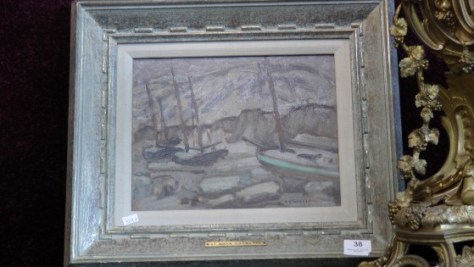
Which sold for $3,930.41 and $22,272.34 respectively.
A gouache on paper painting attributed to Cornelius Krieghoff and a bronze sculpture by Louis-Philippe Hébert.


Which sold for $2,358.25 and $6,812.72 respectively.
An oil painting on board by R.W. Pilot.

Which sold for $9,170.96
An oil painting on panel by Marc-Aurèle Fortin.

And an oil painting on panel by J.W. Beatty.

Which sold for $12,446.31 and $10,088.06 respectively.

The lowlight of the auction had to be this painting by André Bergeron, which even when the opening bid was lowered down to $50, did not get a single bid.

But besides the obvious differences between the auctions of M. Blaizel and M. de Saint Hippolyte, M. Blaizel sold real estate, furniture, collectibles and other things besides the art, the thing that fascinated me was the differences in their style of selling art. M. Blaizel clearly points towards the current high bidder, talks with the audience, offers certificates of authenticity, tells the audience when something doesn’t meet the reserve price and in general is much more transparent in how he does business.
And it appears I’m a YouTube superstar, I’m all over this video from Iegor – Hôtel des Encans, that’s me in the white t-shirt with the glasses on a string.
Howdy!
Last week I went to see the Armand Vaillancourt exhibit at the Galerie Lounge TD in the Maison du Festival Rio Tinto Alcan. Off the top; I think that M. Vaillancourt is the bomb. Kick-Ass. About as close to godlike status you can get when you’re agnostic, atheistic or just can’t be bothered. So as advance warning, it is not likely that I am going to be objective.
The first thing that surprised me was that I wasn’t the only person in the gallery. I had heard that there had been some sort of peinture-en-direct event the week previous and figured that the folks behind the Jazz Festival, the Francofolies, the Hydro-Quebec festival of electricity (now that I write that name in jest, why hasn’t any Jewish, Hindu or Persian organization raised a fuss about Spectra completely co-opting Hanukah, Diwali and Chaharshanbe Suri? – For the agnostics, atheists and folk who just can’t be bothered in the house, Hanukah, Diwali and Chaharshanbe Suri some fairly heavy duty religious holidays that are also known as Festival of Light. The Spectra folk do this thing called the “Festival en lumiere” in order to rationalize how much money Hydro-Quebec gives them, that happens in February. Not that I’m saying anything. But just saying…
But I digress. Apologies. As I was saying, I completely and utterly expected to be the only person in the room, seeing as there hadn’t been any advertising that I had seen talking about how this was your last chance to see the Armand Vaillancourt exhibit. You know, the kind we’re about to be bombarded with for the Jean-Paul Gaultier show at the MBAM… But I wasn’t. There was actually a healthy crowd. I would venture a guess of about two dozen folk wandered in and around me during the hour that I hung out there. But as long as I’m being the extreme cynic, I’m convinced that all of them, all two dozen were heathen tourists from beyond our borders who wouldn’t know kick-ass art if it hit them in the ass and just were mindlessly following some hack tourist guide book that had taken journalistic shortcuts by republishing press releases issued by Spectra. Or maybe Spectra has started publishing tour guide books. I don’t know, but it was very surprising.
What wasn’t surprising, was that most of the work being exhibited was for sale and at very healthy prices I might add. Unfortunately I didn’t see any red dots signifying works that had sold. But that just might mean that the Spectra folk who are responsible for the gallery don’t know about red dots and how they are used to signify that a particular piece of art has in fact been sold. Although when I inquired at the desk (which thankfully was not staffed by a 20 year-old woman in a black micro mini skirt and 12 inch heels) if there was a list of all the works in the show, I was told that all the information was on the wall tags. Which would lead me to believe that if I had indeed (or one of the tourists) wanted to purchase a piece I would have been given M. Vaillancourt’s telephone number and told to contact him myself. So my best guess would be that a) nothing sold and b) that the Spectra folk don’t know about red dots.
But enough about the organization of the show, what about the art? Well, it was mostly made up of painting and prints. There were a couple of sculptures scattered about the room along with a couple of political pieces as well. The paintings and prints expressing quite clearly that M. Vaillancourt is an amazing sculptor. The political pieces show he has a great sense of humor but is better served earning his living as a sculptor than as a stand up comedian.

There’s not much that can be said about the colorful abstract paintings. Well actually there is an awful lot that can be said about them. Things like the colors, the method of application to the canvas, the density, the patterns that they create and lots more. So if I were to be more precise, there’s not an awful lot that I want to say about the colorful abstract paintings. And even less about the monochromatic abstract prints. They are perfectly suited for hotels, large corporations and benefit auctions, all places where people like having “serious” art but really don’t spend all that much time looking at it and where the name “Armand Vaillancourt” will elicit sage head nodding and depending on what benefit auction or large corporation certain feelings of Quebecois pride.

One look at the political pieces and you get the point. They’re the proverbial one-trick pony. Which depending on your point of view is either exactly how they are supposed to work; get the point across quickly, easily and forcefully. Or their downfall; simplistic, lacking any depth and cartoonish. I tend to think of them as both. Sort of like a three-dimensional editorial cartoon designed to bring attention to some cause through the use of M. Vaillancourt’s name. It would be nice to have shown some of the more obscure causes that M. Vaillancourt supports instead of going for well-known and easy ones. But no one asked me.

Which pretty much leaves us the maquettes or sculptures. There were four of them. If I remember correctly, they were called something like “Place Publique” or something else equally memorable (as an aside I made the complete and utter faux-pas of neither taking notes, nor taking pictures of the wall tags. I was totally unprofessional. Does anybody have a wet noodle handy? And sorry, I promise it won’t happen again.

But now that I have that out of the way, I gotta say that despite the silly cutouts of people from magazines, that they were drop-dead gorgeous and amazing. I, honest to god, caught myself on a couple of times doing one of those reverse whistle intakes of breath and even once letting out a long low whistle. If they hadn’t been playing so much music from the 1980s in the place where I’ve been writing this, I might have even gone so far as to quote the band Berlin.
All but one were on stainless steel bases and used (what I presume) were recycled bits of metal to create forms based on symmetry and repetition. They kind of prove (to me at least) that M. Vaillancourt is a master of the form (or should I write that Master of the Form?) At some point I’m going to have to ask him how he came up with the ideas for them and how difficult it was to make them. From the monochromatic prints it is possible to see how they would lead to the maquettes. And I truly hope that they are indeed maquettes and not fully realized sculptures, because they would be breathtaking if blown up to monument size.

Unfortunately my snapshots don’t do them the justice that they deserve. Some of them were placed directly in front of windows and I haven’t quite figured out what buttons I need to push on my camera when objects that I want to photograph are back lit and I also am not in the habit of carrying around a set of lights with me. Next time, I promise.
Beyond that, there wasn’t much. It kind of left me torn, one one side I really really liked the maquettes or sculptures. On the other side everything else kind of seemed “meh.” And while “I think that M. Vaillancourt is the bomb. Kick-Ass. About as close to godlike status you can get when you’re agnostic, atheistic or just can’t be bothered.” This show did nothing really to support my belief. I dunno, maybe the out and out commercialism in the “Galerie Lounge TD” or the way that everything was set up more as if it was a store than an art gallery had a stronger influence than I would like to admit.
Howdy!
The fountain was made in the 1982 by an unknown company.
+This is the sixth in an occasional series of videos on the fountains of Montreal+
Howdy!
Earlier this month I was out and about on Île Sainte-Hélène (hence the video of the fountain at the Biosphere…) and while I was there I snapped some shots of some of the non-Calder public art that was there.

If you want to see what it originally looked like, try this.


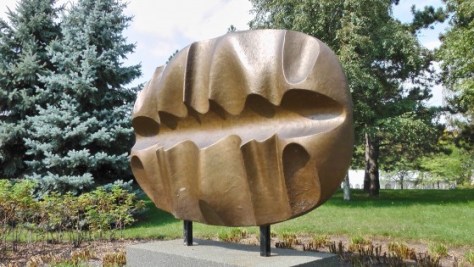
Jean leFébure‘s website is here.


João Charters de Almeida‘s website is here.


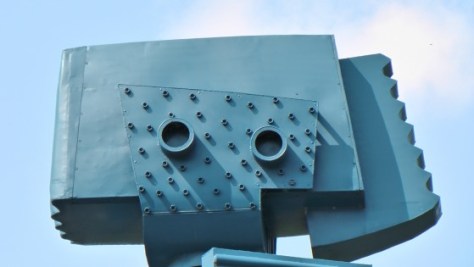
Yves Trudeau’s wikipedia page is here.


My new nominee for most obscure piece of public art in Montreal. Not only is it on a part of Île Sainte-Hélène where no one goes, it is half obscured by a bush! Took me over half an hour to find it. Robert Roussil‘s website is here.


The Kwakiutl website is here. Tony Hunt‘s website is here. And Henry Hunt’s wikipedia page is here.


Initially I was extremely disappointed. I was thinking it would be some grandiose fountain spewing and spouting water all over the place. Then to only find a trickle… But there is this extremely informative article on wikipedia explaining all about Wallace Fountains and their purpose. Charles-Auguste Lebourg’s wikipedia page is here.


Michel de Broin‘s website is here.
Sadly, when I was there, Obélisque oblique by Henri-Georges Adam was not viewable due to construction. I couldn’t find Migration by Robert Roussil. The Moai Head was being restored. And Oh Homme by Yvette Bisson was marked on the map, but was nowhere to be found, and does not appear on the website.
I’ve written to the Bureau d’art public asking about the three and as soon as I have any news, I’ll let you know.
Update, September 28: Oh Homme, Obélisque oblique and the Moai Head are all currently being restored. Obélisque oblique will be returned in 2013, the Moai Head within the next year, and it isn’t known when or where Oh Homme will be returned.
Howdy!
The fountain was made in 1967 by Cambridge Seven Associates.
+This is the fifth in an occasional series of videos on the fountains of Montreal+