Howdy!
Imagine if you will a piece of art that is ignored by approximately 150,000 people ever year. And a pretty gosh darn spectacular piece of art at that… Such is the predicament of Micheline Beauchemin‘s Rideau de lumière, couleur du temps (1967). I guess that there are approximately 750 seats in Théâtre Maisonneuve at Place des Arts, and that it has some sort of performance about 200 nights every year. Therefore if my guesses are right, 150,000 people pass by it each and every year. (Although, before you go quoting me, be aware, I am horrible at guessing things and I have been wrong before, and most definitely will be wrong again).
 |
| The Plaque for Micheline Beauchemin’s Rideau de lumière, couleur du temps (1967) |
As the plaque says:
Curtain of Light, Color of the Times (1967). 300,000 pieces of acrylic mounted on stainless steel wires. 305 feet by 25 feet. Collection Place des Arts, restored in 2000.
And I presume it was all made by hand. Because back in those days they had just graduated from inventing fire and the wheel, and no one had figured out how to invent technology, yet.
But one of the weirdest things is watching how just about everyone before a performance at Théâtre Maisonneuve and during intermission pretty much ignores it. While the drinks they serve at the bar during intermission might be cold and delicious, or the desire to get that front row centre seat might be overwhelming for those that arrive early, flat out ignoring Micheline Beauchemin’s Rideau de lumière, couleur du temps (1967) just ends up making someone look like a mouth breather.
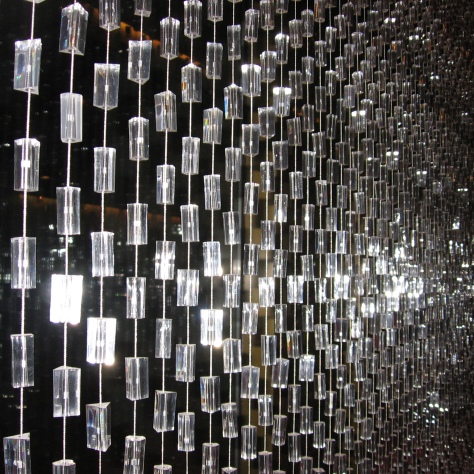
As I mentioned, it is made out of pieces of acrylic and stainless steel wires. The pieces of acrylic appear to be extruded in a variety of different shapes; triangular, diamond, pentagonal, and something looking like a vaguely irregular cylinder. Each one is about one inch in length (the metric system hadn’t been invented then, either) and has about a one inch gap separating it from the piece above and about another one inch gap separating it from the one below. Each thread is spaced about two inches from the ones adjacent. The acrylic pieces are suspended on stainless steel spacers that have been crimped onto the wires. These spacers are used as stoppers to prevent the pieces of acrylic from falling, by means of a conical hole drilled into the center of each piece of acrylic. And finally, each wire has a plumb at the bottom so that it hangs straight.
 |
| Installation view of Micheline Beauchemin’s Rideau de lumière, couleur du temps (1967) |
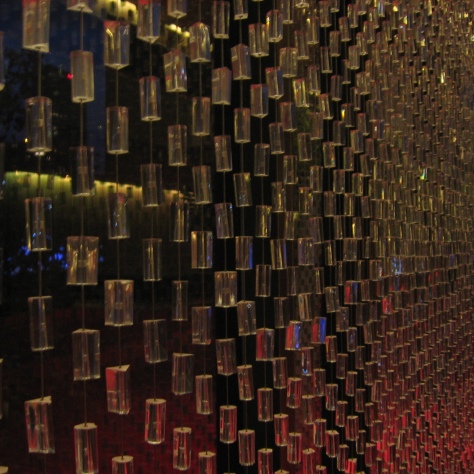
In the picture above you can see the spacers, notice as well, the regular distribution of the acrylic pieces both horizontally and vertically. Although surprisingly, I was not able to figure out, nor see any pattern made using the shapes of the pieces of acrylic. But then again wrapping my head and eyes around 300,000 pieces of extruded acrylic is not something I try and do every day. When viewed head on, the curtain appears for the most part translucent, because your eyes naturally focus on what is beyond the curtain and window it is hung in front of – the plaza of Place des Arts, and now (unfortunately) the behemoth that has become the Quartier des Spectacles. However, when viewed on an angle it quickly becomes opaque, due to the fact that your eyes will naturally focus on the pieces of acrylic.
 |
| Installation view of Micheline Beauchemin\’s Rideau de lumière, couleur du temps (1967) |
Micheline Beauchemin was born in Longueuil in 1929 and died in Les Grondines in 2009 about a month short of her 80th birthday. In between those dates she packed an amazing amount of travel, work and awards into her life. Initially trained as a painter and in stained glass at the Montreal School of Fine Arts, the École des beaux-arts in Paris and the Académie de la Grande Chaumière in Paris. She began making tapestries in the early 1950s, and first exhibited her tapestries in 1956 in France. In about 1963 she hit her stride, and by 1968 was making monumental tapestries like this one. (If you would like more details about her life, I snagged some useful information from these websites, one, two, three, and I’m certain that if you dig a little deeper, you can find lots more).
 |
| Installation view of Micheline Beauchemin\’s Rideau de lumière, couleur du temps (1967) |
There is an awful lot that can be read into Rideau de lumière, couleur du temps (1967) starting with the materials used; while it is called Curtain of Light, Color of the Times the curtain itself doesn’t give off any light, but it does both reflect the light and let the light through. As mentioned above, the curtain becomes opaque, and starts reflecting light when you view it on an angle, this is a purely physical reaction due to the spaces between each strand appearing smaller and smaller. Because it reflects the light when viewed on an angle, depending on the lighting in front of the Curtain of Light, Color of the Times it can appear warm or cold, and it can have a muted glow or a bright and hard shine. In fact it is incredibly chameleon-like. This characteristic is especially evident when it is viewed head on. When viewed head on, the spaces between each strand are large enough that your eyes naturally focus on what is behind the curtain, in effect making the curtain not only transparent but in certain cases, invisible.
 |
| Installation view of Micheline Beauchemin\’s Rideau de lumière, couleur du temps (1967) |
Made at the height of the 60s, and at the time when Montreal appeared to be the absolute best-est place in the entire known universe to live, Rideau de lumière, couleur du temps (1967) absolutely and completely lives up to and beyond its name. As a curtain of light, it is a spectacular example, reflecting and glittering gently, in the background unobtrusively doing its business – hence why so many people ignore it – working as a barrier between the inside and the outside. It also serves as a very hippy take on marquee lights, and can also be interpreted as a way of reflecting and thereby reminding the audience of what happens (or has happened) in Théâtre Maisonneuve. And as it is also transparent and see-through, it thoroughly can be understood as a color of the times – or more bluntly, you can see through it to see what is happening now, what is coloring and shading reality.
Outstanding in just about every respect, Micheline Beauchemin’s Rideau de lumière, couleur du temps (1967) is a monumental tapestry that works well on very many levels. From the purely aesthetic, to the highly theoretical and abstract. Suitable as a discreet background for a public room and as an object in its own right that commands 100% of your attention, it shows off many of Micheline Beauchemin’s ideas and concepts while at the same time spotlighting her skill and mastery as an artist.
[cross posted at art and society]


