I’ve been hanging around Ontario street down in Hochelaga-Maisonneuve recently (it must be something in the water…) and I came across this street art. Great idea and concept, some of them could have been executed slightly better. If you want to click on the link that adds no more information try this or peristylenomade.org.
Something about the bright orange stripes caught my eye.Although given the background, it’s easy to see how it might get lost.Then I noticed another one.And another one…Then I read it (in English I pass by here everyday)And another (in English, That’s very well done graffiti)So I went back to the first one.So I went back to the first one. (That’s the neighborhood in a snapshot)And peered through the frame. And what do you know?!?
Between the apartment building, the McDonald’s, the Metro and the concrete, it pretty much is.
Just in case you missed it the first time around.It seems like I’m in another world, not Montreal.
Last week Eloi Desjardins from Un show de mot’arts and I got together again to talk about the summertime art in Montreal. We’re calling it episode 2 of the EZ Montreal Art Podcast – get it?
The EZ Montreal Art Podcast episode 2
Listen (47:55):
Audio clip: Adobe Flash Player (version 9 or above) is required to play this audio clip. Download the latest version here. You also need to have JavaScript enabled in your browser.
[Author’s note: I took a bunch of pictures, but given that the Tom Wesselmann Estate has a large notice stating people publishing pictures will be prosecuted. And that the Musée des beaux-arts de Montréal website for the exhibit has humongous (larger than the images) credits that involve Sodrac and a bunch of other organizations where lawyers rake in the cash by sending out cease and desist letters, unless I am discussing a specific piece and need to illustrate a point using Fair Dealing I’m refraining from posting anything because I don’t feel like making any lawyers richer than they already are. If you feel like seeing his art on your screen might I suggest Flickr, Tumblr and Pinterest. On August 13 I got an email from the museum explaining that pictures were in fact allowed because of a special agreement. My mistake.]
I first heard that the Musée des beaux-arts de Montréal was going to be exhibiting a retrospective of the work of Tom Wesselmann way back in September 2010. As you can read, at the time, I thought it was a step down for the Musée des beaux-arts de Montréal in the art world galaxy. I also had no clue who the heck Tom Wesselmann was at the time (my knowledge of art history, even relatively recent art history outside of Montreal is extremely sketchy). When I told a friend who is infinitely more knowledgeable on things involving international art she poo-pooed him, dismissing him, his art and everything else he ever did in his life with two mono syllabic words.
Given that it wasn’t all that important to me, I pretty much trusted her judgement up until the time I got to see the show. Or in other words, I didn’t do any research prior to going to see the show. As I’ve said numerous times, I’m extremely saddened to see what I can only imagine is a former member of the group Bizot fall so low, so fast. It’s all fine and dandy to tout how the show is a “traveling” show, but when it’s traveling to only the third largest city on Ohio, notorious for charging a local museum with exhibiting obscene photographs when they had an exhibition of Robert Mapplethorpe’s photos, I’m not so certain I would agree wholeheartedly. Then when you realize that the Musée des beaux-arts de Montréal acquiesced when the fine folk in Cincinnati said they wanted to disavow any knowledge of it previously being in Montreal, I just cluck my tongue, shake my head and wish really hard that the descent stops, and sometime soon the Musée des beaux-arts de Montréal begins it’s rise up the charts of museums in the world again.
(For more on the split, read between the lines where and how it is touring read these here and here and if you wish, email me and I can supply more details.)
[Edit August 14, 2012: To clarify, the show is traveling to Richmond, Virginia and the Virginia Museum of Fine Arts, which I have heard from unimpeachable sources is one of the top 10 museums in the United States, as well as going to Denver, Colorado and San Diego, California. In Cincinnati, the art museum there will be using the catalogue from the Musée des beaux-arts de Montréal.
But thankfully, what’s on the walls, and written about in the catalogue has nothing to do with museum politics and is 100% the opposite of what my friend thought. In short it’s a pretty kick-ass show, it’s up until the beginning of October and you really should go see it, honest. Plus for a variety of reasons they are desperate for visitors so they are offering this sweet deal
In July, enjoy 2 FOR 1 admission to the Tom Wesselmann's exhibition! Applicable upon presentation of the promotion code TOM2004
(between you, me and the screen in between us, I betcha dollars to doughnuts that the sweet deal continues through August as well) So you really have no excuse not to go see it. But as long as you’re sitting on your duff reading what I have written, I have some more things to say.
The first question I had, and still continue to have is why isn’t Tom Wesslemann a better known artist? While an awful lot of the quote Pop Art unquote movement didn’t age terribly well – Peter Max. Anyone? – an awful lot of it actually has not only aged well, but become more than significant and important. If Mr. Wesslemann was worthy of a significant and important retrospective at the Musée des beaux-arts de Montréal shouldn’t he previously be know as a significant and important artist? Well, every time I asked someone who knew more about art than I did, I got a bunch of bafflegab and gobbledy-gook. Anything from “he was independent,” and “the feminists beat him up” to “he wasn’t exactly the most diplomatic of people” or [insert your choice here]. None of them really held (or hold) any water but despite that I get the sinking suspicion that he is going to go down like so many other artists as a footnote in history. It ain’t like the Met, the Louvre, the Hermitage and the Prado are beating down the doors wanting to exhibit his stuff. I figure at some point I will either find an answer or Mr. Wesselmann’s work, despite how good it is will fade into the background of my memory, like so many other artists.
In the really pretty, but badly bound catalogue (the binding on mine split after one reading) Stéphane Aquin, one of the co-curators, writes things like The success of Wesselmann’s early works would eclipse the brilliance of those that were to come, and the Pop label associated with them would distract critics from the real aesthetic challenges with which he grappled. He goes on to hypothesize that the conservative climate in the United States of America during the 1980s might be to blame for the lack of recognition or going out on a limb he postulates that the lack of fame might be due to his not being a party-animal. More likely it is some combination of all of them along with a bunch of other stuff that I can’t even begin to contemplate. Although it occurred to me, since the museum showed the film on Henry Geldzahler, Who Gets to Call It Art? that perhaps there was some kind of falling out between the two of them as Mr. Wesselmann was not included in Mr. Geldzahler’s highly influential exhibit at the Metropolitan Museum New York Painting and Sculpture: 1940-1970 and the Met doesn’t have a single painting or sculpture. (Then after re-reading Constance Glenn’s essay in the “really pretty, but badly bound catalogue” I realized that she probably put that thought in my head, although with just a little bit more poking around, you can discover that Mr. Geldzahler was head of the Visual Arts department of the NEA from 1966 to 1969, just at the time when all the other Pop Artists’ careers were exploding, while Wesslemann’s appears to have plateaued).
While it is possible to get “famous” on one’s own, for the most part it really really helps to have someone else championing you and your art (or whatever other discipline you want to get famous in) and from my cursory and limited knowledge of New York art and artists in the 1960s, 1970s and 1980s Mr. Geldzahler was the go to guy when you needed a champion. But enough about me hypothesizing about stuff I don’t know. What about the Art?
Ostensibly a complete retrospective, it somehow misses, avoids and otherwise glosses over the fact that Mr. Wesselmann was a cartoonist before he became a painter. Given that the previous fancy and big exhibit at the Musée des beaux-arts de Montréal on Lyonel Feininger included the early cartooning work, I can only guess at the reasoning behind the omission. However, it’s a minor complaint, as I wrote above, it is a glorious show. For those of you who aren’t aware, when speaking I tend to start my sentences “No, but…” So even if I do say something negative, remember, this is a really good, if not great show, despite its faults. The show itself is grouped into six sections (seven if you include the music, I’ll get to that later) titled, Early Collages; American Beauty; Still Lifes; Form, Focus, Scale; Lines Made Object; and The Final Years. I would presume roughly chronological, I did not study the tags too, too closely.
I’m not going to get much into his history, or biography, there is more than enough of that sort of stuff available elsewhere on sites such as wikipedia, The Tom Wesslemann website, Haunch of Venison and the Musée des beaux-arts de Montréal. Suffice it to say born in Cincinnati, moved to NYC, became artist, married, had kids, made art, died. As for the art theory stuff, I’ll leave that up to the big guns with the multiple diplomas as well. The quick and dirty version would be: adored De Kooning, studied real hard, figured he couldn’t do abstract as well as De Kooning, so did figurative. Using modern techniques tried (and lots say succeeded) in doing modern old masters (ie still lifes and nudes). Over time his work got larger and larger. In the 1980s discovered the technology for laser cutting steel and became a sculptor while still calling himself a drawer and making art completely and utterly different from what he did previously. Ultimately returning to painting, but in a much more abstract form while still retaining a figurative nature, before his death.
There are (if my memory serves) six or seven rooms, one almost three times the size of the others. In the first room there are a bunch of his tiny collages mounted behind acrylic masquerading as bulletproof glass. Despite the excessive security, they are utterly charming. In the second part of the room are a selection of his nudes, including one large scale preparatory drawing for one of them. Given that the museum had the “full support of the Estate of Tom Wesselmann, New York” there are a bunch of these drawings and maquettes for a wide variety of the paintings and sculptures. Unfortunately they are all ghettoized in a separate section for the most part making it extremely difficult to compare the preparation to the finished product.
One thing I discovered, was that while the nudes at the museum are extremely tame, even for Cincinnati moral standards, if you scroll through Flickr, Tumblr and Pinterest there are a bunch of nudes he made, not in the exhibit, that are slightly, if not much more explicit, and not only could be considered NSFW in Cincy, Virginia, Denver, San Diego and beyond, but also by their exclusion from the show here end up giving a certain amount of credence and credibility to the quote feminist theories unquote that apparently were the major reason why Mr. Wesselmann failed to be as well known in the art galaxy as his other contemporaries. It would have been nice to see the gamut of the nudes so that you could judge for yourself whether knee-jerk feminist criticism held water against the paintings or not, instead of just being told that the criticism doesn’t hold water.
Personally, given the lack of wall space and the lack of controversy, I wasn’t all that impressed with the nudes. I can definitely launch into all sorts of conspiracy theories right about here, but how about I don’t, and instead point out that the second room, filled with still lifes, not only left me slack jawed, but knocked my socks off, left me gasping for air and pretty much set the tone for the rest of the show. All of it is Big Art. And as I have said before, and will say again, big art (especially in a museum) is pretty much guaranteed to be great art. Obviously there are going to be some exceptions to the rule. But when you have the space to present it, the time to explain it, and the budget to do so with a flourish, I don’t think you’re going to get many complaints, nor is it likely that those complaints that do get heard will be given any weight.
I had heard of (and probably seen) some of Robert Rauschenberg‘s combines so I wasn’t shocked that Wesselmann had incorporated televisions, sinks and refrigerators into his paintings. But the way he did it was, unlike the Combines not done in an abstract manner, but completely figuratively. If I were writing some PhD thesis, this would be the place to go off on some 2,000 word aside about how his collages and the combines led to the still lifes, but I’m not so consider yourself saved. My complaint (small, tiny and insignificant, remember this still is an awesome show) is that on the tags, each and every one said “working” whatever – however none of them were working in the museum. Along the lines of a “look, don’t touch” or “trust me on this one” line. It would have been nice to see the light on, or the TV showing the Honeymooners or something along those lines instead of just once again having to take the museum’s word that in fact the antiques were still in working order (when you buy something off of Craigslist or Ebay, do you trust the seller or do you make sure for yourself that everything is in working order?)
Then we get into the space where I start losing track of the number of rooms, and exactly what’s happening, as I just end up trying to concentrate while consistently picking my jaw up off the floor. At this point in his career Mr. Wesselmann has completely bought into the idea of “Go Big or Go Home.” While the previous stuff was large in size, the stuff in these rooms is larger still, and it’s kind of easy, in retrospect to see how he got into sculpture (even though he called it drawing). At this point everything has a very nice gloss on it, there are a bunch of lips, cigarettes, cars, Ray Ban sunglasses (so what are the odds that the producers of Risky Business saw Still Life No. 60? And did John Pasche influence Tom Wesselmann or was it the other way around? Or were they both unaware of each other?) and other paraphernalia representing the luxury life.
Installation view of the Steel Drawing/Really Shiny Floor room in Tom Wesselmann, Beyond Pop at the Musée des beaux-arts de Montréal.
The next room is what I’m calling the Steel Drawing/Really Shiny Floor room, and yes, the steel drawings are everything they’re cracked up to be and then some. I don’t know whose idea it was to slap down some seriously reflective floor tiles, but they should be given a raise and whoever it was who said “no you can’t do that in the rest of the show.” Should be demoted to mopping the floor of the Really Shiny Floor room for the duration on the exhibition. The steel drawings play on so many senses, concepts and ideas to begin with – especially the whole thing about how do you handle negative space – that in effect doubling it by making the floor shiny is absolutely brilliant. In my standard issue curmudgeon state, I only ask not only why they didn’t do it for the rest of the show, but in this particular room why they didn’t do it on the walls and ceiling as well.
Then (I think, I’m going to have to go back for a fifth time and write down some stuff instead of just taking it all in by osmosis) we get to the room I love and hate. The museum, for whatever reasons (personally I think it has to do with the need for cash) has decided that any Fine Arts (notice the capital F and the capital A) exhibit not only needs, but requires a musical component. To that end the powers that be have decided to stick a whole bunch of Mr. Wesslemann’s musical noodlings on an endless loop that blares at about 55db as you attempt to look at his sketches and maquettes. Nothing personal, but if Mr. Wesselmann had been even a halfway almost decent composer he would have gotten his due long ago – especially since he apparently (I stuck my fingers in my ears) only wrote country music – after all it ain’t like “A Boy Named Sue,”
or “Okie from Muskogee,”
or “They Ain’t Makin Jews Like Jesus Anymore”
are on a par with either Shakespeare or Moliere. But they are all great country tunes, and head, hands and shoulders better then anything Mr. Wesselman wrote, Brokeback Mountain soundtrack or not (and apparently according to this Wikipedia article the song “I Love Doing Texas with You” sung by Kevin Trainor didn’t even make it into the final cut of the film). I have gone off elsewhere about how the last darn thing the the Montreal Museum of Fine Arts should be doing is music, and I will continue to rail against this dictatorially enforced synesthesia until I either go hoarse or someone else shows up with more money and is able to show the Board of Directors the error of their ways. – Rant, off.
The last room is actually the penultimate room (as the MBAM always makes sure to end an exhibit in a sales annex) and while Mr. Wesselmann’s later works are good and still carry some oomph, I kind of felt that the great stuff had been in the middle. Not to slight his later works, after all it’s really nice reading how he was finally able to reconcile his love of De Kooning and Matisse before he died (I’m probably simplifying things too much) and it ain’t like they’re bad paintings. But like his much earlier collages they only suffer in comparison to his other work.
As per normal, I’ve kind of foamed at the mouth here. The show is more than worth the $15 the museum ostensibly wants to charge, it’s a bargoon at $7.50 which is what they are effectively charging, and I’m 100% certain that if you got as creative as Slim Stealingworth you could actually get the museum to pay you to go see it. In passing, why hasn’t anyone noticed the level of emotional insecurity in Mr. Wesselmann’s pseudonym? In reading the catalogue for the show, I must’ve gone over 10,000 dense words about his art, maybe 20,000, I didn’t count. But while each and every author quoted “Slim Stealingworth,” not a single author transliterated the name which means Not worth an awful lot of money if you steal it. And since Slim Stealingworth was the pseudonym for Mr. Wesselmann personally I venture a guess that the main reason why Mr. Wesselmann’s art isn’t better known is because of his, you want to call it insecurity, his reticence, his shyness, whatever – but if he chose to hide behind a facade that emphasized the lack of value in hos work, it probably ends up in a self serving result, which is unfortunate, because despite whatever he thought about his art and whatever I think about how the Musée des beaux-arts de Montréal exhibits it, the stuff he made really is kick-ass.
Due to the generosity of a bunch of folk I was able to see Les 7 doigts de la main latest and greatest show, Séquence 8, not once, but twice. The first time at the opening last week and then a second time on Tuesday night. I’m going to have to try to make a point of seeing more performances twice – it is extremely helpful in trying to get a handle on what’s happening. As I have pointed out before, all too frequently, the show that I see at a première and the show I see at the end of the world tour are two completely and utterly different beasts. Being able to see a show a second time allows for a certain familiarity and comfort, I kind of know what’s going to happen next, instead of jotting notes furiously trying to just keep up with what’s happening on stage – in effect being the play-by-play announcer, it affords a certain perspective so that I can also take notes that are the equivalent of the color commentary as well. In short a more well-rounded perspective, which in the case of a review, really can’t hurt.
To begin with, the logistics; at the première (where I was told by someone who seemed reliable) that every last ticket was comped (my back of the envelope math placed it about 950 to 1,000 seats). I couldn’t quite get a hang of where I fit in the Montreal performing arts hierarchy, other than understanding I’m in the top 1,000, because on the downside, the seats were in the absolute last row, so if I had any insecurities, I would have been absolutely crushed by having to walk up all of those stairs. But on the positive side the seats were pretty much as close to the center as they could be, so not only were there other people who were also in the back row, but they could only see the show from an angle, or in the worst case from behind the performers. If I had tried to I could have tripped myself and fallen into the laps of Shana Carroll and Sebastien Soldevila the two non-performing folk who were most responsible to the show. Something called Mise en scene and direction artistique (basically directing and artistic direction in the Devil’s language). And while I’m at it, Ms. Carroll was wearing a particularly smashing outfit, one of those tuxedo tail-like suit coats from like the 1880s or a Fred Astaire film, unfortunately she was nowhere to be seen last Tuesday. For the life of me I can’t remember at all anything that Mr. Soldevila wore.
I don’t know if it was because we got to Tohu earlier last week than this week, or if there is a significant difference in the traffic on the 40 between Thursday nights and Tuesday nights, but before the show on Tuesday and again at quite points there was a very distinct low rumble that could be heard. On the Tuesday night performance it wasn’t there, and I don’t know why. But at the time I guessed that it was from the large and particularly busy elevated highway that runs right beside the theatre. But since I wasn’t able to hear it on the Tuesday performance, it might be something else entirely, I dunno. But no matter how nice, good and sweet circus stuff and circus performers are, I’m still not to certain I would want to be working that close to cars and trucks going 60 miles an hour.
But enough about the stuff that has nothing to do with the show, despite any desires I have to discuss the atmosphere before the show, who else was sitting next to us, how slowly the crowd moved, the vaguely museum like display in the hallways or why it appeared that 75% of the people entered from stage right, I will refrain so that I can in fact get to the meat of the matter; Séquence 8.
Now this was my first time seeing Les 7 doigts de la main, and if you weren’t aware, they are one of these “new-fangled” circuses that don’t use animals and focus on the body, as in acrobatics, gymnastics, contortion and other stuff like that. After seeing the show twice, I’m trying to wrap my head around how exactly I would define a circus and a circus troupe. Because for the most part, it seems that a circus troupe is a collection of freelance performers who happen to be available to perform for the duration of whatever tour has been organized. As far as I am able to figure out, continuity of performers is not something that is a priority with a 21st century circus troupe. Similarly, it seems to me that a “new-fangled” circus is a loose collection of things that the performers can do, seemingly linked together by a director. Now that I think about it more and harder, I’m surprised that I haven’t seen (or more to the point heard, since I really haven’t seen tons of circuses) a circus that uses Frisbees and/or pogo sticks – after all there are tons of circii (that’s just pretentious, the plural of circus is circuses) which use hula-hoops, hacky-sacks and other products popularized by Wham-O. But if you haven’t noticed, I’ve digressed. Apologies.
The show itself starts when someone I think is Colin Davis plays at being some sort of host/presenter part starts reciting in badly accented French while dropping papers that look like those you get from fortune cookies something that after having seen the show twice I am completely and utterly unable to remember at all. Then it quickly becomes obvious that this is one of those “new-fangled” circuses as the seven other performers quickly run on stage and do an awful lot of tumbling, acrobatics, gymnastics, jumping around and rolling. After having seen the show twice, I get the distinct sensation that Ms. Carroll and M. Soldevila were the ones responsible for the parts like that trying to use the mass movement as some kind of unifying undertaking that makes it obvious they are all part of one unit and not disparate parts.
While the jumping up and down and the gymnastics were very well done, I’m not quite certain I buy into the concept of it making them all one unit. But I’ll get to that in more detail later. In total there are about 15 vignettes that for the most part spotlight the specialties of the performers. Because of them being very distinctly separated, any kind of half-assed, after the fact attempt to group them together is going to obviously come up short. Not only because the rolling and tumbling isn’t anybody’s specialty, but also due to the fact that by getting everyone to do kind of the same thing they all end up going down to the lowest common denominator, which is never a good thing, and when being juxtaposed against everyone’s best is only going to suffer, and suffer badly.
The first significant vignette, is Alexandra Royer‘s Russian Bar act. She acquitted herself very well, doing a bunch of double flips (which is about two more rotations than I am capable of doing) but what I found particularly weird was that the audience applauded on the simple flips and was pretty much silent on the more complicated ones. I also was able to take advantage of a thought I had towards the end of the first performance, that was to note how many times acts required spotters. Under the presumption that no spotters meant that whatever was being done was relatively easy, and spotters meant that, while not necessarily difficult, potentially dangerous. Ms. Royer had spotters. In between the first time I saw the show and the second time, there were (obviously) some changes made, most notably being the talk-show portion at the beginning between Mr. Davis and Eric Bates in French. I can’t say I missed it the second time around, and it left me wondering why they even thought that it was a good idea in the first place.
There’s a short segment that effectively kills some time while they play around with the pole during blackouts (the stage was made rather bare. Six large wooden cubes, one pole that was probably 15 to 20 fee tall, a desk with some very funky legs, and a backdrop made of some empty but ornate frames). Imagine assuming a pose on the pole, and then when the lights come back on there is another person or persons in completely different poses on the pole. Easy laugh. Which doesn’t quite lead into or progress naturally, but is succeeded by Maxim Laurin‘s trapeze act. Which is quite spectacular. On both nights it got the biggest round of applause up to that point, and I noted his stomach, which not only was the major muscle he used to manipulate his body, but was also very flat and made me realize that I probably could use a little bit more exercise than I am getting.
At various points all of the gentlemen performers performed shirtless, and there was an entire time killing segment where three of them (including one lady performer) very slowly disrobed, after putting on a bunch of excess layers. For the most part it was what I called the time killing segments that while not bad per se, didn’t really seem to me to serve any purpose other than possibly allowing some folks to catch their breath. Specifically the thing with the tape, the thing with the loop machine and the previously mentioned cut talk show bit. I could understand how initially they might have been put there to either establish character, or further the plot, but when they finally put the show together, there wasn’t any plot and beyond being themselves, there weren’t any characters. The only time killing segment that even came close to working was the ring the bell one, where Mr. Davis asked questions of the audience and M. Laurin had to climb the pole to ring the bell.
I also was unable to figure out any connections between the music played and what was happening on stage. The music veered from a really bad lounge jazz version of Cry Me A River by Lisa Ekdahl
to a pretty pathetic attempt at hip hop sung and performed by the performers themselves. Note to future show producers, if you have cast members who know how to juggle and/or do acrobatics in the air and on the ground, it doesn’t mean, and in fact is extremely unlikely, that they also are great singers and musicians. If you haven’t noticed when you’re even a halfway decent singer you get paid an awful lot more than being a great circus artist. If I had a choice between doing flips in the air and singing on how I wanted to express my creativity, the songs would win out every time, and while I recognize that I don’t think like everyone, in this particular case I do think I am in the majority.
But enough of the negativity, despite the past couple of paragraphs, it really was a good show. Besides the Russian Bar and the Trapeze, there were five other circus vignettes. Mr. Bates juggling cigar boxes, Devin Henderson and Mr. Davis doing a Chinese hoops act, Tristan Nielsen and Camille Legris doing some hand-to-hand act, Ugo Dario and M. Laurin on a Korean Plank and Ms. Royer on and in an aerial hoop. All of which were particularly good. If you want to get a general sense of the circus-y stuff that was in the show, I would suggest watching the videos that I put in the preview article I wrote about the show.
While watching it the first time, it seemed like each performer brought their specialty to the table and then someone else tried to link them together into some whole. It ended up giving the performance a sincere but naïve sense. Sincere in that all the circus stuff was dead-bang on, drop dead amazing. Naive in that it almost seemed like the performers had written the show.
On the second night I saw it, everyone seemed to have a case of the dropsies, although on both nights when the Chinese hoops were lined three high it took the same number of tries for Mr. Henderson to make it through the triple high stack, which on one hand-made me question the possibility that he missed on purpose. And on the other caused the audience to become incredibly sympathetic, actively cheering for him each successive try, until he got it. Which led to the evening’s largest and loudest round of applause. On Tuesday Mr. Bates dropped boxes, the trumpet failed during the rap number and there were a couple of other non-scripted moments.
Despite that, I thought that the second performance I saw was much tighter. I don’t know if that would be due to the revisions made in between, or if it only seemed that way because I had seen everything before, or if my concept of “tightness” as it applies to a circus performance is woefully outdated. Personally I prefer the first one. I also should point out that on the first night I was almost sitting next to Teklieng Lim who had been hired by the 7 doigts de la main to draw some sketches of the show,
Teklieng Lim’s sketch of Alexandra Royer of Les Sept Doigts de la Main in Séquence 8
The actual circus stuff in Les 7 doigts de la main’s Séquence 8 is quite good, actually even better than that. I think I could easily watch Mr. Bates, Ms. Royer, M. Laurin, Mr. Henderson, Mr. Davis, Mr. Nielsen, Ms. Legris and Mr. Dario do their stuff many more times than the twice I have already. However, I have no real need to hear them sing or watch them act even if it was something written by Shakespeare sung to a tune written by Bach. Trying to link various circus acts together with characters and plot just doesn’t work in this case, I’d almost go so far as to say that it would be better titled as Eight Séquences instead of Séquence 8.
If you haven’t seen it, it is still playing here in Montreal until Sunday, and then after that you’re going to have to go to Monte Carlo, Graz, Philadelphia, Boston or Toulouse to see it (although judging by the schedule there will be more performances added, there are some holes
288 Saint Jacques360 Saint-Jacques266 Notre Dame O480 Saint-Jean464 Saint-Jean300 Saint-Sacrement315 Saint-Sacrement457 Saint Francois Xavier204 de l’ Hôpital482 Saint-François-Xavier500 Place d’ Armes511 Place d’ Armes60 Saint-Jacques510 Saint Laurent.1 Notre-Dame Ouest1 Notre-Dame Ouest100 Notre-Dame Est1 Notre-Dame Est902 Saint-Laurent181 Saint-Antoine O
Maurice “Rocket” Richard by Jules Lasalle and Annick Bourgeau, 1997Maurice “Rocket” Richard by Jules Lasalle and Annick Bourgeau, 1997Maurice “Rocket” Richard by Jules Lasalle and Annick Bourgeau, 1997Maurice “Rocket” Richard by Jules Lasalle and Annick Bourgeau, 1997Maurice “Rocket” Richard by Jules Lasalle and Annick Bourgeau, 1997Maurice “Rocket” Richard by Jules Lasalle and Annick Bourgeau, 1997Maurice “Rocket” Richard by Jules Lasalle and Annick Bourgeau, 1997Maurice “Rocket” Richard by Jules Lasalle and Annick Bourgeau, 1997Maurice “Rocket” Richard by Jules Lasalle and Annick Bourgeau, 1997Maurice “Rocket” Richard by Jules Lasalle and Annick Bourgeau, 1997Maurice “Rocket” Richard by Jules Lasalle and Annick Bourgeau, 1997Maurice “Rocket” Richard by Jules Lasalle and Annick Bourgeau, 1997Maurice “Rocket” Richard by Jules Lasalle and Annick Bourgeau, 1997Maurice “Rocket” Richard by Jules Lasalle and Annick Bourgeau, 1997Maurice “Rocket” Richard by Jules Lasalle and Annick Bourgeau, 1997Maurice “Rocket” Richard by Jules Lasalle and Annick Bourgeau, 1997Maurice “Rocket” Richard by Jules Lasalle and Annick Bourgeau, 1997Maurice “Rocket” Richard by Jules Lasalle and Annick Bourgeau, 1997Maurice “Rocket” Richard by Jules Lasalle and Annick Bourgeau, 1997Maurice “Rocket” Richard by Jules Lasalle and Annick Bourgeau, 1997Maurice “Rocket” Richard by Jules Lasalle and Annick Bourgeau, 1997Maurice “Rocket” Richard by Jules Lasalle and Annick Bourgeau, 1997Maurice “Rocket” Richard by Jules Lasalle and Annick Bourgeau, 1997
In theory I really like the concept and ideas behind Mouvement art public, in practice, not so much. But let me back up a little bit. Back in 2007, Manuel Bujold, a friend of mine was able to convince a whack of people that any unused inventory of ad space on bus shelters should be given over to quote art, unquote. All fine and dandy, until I saw it in action. Basically, besides the photographs they reproduced there was also some text about Mouvement art public, the artist and if I remember correctly, the artist as well. I’m still undecided if I like the fact that they were blatantly obvious about the images being reproductions or not, and while I like some information about the artist, especially when they are not well known artists, I prefer to have to figure out the actual art myself.
They continued in 2008 adding some fairly well known artists, like Ed Burtynsky into the mix. Then they started branching out into those ubiquitous billboard like structures that the city uses on some major streets like McGill College in a misguided attempt to get people to stroll along a rather desolate but none-the-less major thoroughfare. Then for unknown reasons they installed them over at the Atwater Market, Place Émilie-Gamelin and Marche Maisonneuve.
These people sized (as opposed to highway sized) billboards ditched the excess text explaining stuff, and made it look like the images being presented were if not originals, intended to be exhibited that way. Digging slightly deeper, it seems that once, or twice a year they change what’s being shown. Although as you might expect it doesn’t get an awful lot of press.
Anyhows, in my meanderings around the city, I’ve seen two exhibits at Place Émilie-Gamelin and one at Marche Maisonneuve. The exhibits at Place Émilie-Gamelin were called Why Don’t We Do It In The Road, and Backstage. Today I am going to focus on the exhibits at Place Émilie-Gamelin, and if I am real good I’ll get down to the Atwater Market to find out what they have up there sometime soon.
Backstage is a series of photographic portraits of pop musicians before or after performing taken by Valerie Jodoin Keaton.
From Backstage by Valerie Jodoin KeatonFrom Backstage by Valerie Jodoin KeatonFrom Backstage by Valerie Jodoin Keaton
Initially, because of the location and the rather scruffy nature of the various Green Rooms, I thought that they were in fact portraits of folks who were itinerant in nature, which goes to show you how much I pay attention to pop music. I personally know a couple of people who also do that sort of photography, namely Eva Blue and Susan Moss. Both of them take much better pictures of musicians than Ms. Jodoin Keaton
And that is ultimately why I like the concept in theory more than practice, when push comes to shove, it truly is about the art, and if the art doesn’t cut it, then no amount of posturing is going to save it. Her black and white portraits don’t really capture anything about any of the musicians. They are more voyeuristic, but not in a good way, attempting to document something ephemeral or transient. More in a “I got to go backstage, and you didn’t” sort of way.
In particular, I find her insistence on converting her images to black and white completely annoying and thoroughly useless. It’s a pathetic attempt to give some thin veneer of history to some rather pedestrian pictures of pop stars, whose music for the most part will not be remembered for much longer than the time it takes to sing one of their songs.
Why Don’t We Do It In The Road? By The Blind Artists CollectiveFrom Why Don’t We Do It In The Road? By The Blind Artists Collective
Why Don’t We Do It In The Road? By The Blind Artists Collective while significantly better than Ms. Jodoin Keaton’s pictures, isn’t sufficiently strong to make up for them. Maddeningly obtuse, trying to find any information about the artists, the images or just about anything else on-line was an exercise in frustration. The only thing I could find was this blurb on the Mouvement Art Public’s website, which doesn’t say bupkis.
A series of images, obviously, taken on the street. Each is colorful in its own way. They are all strong enough that they were able to wrestle my attention away from the various dramas happening in and around Place Émilie-Gamelin. But not sufficiently strong to be truly memorable. I’m torn between deciding that it is a good thing that they have been defaced by the various people who frequent Place Émilie-Gamelin, or if it is in fact a bad thing. Given that it is so obviously some kind of empowering project for disadvantaged folk, the idea that the “collective” is larger than just the people squeezing the shutter button is intriguing. But at the same time, I’m not that keen on condoning obvious vandalism.
Ultimately, I think that this is the kind of art that Mouvement Art Public showcases best. It’s just a matter of getting more information about it out there, and attempting to get more attention paid to it at the same time.
Yes, I know it sounds like a strange request, but Denys Arcand is getting up there in years – he just turned 71 years-old. I bring it up, because one of my favorite places in the city is Parc Claude-Jutra at the corner of Clark and Prince Arthur where there is a Charles Daudelin statue memorializing Claude Jutra, who died in 1986 at the age of 56.
Parc Claude-Jutra, Clark and Prince-Arthur
Both the park and the statue are stately and elegant, comfortable and very well planned and made.
Hommage à Claude Jutra, by Charles Daudelin at Parc Claude-Jutra, Clark and Prince-ArthurHommage à Claude Jutra, by Charles Daudelin at Parc Claude-Jutra, Clark and Prince-ArthurHommage à Claude Jutra, by Charles Daudelin at Parc Claude-Jutra, Clark and Prince-ArthurParc Claude-Jutra, Clark and Prince-ArthurParc Claude-Jutra, Clark and Prince-ArthurParc Claude-Jutra, Clark and Prince-ArthurParc Claude-Jutra, Clark and Prince-ArthurParc Claude-Jutra, Clark and Prince-Arthur
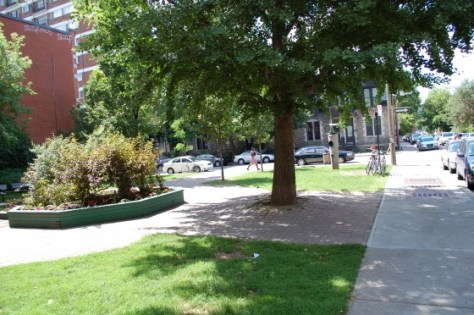
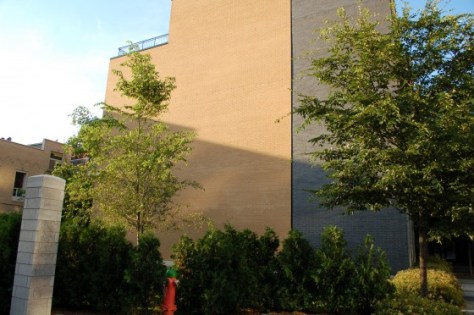
I bring up M. Arcand’s mortality, because I just discovered something called Place Gilles Carle. According to Google, a six minute walk from Parc Claude-Jutra. As you might have suspected M. Carle was also a noted Quebecois cineaste who died at the age of 81. M. Arcand is next in line as amazing, highly respected and extremely influential Quebecois directors. Well anyhows, Place Gilles Carle is a horrible little thing.
All bricks and no movement, nothing green six spindly and scrawny trees that don’t look like they will survive another winter, not a single living soul anywhere, it is obvious that whomever is designing public places to honor recently dead Quebecois filmmakers doesn’t have a clue as to what they are doing. So as a consequence I respectfully ask that M. Arcand stay alive a little bit longer (and so that no one gets the wrong idea, I don’t think he sick or anything, just getting up there in age) in order that someone else can design Square Denys Arcand and not whomever is responsible for the travesty that is Place Gilles Carle.
Place Gilles Carle, at the bottom of Henri Julien just off of Square Saint LouisPlace Gilles Carle, at the bottom of Henri Julien just off of Square Saint LouisPlace Gilles Carle, at the bottom of Henri Julien just off of Square Saint LouisPlace Gilles Carle, at the bottom of Henri Julien just off of Square Saint LouisPlace Gilles Carle, at the bottom of Henri Julien just off of Square Saint LouisPlace Gilles Carle, at the bottom of Henri Julien just off of Square Saint LouisPlace Gilles Carle, at the bottom of Henri Julien just off of Square Saint LouisPlace Gilles Carle, at the bottom of Henri Julien just off of Square Saint LouisPlace Gilles Carle, at the bottom of Henri Julien just off of Square Saint LouisPlace Gilles Carle, at the bottom of Henri Julien just off of Square Saint LouisPlace Gilles Carle, at the bottom of Henri Julien just off of Square Saint Louis