Category Archives: Montréal

The Triennale québécoise 2011 Le travail qui nous attend / The Work Ahead of Us – 1

Howdy!

The Work Ahead of Us, indeed! I’ve heard some people mention that I haven’t been writing too too much about art recently, sorry. And now I’m about to make up for it. Since I have broached the multi-part review, I figure I can do it again, and again, and, well you get the picture. Last week I was able to go see The Québec Triennial 2011 and given that there are something like 50 different artists involved along with a 500 page catalogue, there should be a lot of work involved in reviewing it. If this works out, I figure it’ll take me at least five parts to wrest everything I think about the show out of my system. Apologies in advance if you like things short and sweet.

But since the show itself is a large sprawling show, I figure a large sprawling review is appropriate. I can only hope that my worst paragraphs aren’t as bad as the worst parts of the Triennial, but somehow I have this sinking suspicion that in fact they will be worse. More apologies in advance.

As far as I could tell, there was no real structure to the show. The first piece from it that I saw was Rafael Lozano-Hemmer‘s Architecture relationnelle 18. Intersection articulée.

I had gone to a friend’s house which just so happens to be about a block away from Place des Festivals and while I wasn’t able to make a special trip down there to go see it, once I was there, it seemed pretty darn foolish to ignore it.

So I played with the joysticks for about five minutes, looking up at the giant light sabres in the sky kind of trying to figure out how the whole thing worked. Somewhere I had heard that Mr. Lozano-Hemmer was using the very same spotlights that were used by the US government on the Mexican border, and that there was some kind of political statement being made by virtue of the fact that “the public” could in fact manipulate the search lights, in opposition to how they were normally controlled, which is by U.S. Customs and Border Protection Guards.

I’m not convinced that it works as such. The documentation was kind of sketchy, and having a political piece about the U.S. – Mexican border in downtown Montreal seems a little far-fetched. Almost like being a fan of the Canadiens in Mexico City.

However as a pretty spectacle temporarily juxtaposed against the Place Ville Marie searchlights on the Montreal skyline it worked very well. The chaotic nature of the 18 spotlights, all for the most part aimed vertically, versus the regularity and horizontal nature of the lights on Place Ville Marie make for a very nice couple.

One of the more interesting things about going to see it, was how self-referential it was. When someone would play with the joystick, they were pretty much always looking at the light that they controlled. If you weren’t controlling a joystick you were most likely taking a picture or a video of your friend who was controlling a joystick.

Viewing it from afar, it would crop up in your field of view, and compete for your attention depending on where you were in town, but very rarely would it be able to keep your (read “my”) attention for more than a couple of seconds.

Architecture relationnelle 18. Intersection articulée also works as a proxy for the entire Triennale québécoise 2011 in that it is self-referential, attracts attention briefly and like all the artwork that pops up on Place des Festivals disappears without leaving a trace.

I could also write about how Architecture relationnelle 18. Intersection articulée also was designed for people with short attention spans, wasn’t too too deep and the similarity to those searchlights that are rented by event planners for the opening of a new car dealership or a discotheque in order to attract more attention. But instead of doing that, I’ll leave it up to you to make those connections and any others that you can think of. Otherwise this review could end up as long as the catalogue.

And speaking of length of reviews, I got a stick up my ass about the current state of affairs. This “review” in La Presse is 1,441 words, or about the equivalent of about 29 words for each artist. This “review” in Canadian Art magazine is 2.007 words, or about 40 words per artist. This “review” in Le Devoir is 1,162 words, or about 23 words per artist. This “review” in View on Canadian Art is 1,063 words, or about 21 words per artist. This “review” in The Montreal Gazette is 764 words, or about 15 words per artist. And lastly, this “review” in Voir is 797 words, or about 16 words per artist. (In case you were interested, the press release is 2,125 words long, or the equivalent of about 42½ words per artist, and the list of artists is 111 words long.)

How the heck is anyone going to get any sort of understanding or deeper comprehension on an exhibit that professes to be the definitive statement on art in Quebec in 2011 if the people who are paid to explain it to the general population, don’t even give it more than lip service. And what’s probably even worse is that I imagine the fine folk at the museum who are charged with things like tracking reviews are all quite chuffed about the reviews the show has received.

For the record, this is at 926 words and I’ve only mentioned one piece of art, in passing. In for a penny, in for a pound.

As long as we are on this tangent, I might as well apologize for the lack of pictures and videos, I asked the museum if I could go and take videos and was politely rebuffed, and after the issues the last two times I went to take still pictures, I decided to take my doctor’s advice and keep my blood pressure down, so we’re stuck with whatever I can find on YouTube, Flickr and the lousy reproductions I take myself from the catalogue (cf. paragraph 29 of the Canadian Copyright Act).

So how can I get this review back on track? Well, let’s start with perception, for those of you who have been under a rock for the last little while (and to be honest, I don’t blame you) or those of you from out-of-town and who don’t obsess over the microscopic Quebecois art world happenings, this is the second Triennial (website for the first is here). There is also a Biennial (more properly known here in town as The Biennale) and then just down the river there’s the Manif d’art (aka The Manifestation Internationale D’Art de Quebec). Or in other words there is a large overview of art made in Quebec, funded by the government every year (the Manif and the Biennale alternate years) and sometimes (like this year) there are two.

[As an aside, if you’re interested in hearing and seeing what I thought of this past year’s Biennale watch these.]

Given that any organization that gets money from the government and is successful in bringing in tourists, shouts about it from not only the tallest rooftops, but every darn rooftop in town; one, two, etc) I can only presume that since I haven’t heard about how many tourist dollars these art exhibits are responsible for, that they aren’t responsible for any. Which translates into they are all only playing for the locals. Which when you come to think about it, could be one major reason why art from Quebec isn’t appreciated much beyond the borders.

It’s that “definitive statement on art in Quebec in 2011” that kind of sticks in my craw. Looking back at the press release, they use sentences like “arriving at a comprehensive sense of Québec artistic practice in these early years of the twenty-first century.” and “a reference work on contemporary art in Québec” and while it’s very easy to think that something so large is definitive and comprehensive; from my perspective there are whacks and whacks (or if you prefer scads and scads) of artists who have been left out and ignored.

And that’s one place where I have some difficulties with The Triennale québécoise 2011 Le travail qui nous attend / The Work Ahead of Us. Like Rafael Lozano-Hemmer‘s Architecture relationnelle 18. Intersection articulée which can also be seen as just a bunch of light beams moving spastically across the sky, kind of like an ephemeral game of pick up sticks, there is something to be said about the spaces between the sticks that allow you to pick up the sticks without dislodging the others. The Triennial can also be likened to a random collection of similar objects that need to be organized, but once you recognize that the spaces in between the objects is as important as the objects themselves then it becomes easier to glom on to and get a grip on the show.

Initially, I thought I would reference my notes, the catalogue and what I could find on the internet to write about a paragraph or so on each artist involved in The Triennale québécoise 2011 Le travail qui nous attend / The Work Ahead of Us, but now I’m not so sure. I’m still going to reference my notes, the catalogue and what I can find on the internet to talk about the show, I’m just not so certain that a) It’s going to be a paragraph for each artist, and b) I hope that tomorrow I can discuss more than one work.

La Dame de la Tour by Daniel-Vincent Bernard

Howdy!

Still another kind of obscure piece of public art.

La Dame de la Tour by Daniel-Vincent Bernard

I have no idea when it went up or when it was made, but if you would like more information on Daniel-Vincent Bernard, click here. He is also the artist who created Mañana at the Habitations Jeanne-Mance.

The Fountain at the Holiday Inn Select (B)

Howdy!

Built in 1998.

+This is the 35th in an occasional series of videos on the fountains of Montreal+

The Fountain at the Holiday Inn Select (A)

Howdy!

Built in 1998.

+This is the 34th in an occasional series of videos on the fountains of Montreal+

Outfits from a New Era at the Biosphere (Part Five)

Howdy!

Part One is here, Part Two is here, Part Three is here, and Part Four is here.

Haute couture 2.0 by Mélissa Turgeon

Haute couture 2.0 my eye! A) Who uses a mouse with a wire these days anyhows? Haute couture 1.75. B) PS/2 connectors were beginning to be phased out 2001. Haute couture 1.50. C) Compaq hasn’t existed as a company since 2002. Haute couture 1.25. Web 2.0 was coined as a term in 2004. Haute couture 1.00. And I’m certain if I looked closer I could come up with at least four other mistakes with the name.

So how about we call this something more like Long Stringy Dress Made out of Colorful Wires? Or Non-Grass Grass Skirt for Quebecois Hula Dancing, or something like that? Instead of showing off a blissful ignorance of technology and technological terms.

Now that I’ve got that off my chest, we can take a closer look at the Non-Grass Grass Skirt for Quebecois Hula Dancing.

Detail from Non-Grass Grass Skirt for Quebecois Hula Dancing by Mélissa Turgeon

Overall I gotta give Ms. Turgeon some props. Despite not knowing how to name her dresses, the Non-Grass Grass Skirt for Quebecois Hula Dancing quite possibly best exemplifies the ideas and concepts behind Outfits from a New Era at the Biosphere. In that none of the materials used were new, and that what she uses as textiles truly has been salvaged from the scrap heap.

Personally I would have ditched the actual mice (mouses?) all they’re going to do is bruise someone’s ankles, and the biegeness of them definitely detracts from the extremely colorful nature of the rest of the dress. Maybe, perhaps, possibly they could have been used as ear flaps for the headgear. It wolod have also been nice to see what it looked like if all the wires were grouped together by color.

I’m not certain that it would have been “better.” But I still would like to be able to compare. I have a feeling that the sense of the material (ie making people more aware that it was made out of wires) would have come through slightly stronger. But then again, what do I know about making a Non-Grass Grass Skirt for Quebecois Hula Dancing?

Headgear for Non-Grass Grass Skirt for Quebecois Hula Dancing by Mélissa Turgeon

Sort of flapper inspired (I’m not entirely certain that it would go with the Charlestea dress by By Maude Lapierre) for the next time she makes one, she should try to spell out some messages in the hat.

Caustic Swimsuit By Jennifer Bergeron

Now we’re coming into the homestretch. Caustic Swimsuit and a dress called Hit Parade. The Caustic Swimsuit is particularly intriguing, in that I am not entirely certain that there is anyone who could swim while wearing a 240 lb. swimsuit. Heck, even lying around the pool would be a chore! OK, maybe Iris Kyle could wear it without collapsing. But nonetheless, there’s something kinda cool in a bling-bling way about 1,200 batteries glued together.

But who has the sort of twisted mind to make a swimsuit that would drown you if you wore it into the water? Although perhaps Jennifer Bergeron was also trying to make some sort of statement on the state of the water in and around Montreal? You know, in a roundabout sort of way kind of tell you that the water is polluted.

Detail from Caustic Swimsuit By Jennifer Bergeron

And while you’re not going to get electrocuted from wearing a swimsuit made out of dead 1.5 volt batteries, putting them in water probably will make them corrode quicker and end up releasing some rather unsavory chemicals (although it should be noted it depends entirely on the type of battery. Alkaline batteries leak potassium hydroxide, while zinc–carbon batteries leak zinc oxide) it also should be noted that while potassium hydroxide is caustic, zinc oxide is not (or at least that’s what I think).

Like the Non-Grass Grass Skirt for Quebecois Hula Dancing, the Caustic Swimsuit is truly made out of post-consumer waste and lives up to the ideals and concepts of Outfits from a New Era. Which is all very nice, but it still is 240 lbs.!

Detail from Caustic Swimsuit By Jennifer Bergeron
Hit Parade By Valérie Bédard

The last of the 16 dresses is Hit Parade By Valérie Bédard. Made from video tape, audio tape, slides and 35 mm film it is another pretty good example of post consumer waste being put to better use than landfill.

Detail of Hit Parade By Valérie Bédard

Initially, because I wasn’t looking too closely, when I read that it was called Hit Parade i mistakenly thought that it had been made from LPs that had been melted down. But no siree bob! I was thoroughly and completely wrong. Made me realize that I needed to pay closer attention at all times.

This dress not only works as an effective example of what Outfits from a New Era is trying to prove, but also looks like it would actually work as something that could be worn, and worn comfortably, to the discotheque. Which is probably why Ms. Bédard started up Audiofil, a company to make things using old cassette tapes as the thread for the fabric. If she ever gets to the point where she makes another one, I would strongly suggest copping some pattern from the 1980s, as that was the height of cassette culture, and social self-reference would just make everybody’s head spin. In a good way.

Detail from Hit Parade By Valérie Bédard

As you might have expected after reading all five posts, I was quite charmed by Outfits from a New Era. It seemed that this past summer was a summer of fashion. Beyond the Jean-Paul Gautier exhibit, which I very deliberately did not write about, there was the Arlette Vermeiren Zucoli exhibit and the Les Ballets Russes de Diaghilev exhibit all of which added up to more costumes, fashion and fabric than I had seen in a very long time.

I’m going to have to start studying things much closer, because I’m going to be covering (if that is the appropriate verb) a Lundstrom Fashion show which is happening to benefit the Colorectal Cancer Association of Canada on November 15, 2011.

But not only did I like most of the dresses in Outfits from a New Era but the rationale for making them was also nice, and then the thing that really made my heart go “pitter patter” over the show was since it was at the Biosphere there was hardly anyone there, which while not that great for the Biosphere was great for me, as I can’t stand crowded exhibits where you have to crane your neck to see things or wait patently in line while everyone else ahead of you takes a gander. Although they could have easily saved some cash by ditching the whole vedette thing. I don’t think getting autographed ephemera aids in any way the pedagogic nature of the show, although if I can remind you, I have been wrong before, and I will be wrong again.

I would suggest heading over during the upcoming holidays, as it will guarantee that you don’t run into any school trips. The exhibit itself is on display until December 2012, so if you miss the Christmas season, there’s spring break, Easter, and next summer, ie plenty of time to catch it. And then I seem to remember someone telling me that it was going to tour the country.

For Tags: Names of all the designers, names of all the dresses, Biosphere, Outfits from a New Era, Objets Non Enfouis all the French translation

The Fountains at the Centre de commerce mondial de Montréal (2)

Howdy!

Built in 1991 by Arcop and Provencher Roy et Associés.

+This is the 33rd in an occasional series of videos on the fountains of Montreal+

Outfits from a New Era at the Biosphere (Part Four)

Howdy!

Part One is here, Part Two is here. Part Three is here.

Plush Empress By Majorie Labrèque-Lepage

Plush Empress By Majorie Labrèque-Lepage

What would you expect from someone who makes stuffed toys for a living? Cute and lighthearted, I’d really like to kn ow what was used to make the skirt hold its shape. A Hoop skirt? Petticoats? Crinoline? Or something else. The tag says that only 4 sweaters, 7 pairs of jeans and 100 buttons were used to make this dress. But I suspect that there were some other things involved as well.

It actually looks like it could be worn, but I’m not 100% convinced I would be able to survive the constant barrage of cuteness. Maybe if I was partial to dressing up for Halloween, I’d be more open to a dress that had a hood with ears and some sort of bear-like soccer ball protruding from the crotch.

Detail of Plush Empress By Majorie Labrèque-Lepage

The Outfits from a New Era exhibition were designed to highlight “cast-offs from our society in a whole new light” and while the vast majority of them were made from waste products, four appeared to be made from new material. Of the four, the two following were notable examples.

WFA - With Fixed Address By Stéphanie Lévesque

Another fantasy dress, another material list that isn’t quite complete. That bodice is not made of plywood (unless that’s the thinnest plywood ever – or perhaps it should be the veneer used to make plywood). Although I kind of like the concept of living in your dress. Once you glom onto the idea behind this dress there isn’t an awful lot of depth to it. But I bet you that it is well insulated (yuck, yuck, yuck!)

Of all the dresses in the exhibit, I would guess that this one is the most structurally sound. But probably the most difficult to modify if you gained a couple of pounds. Although I think Stéphanie Lévesque should try to get someone from Mon Plan Rona to wear it as a publicity stunt.

Grand Design By Isabel Vinuela

This, I think is the weakest of all 16 dresses. Made out of canvas its “twist” is that the drawing and the stickers are supposed to be part of it as well. More of a coat than a dress, it’s kind of difficult to pick out from the drawing, which while obviously the intention, doesn’t make it any better in my eyes. It’s not like I’m going to be walking around wearing the drawing when I put on the dress (or coat).

Wall tag explaining how to interact with Grand Design By Isabel Vinuela

Sorry that my picture is so blurry.

I can’t quite accept that the backdrop for a dress is as important (or even more so) than the actual dress.

Grand Design By Isabel Vinuela

Still more tomorrow.

The Fountains at the Centre de commerce mondial de Montréal (1)

Howdy!

Made by Dieudonné-Barthélemy Guibal and installed in Montreal 1991.

+This is the 32nd in an occasional series of videos on the fountains of Montreal+

Outfits from a New Era at the Biosphere (Part Three)

Howdy!

Part One is here, Part Two is here.

Dress the Part by Isabelle Bérubé

Detail from Dress the Part by Isabelle Bérubé

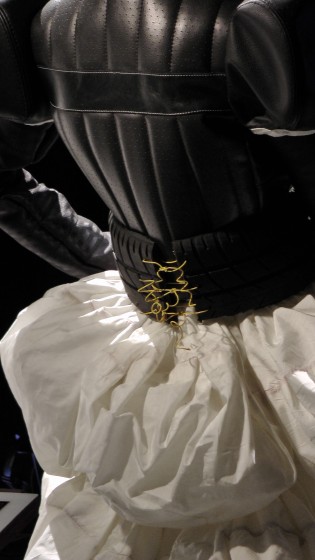
Now those are some shoulder pads I can really get into… Or if you would prefer less colloquial phrasing, I get a big kick out of this dress as well. Although I’m not certain I would ever be invited someplace where it would be formal enough to wear. And while I would venture a guess that most of the pieces that were used to make it came from sports cars, it is not a “sporty” outfit in the least.

Dress the Part by Isabelle Bérubé

Ms. Bérubé appears to have turned this concept of transforming old car parts (or more precisely old car seats) into fashion accessories fulltime. Although I think she should exhibit her work at the auto show.

Detail from Dress the Part by Isabelle Bérubé

I can’t imagine that a car tire as a corset or belt would be all that comfortable, however choosing it was an inspired choice. Clearly marking the difference between bottom and top, while at the same time hitting you upside the face with where the materials used to make the dress came from. Without the tire, it would be like some sort of overwrought futuristic ball gown suitable for the cover of a Harlequin Romance about a 22nd century debutante.

Although now that I have gone to the Harlequin Romance website, I have discovered that in fact they do not publish any science fiction, but that they do have a series called Harlequin NASCAR (The rush of the race car circuit; the thrill of falling in love®.) So maybe I should change the lines above to read something like “with the tire it is perfect as the ballgown of Dr. Nicole Foster, the heroine of Running Wide Open.

Naw, not even close.

Detail from Dress the Part by Isabelle Bérubé

And I’m also not certain what to make of the wires…

Pillbox Dress By Marie Line

Surprisingly, this dress is badly translated. In French it is called “Ordonnance Royale” a pun on the multiple definitions of the word ordonnance. A) a prescription and B) a law. Since it is made up of melted down plastic pill containers and made to look like a ballgown. I think I would have called it something like Royal Script, playing off the multiple definitions of the word script, ne of which is “prescription.” But nobody asked me.

And while it does look like it would be suitable for a princess, I would hate to ask Kate Middleton to have to wear it. As I don’t think melted plastic is the most malleable of materials and according to the tag beside the dress, it weighs in at a little more than 200 pounds.

Detail from Pillbox Dress By Marie Line
Scanty Attire By Jeanne Cirume

I’m not sure what to make of this one. Despite using Styrofoam from packaging for the socks and the collar it is mainly made out of what they call a “vacuum bag” but is actually a Madvac Collector Bag. You know one of those little four wheeled buggies with a vacuum tube that looks like an elephant’s trunk that sucks up the garbage from the sidewalk? Well, the bag that is used to collect the trash was used to make this dress.

Bird's Nest made from Margie Gillis' hair from 1984

As I’ve mentioned before, there are signed objects from Quebecois vedettes displayed alongside the dresses. Some have obvious connections, some less so. This is one of the more obvious connections. While Margie Gillis has cut her hair (for a very long time she didn’t) this bird’s next comes from the period when she wasn’t cutting it. At the Biosphere they have a very nice story explaining how it came to be.

The reason it is an obvious connection is that the nest is displayed next to this dress.

Hairdress By Roxane Cheibes and Amélie Bruneau Longpré

It can’t be that comfortable to wear even if they attached the hair to a nylon hairstyling cape, I also would love to know how the hair was attached, colored and how much hairspray was used to keep the hair in place. And while it looks really cool, I’m not entirely convinced that hair counts ass garbage.

It also can serve as an example of how unreligious Quebecois culture has become. As recently as fifty years ago, a hairdress would have been worn by someone feeling particularly guilty about some thing (or things). But this exhibit makes no mention or reference in any way shape or form to the religious nature of wearing hair. Which is apparently still done by Carmelites.

Rear view of Hairdress By Roxane Cheibes and Amélie Bruneau Longpré
Details of Chapter Ten: Words & Wonder By Geneviève Oligny

Another impractical dress, especially since it is lit from within. You can see it in full here. I do not know, but I would imagine that this dress was possibly responsible for the Dramatic Lighting! (with the capital “D,” capital “L” and an exclamation mark) and as with the hairdress, I’m not convinced that books qualify as garbage material.

That all being said, an upskirt shot of Chapter Ten is a very abstract thing.

Details of Chapter Ten: Words & Wonder By Geneviève Oligny

Still more tomorrow.

Gratte-ciel, cascades d’eau, rues, ruisseaux… by Melvin Charney at Place Émilie Gamelin 5/5

Howdy!

+This is the 31st in an occasional series of videos on the fountains of Montreal+